Work with us
Become a partner trainer
Teach two-day hands-on epoxy classes in your state, to students who have already learned the business side online. The school handles enrollment, the curriculum standard and the marketing. You bring the slab, the experience and the two days.
At a glance
- Who
- Working installers, supplier stores and training schools
- You teach
- The two-day class, to the school’s curriculum standard
- We bring
- Enrolled students, the online prerequisite, marketing and the certificate
- Pay
- Owner: how partners are paid
Who we're looking for
People who already put down floors, or already teach
Hands-on classes at Epoxy Business School are taught by partners, not by school staff, state by state, where students are asking for them.
Supplier stores
Stores that already host classes have the space, the slabs and the routine. They're the first partners we talk to in a state.
Training schools
Independent schools that run hands-on epoxy classes today, and want students who arrive knowing the business side.
Working installers
Coating contractors who install floors for a living, can host a class on real concrete, and like teaching what they do.
What partners get
- Enrolled students. The school finds and enrolls them through its site, its state pages and its class waitlist.
- Prepared students. Every student completes the installation recordings in The Epoxy Playbook before class. They've watched every step, start to finish, so you spend the two days correcting technique instead of explaining the basics.
- A clear curriculum. The two-day standard below says what the class covers, so you can plan the days and the materials.
- Marketing. Your class is listed on the school's state page and texted to the waitlist in your state.
- How partners are paid. Owner: partner pay terms, what they cover (materials, venue) and when partners are paid
What the school provides, and keeps
- The curriculum, including the two-day class standard.
- Enrollment and student support, before and after class.
- The Epoxy Playbook: full installations recorded start to finish, which every student watches before class.
- The certificate of completion, issued under the Epoxy Business School name.
- Students enroll through the school.
The class standard
What a partner class covers
Two days on real concrete. This is the curriculum standard every partner class follows; it isn't a scheduled class.
Day 1
The slab
- Reading the slab. Moisture testing (calcium chloride and in-slab relative humidity), checking for old coatings, sealers and oil, and mapping cracks, spalls and joints.
- Grinding. Setting up the grinder and the HEPA dust extractor, grinding to the profile the data sheet calls for, then edges and corners.
- Repairs. Filling cracks and joints, repairing spalls, and knowing when a repair has to cure before the coating goes down.
- Prep check. Inspecting the floor against the job-day checklist before any coating is mixed.
Day 2
The coating and the business
- Base coats. Mix ratios, pot life and spreading at the rate on the data sheet.
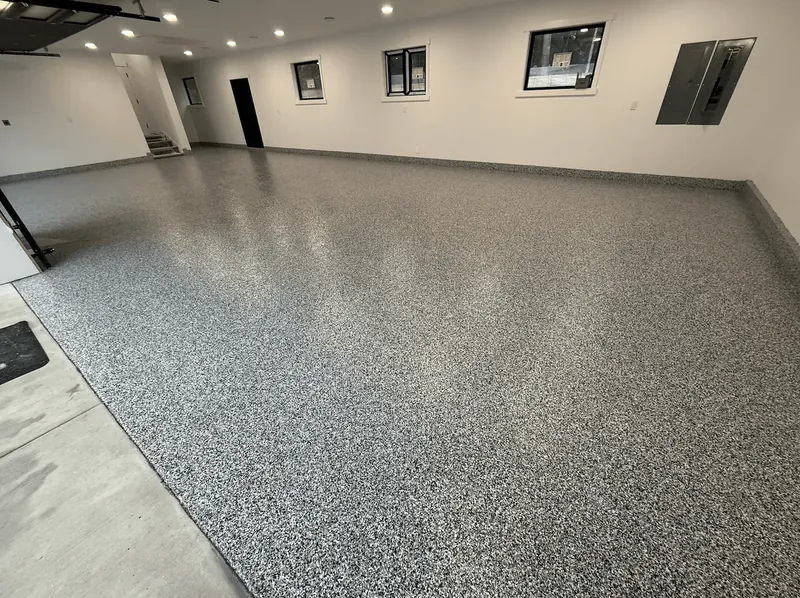
- Full-broadcast flake. Broadcasting flake to refusal, then scraping and vacuuming before the top coat.
- Metallic demonstration. How a metallic floor is poured and worked, shown by the trainer.
- Top coats. Polyaspartic or polyurethane top coats, recoat windows and slip resistance.
- Business wrap-up. Pricing and quoting the floor you just installed, the warranty terms you would put on it, and your next steps.
Requirements
What you'll need
- Insurance. General liability that covers teaching on your premises or venue. Owner: minimum limits, and whether the school must be named as additional insured For reference, general liability for a flooring installer typically runs $77 a month ($919 a year) for a $1 million / $2 million policy.
- A place to teach on real concrete. Slabs students can grind and coat, with power for the grinders and room for a class. Owner: minimum slab area per student, indoor or covered, power (230-volt) and parking
- Experience. You install the systems you'll teach, for paying customers. Owner: minimum years installing, and any references or sample work you'll ask for
- Equipment and safety. A grinder with a HEPA dust extractor and the dust controls OSHA's construction silica standard (29 CFR 1926.1153) sets for walk-behind floor grinders, and protective equipment in use for everyone on the slab. Owner: who supplies materials and protective equipment
- The two-day standard, taught in full.
The process
From application to first class
Apply
Tell us about your company, where you work, what you install and whether you have a venue.
Intro call
We talk through your experience, your venue and how classes work.
Review
Insurance, venue and experience checked against the requirements.
Agreement
Pay, materials, dates and responsibilities in writing. Owner: agreement terms
First class
Scheduled once enough students in your area are ready to enroll.
Where we're recruiting
States where students are asking
Classes open where students are asking for them, and we talk to partners in those states first. You can apply from any state; if yours isn't busy yet, we'll keep your application and come back when it is.
Already listed on our class comparison? Those listings are there so students can compare, and being listed doesn't make you a partner. Once partner classes exist, they're marked as Epoxy Business School classes on the state pages.
What the school won't ask of you
- To sell students a product line. The school doesn't sell coatings or equipment.
- To promise students an income.
Owner: say whether there is any fee to apply or to partner
Application
Apply to teach
A few questions about your company and your venue. We'll text you to set up a call.
Prefer to talk first? Use the contact page and choose “Partner trainers”.
Applying doesn't commit you to anything, and it doesn't guarantee a class in your state.
Who can become a partner trainer?
Working installers who run coating jobs for a living, supplier stores that host classes, and training schools that already run hands-on classes. You need insurance, a place to teach on real concrete and the experience to teach the two-day curriculum standard.
Can a supplier store or an existing school be a partner?
Yes. Supplier stores and schools that already run hands-on classes are the first partners we talk to in a state, because they have the venue and the routine. Working installers who can host a class come next.
Where are you looking for partner trainers?
In the states where students are asking for classes. You can apply from any state; if yours isn’t busy yet, we keep your application for when it is.
Who enrolls the students in a partner class?
The school. Students enroll through Epoxy Business School, complete the installation recordings in The Epoxy Playbook before class, and receive the school’s certificate of completion. The partner teaches the two days.
Do you sell coatings or equipment?
No. Epoxy Business School doesn’t sell coatings, equipment or territories, and there are no paid placements or affiliate links on this site. Classes and suppliers we mention are there to help you compare, not because they pay us. How we stay independent.
Partner trainers
Questions before you apply?
Ask us about partnering, the class standard or your state. We'll answer by text or email.