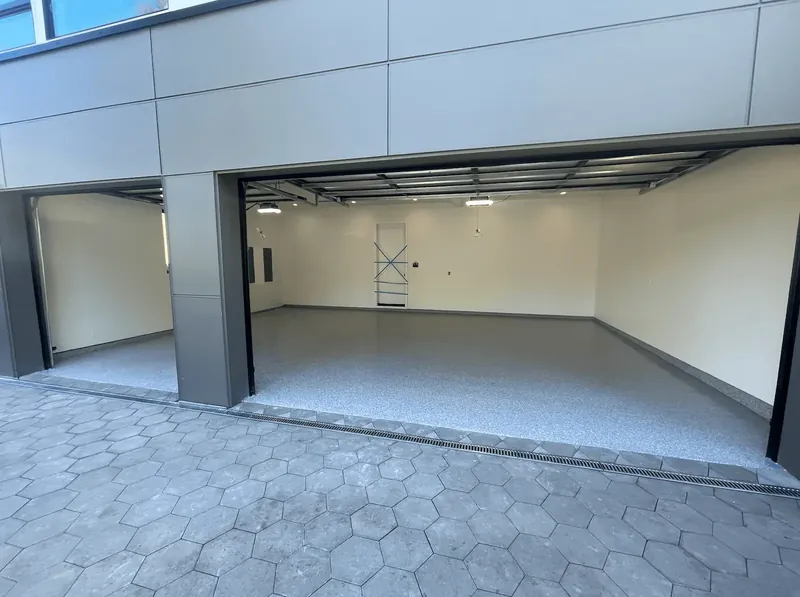
Key takeaways
- There are two formats: a traditional plan with nine sections, which lenders expect, and a lean one-page plan, which is enough if you're self-funding.
- An epoxy plan needs a few sections generic templates skip: the systems you'll install, the slab conditions you'll turn down, an equipment plan (rent first, buy later) and a weather-aware schedule.
- Use real demand data in the market section: 'epoxy flooring companies near me' draws 10K–100K searches a month in the US and 'garage floor coating companies near me' 1K–10K.
- In our worked example, a renting startup with $18,004 of yearly overhead needs about 21 jobs a year to break even; 36 jobs would leave $13,664 before tax. That's an illustration from stated assumptions, not a forecast.
- Build the numbers from your own costs: price per job, direct cost per job, overhead, and the number of jobs you can realistically win.
An epoxy flooring business plan follows the same structure as any small-business plan, nine standard sections, plus a few things specific to coatings: the systems you’ll install, the slabs you’ll turn down, your equipment plan, and a schedule that works around the weather. The part that matters most is the numbers: price per job, cost per job, overhead and the jobs you need to break even.
Below: the format to choose, each section with an epoxy example, a year-one projection built from stated assumptions, and an outline you can copy at the end.
Traditional or lean: which format?
- Traditional plan: a standard structure with detail in every section, often dozens of pages. This is what lenders and investors expect.
- Lean plan: a one-page summary of the key points that you can write in an hour or two.
If you’re applying for a loan, write the traditional plan. If you’re funding the start yourself, a lean plan plus the startup budget and break-even math below is enough to start, and you can expand it later. The U.S. Small Business Administration’s free business plan guide walks through both formats; the rest of this guide follows the traditional sections.
1. Executive summary
Write it last, in half a page: what you’ll install, for whom, where, how you’ll get customers, what you need to start, and when you expect to break even. Example structure:
[Your company] installs full-broadcast flake and metallic floor coatings for homeowners in [county or metro], starting with garages and basements. We’ll win jobs through our Google Business Profile, reviews and Local Services Ads, price every job from our own costs, and rent our grinder until we’re grinding most weeks. Startup costs are about $[X]; at our planned prices we break even at about [N] jobs a year.
2. Company description
- What you install. Name the systems: for example, full-broadcast flake with a polyaspartic topcoat for garages, metallic epoxy for basements and showrooms. Say what you won’t do yet (commercial urethane cement, exterior pool decks) until you’re trained and equipped for it.
- Name. Your legal and trading name, checked for availability (see epoxy flooring business names).
- Service area. Name the towns and how far you’ll drive.
- Legal setup. Your entity (LLC filing fees run $35 in Montana to $500 in Massachusetts, most $50–200), your EIN, business bank account, and any contractor license your state requires (see epoxy flooring license requirements).
- Insurance. General liability at minimum before the first job; see epoxy flooring business insurance.
3. Market analysis
Combine national context with a close look at your own area.
National demand. In the US, “epoxy flooring companies near me” draws 10K–100K searches a month and “garage floor coating companies near me” 1K–10K, up 900% year over year (September 2025 to August 2026). The US floor coatings market was about $1.91 billion in 2025, growing about 4% a year. More context is in epoxy flooring industry statistics.
Your area. This is the part that matters:
- Search “epoxy flooring near me” and “garage floor coating” from your service area and list every company in the map results, with their review counts and the systems they advertise.
- Note local prices. Nationally, installed epoxy typically runs $4–10 per sq ft, or $1,600–5,800 for a two-car garage; ask suppliers and other contractors what your area pays.
- Describe your customers: homeowners with attached garages, newer subdivisions, older homes with basements, and the businesses (auto shops, gyms, warehouses) you’ll target later.
- Note the season: epoxy should go down between 60°F and 85°F at under 85% humidity, so say how many months you can realistically install and what you’ll sell in the rest (see the epoxy flooring slow season).
4. Competition
List who you’re up against and how you’ll be different:
| Competitor type | What they sell on | How you compete |
|---|---|---|
| Established local coating companies | Reviews, photos, warranties | Faster response, clear written scope, fair minimum job |
| Franchise and dealer brands | Brand, product warranty, marketing budget | Local ownership, flexibility on systems and scheduling |
| Painters and handymen offering “epoxy” | Low price | Grinding, moisture testing, thicker systems, a real warranty |
| DIY kits ($200–700) | Price | Explain prep, thickness and durability honestly |
The trade is fragmented: about 104,000 flooring installation businesses operate in the US, and no company holds more than 5% of the market. Competition is local.
5. Organization and management
Say who does what. In year one that’s usually you: estimates, sales, installs, ordering, bookkeeping. Name your advisors (accountant, insurance agent, attorney for contracts) and your supplier. Say when you’ll hire and for what role, usually a helper first (see hiring epoxy floor installers).
6. Services and pricing
List each system with its build (coats, products, thickness), your price per square foot or per job, and your minimum job price. Show how you got the price: materials from spread rates, labor at a loaded hourly cost, a share of overhead, and your margin. How to price epoxy flooring walks through that model; in its worked example a 484 sq ft flake garage sells for $3,075 ($6.35 per sq ft).
7. Marketing and sales plan
Name your channels, the budget for each, and how you’ll measure them. A realistic first-year mix: a verified Google Business Profile, a basic website with your own job photos, reviews from every job, yard signs and neighbor letters, then one paid channel. Flooring leads typically cost $45–62 each from Local Services Ads and $48–122 from Google search ads. Write down your expected close rate and the cost per booked job (cost per lead ÷ close rate). The full playbook is in epoxy flooring marketing; the sales call is in the epoxy flooring sales process.
8. Operations
Describe how a job moves through your business:
- Lead logged with its source.
- Phone pre-qualification and an estimate visit with a moisture test.
- Written estimate and contract with scope of work and deposit.
- Materials ordered; job scheduled around weather and cure times.
- Install day with a checklist (see the job-day checklist).
- Final walkthrough, care instructions, photos, review request.
- Warranty records filed; follow-up call later.
Also say what you’ll refuse: slabs that fail moisture tests without a vapor barrier, floors with active cracks you can’t repair, jobs below your minimum price.
9. Equipment plan: rent first, buy later
Most new coating businesses rent the grinder until the jobs are steady. Write down the switch point:
| Item | Rent | Buy new |
|---|---|---|
| 22” dual-disc grinder | About $90–142 a day | $8,488 (EDCO 2EC-NG, 230V) |
| HEPA dust extractor | About $225 a week | About $3,400–3,900 for a mid-size unit (about 240 cfm), enough for a 7-inch edge grinder |
At $142 a day, buying the $8,488 grinder pays for itself after about 60 rental days ($8,488 ÷ $142 = 59.8); at $90 a day, after about 94. That ignores tooling, repairs and resale value, which the grinder rent-vs-buy calculator includes. The trade-offs are in rent vs buy a floor grinder.
10. Startup costs
List what you’ll spend before the first paid job. Typical 2026 prices for a renting startup:
| Item | Low | High |
|---|---|---|
| HEPA dust extractor, mid-size (enough for a 7-inch edge grinder) | $3,400 | $3,900 |
| Edge grinder kit | $640 | $716 |
| Application tool kit | $150 | $320 |
| Moisture meter | $25 | $760 |
| Two respirators ($23–52 each) | $46 | $104 |
| LLC filing | $35 | $500 |
| Hands-on class (1 to 5 days) | $99 | $1,899 |
| Subtotal | $4,446 | $8,050 |
| Enclosed 6×12 trailer (optional) | $3,450 | $5,000 |
| With trailer | $7,896 | $13,050 |
Add working cash for your first insurance premiums, first marketing month and materials for practice floors. Build your own version in the startup cost calculator.
11. Funding request
If you’re borrowing, say how much, what for, and over what period. SBA-backed 7(a) loans go up to $5 million and can fund equipment, working capital and buying an existing business; you apply through a lender. If you’re funding the start yourself, renting the grinder first keeps the cash you need down.
12. Financial projections and break-even
A lender-ready plan shows a five-year outlook and, for the first year, quarterly or even monthly projections. Here is a year-one example. It is an illustration built from the assumptions below, not a forecast or a promise of income; your results depend on your market, prices, costs and the work you put in (see our earnings disclaimer).
Assumptions:
- Average job: the 484 sq ft flake garage from how to price epoxy flooring, priced at $3,075.
- Direct cost per job: $1,412.43 materials + $640.89 labor (an installer and a helper at May 2025 median wages plus a 25% burden; if you’re the installer, that wage is your pay) + $142 grinder rental for the day = $2,195.32.
- Each job therefore leaves $3,075 − $2,195.32 = $879.68 toward overhead and profit.
- Yearly overhead for a renting, one-truck startup: typical median premiums for general liability ($919), commercial auto ($2,490) and tools and equipment coverage ($495), plus assumed marketing $6,000, phone, software and website $1,800, accounting, licenses and fees $1,500, and fuel and maintenance $4,800: $18,004, or $4,501 a quarter.
- Jobs: 4 in the first quarter while you build reviews, then 10, 12 and 10: 36 for the year.
| Quarter | Jobs | Revenue | Direct costs | Gross profit | Overhead | Net before tax |
|---|---|---|---|---|---|---|
| Q1 | 4 | $12,300.00 | $8,781.28 | $3,518.72 | $4,501.00 | −$982.28 |
| Q2 | 10 | $30,750.00 | $21,953.20 | $8,796.80 | $4,501.00 | $4,295.80 |
| Q3 | 12 | $36,900.00 | $26,343.84 | $10,556.16 | $4,501.00 | $6,055.16 |
| Q4 | 10 | $30,750.00 | $21,953.20 | $8,796.80 | $4,501.00 | $4,295.80 |
| Year | 36 | $110,700.00 | $79,031.52 | $31,668.48 | $18,004.00 | $13,664.48 |
Read it carefully. Revenue of $110,700 leaves $13,664.48 before tax, a 12.3% net margin. If you install the floors yourself, you also earn the installer wages inside “direct costs” (36 jobs × $373.31 = $13,439.16, including burden), so the plan should show both lines. Revenue is not profit, and profit is not take-home pay.
Break-even: yearly overhead ÷ contribution per job = $18,004 ÷ $879.68 = 20.5, so about 21 jobs a year, or 1.7 a month. Below that, the business loses money even though each job “made” $879.68. Change any input, such as a lower price, a slower crew or more marketing, and the break-even moves; that sensitivity is what lenders and you should look at.
For years two to five, show what changes: buying the grinder, adding a helper, more jobs from referrals, higher prices as reviews build. Keep every change tied to an assumption you can defend.
13. Appendix
Attach what backs up the plan: license and insurance certificates, supplier quotes, product data sheets for your systems, your estimate and contract templates, photos of your practice floors, and résumés or class certificates.
Copy this outline
EPOXY FLOORING BUSINESS PLAN – [Company name] – [Date]

1. Executive summary (write last; half a page)
2. Company description
   - Systems we install / won't install yet
   - Service area
   - Legal entity, EIN, license status, insurance
3. Market analysis
   - National context (search demand, market size)
   - Local competitors: names, review counts, systems, prices
   - Target customers and housing in our area
   - Installing season and weather limits
4. Competition and how we're different
5. Organization and management (roles, advisors, hiring plan)
6. Services and pricing
   - System builds (coats, products, thickness)
   - Price per sq ft / per job, minimum job, adders
   - How the price is calculated (materials, labor, overhead, margin)
7. Marketing and sales plan
   - Channels, monthly budget, expected cost per lead and close rate
   - Sales process from first call to signed contract
8. Operations (job flow, checklist, slabs we refuse, suppliers)
9. Equipment plan (rent vs buy, switch point)
10. Startup costs (table with dates)
11. Funding request (if any)
12. Financial projections
   - Year one by quarter or month; years two to five
   - Assumptions listed
   - Break-even: overhead ÷ (price − direct cost per job)
13. Appendix (licenses, insurance, quotes, data sheets, templates, photos)
A one-page lean version
If you only write one page, cover: what you’ll install and for whom; your service area; your top three competitors; your price for a typical job and your minimum; your direct cost per job and yearly overhead; the break-even number of jobs; your first three marketing channels; and what you need to buy or rent to start.
Want to learn the trade and the numbers together? The Epoxy Playbook pairs recorded installation training, full jobs you can replay, with the pricing, quoting and first-year systems behind this plan, and it’s the required first step before a hands-on class. To talk your plan through with a working coating-company owner, book a consultation. Related reading: how much epoxy flooring business owners make, starting as a side business and buying an existing epoxy business.
Questions
Do I need a business plan to start an epoxy flooring business?
Not legally, but you need the numbers in one. If you plan to borrow, lenders expect a traditional plan with financial projections. If you're self-funding, a one-page lean plan plus a startup budget and a break-even calculation covers most of the value.
How much does it cost to start an epoxy flooring business?
If you rent the grinder, the basic gear (a mid-size HEPA dust extractor, an edge grinder kit, application tools, a moisture meter, respirators), an LLC filing and a class typically add up to $4,400–8,100, or about $7,900–13,100 with an enclosed trailer. Buying a new dual-disc grinder adds about $8,500. Run your own list in the startup cost calculator.
How many jobs do I need to break even?
Divide your yearly overhead by the profit each job leaves after its direct costs (materials, labor and any rental). In our example, $18,004 of overhead ÷ $879.68 per job = about 21 jobs a year. Your number depends on your prices, costs and overhead.
What should the market analysis in an epoxy business plan include?
Local demand and competition: how many coating companies show up in map results in your area, their review counts and the systems they sell, typical prices for your area, and the type of housing and businesses you'll serve. National numbers, such as search demand and market size, add context but don't replace a look at your own service area.
Keep reading
How to start an epoxy flooring business
Start an epoxy flooring business step by step: training, LLC, insurance, equipment to rent or buy, pricing and first jobs, with published prices.
Startup cost calculator
How to price epoxy flooring so every job pays
Build an epoxy floor price from materials, labor, overhead and profit, with a worked two-car garage example, margin vs markup, a minimum job price and adders.
Epoxy flooring marketing: where coating jobs come from, and what each channel costs
Where epoxy flooring leads come from, from Google Business Profile and reviews to Local Services Ads, Meta and Angi, with lead costs and a 90-day plan.