Key takeaways
- Every home improvement contractor business in New Jersey registers with the Division of Consumer Affairs: $110, $500,000 of liability insurance, workers' comp and a $10,000–50,000 compliance bond.
- Home improvement contracts over $500 must be in writing, and the customer can cancel until midnight of the third business day.
- Floor coatings made on or after August 18, 2026 are capped at 100 grams of VOC per liter in New Jersey, down from 250.
- An LLC costs $100 to form since July 1, 2026, plus a $75 annual report.
- XPS New York City runs a three-day class every month in Garfield; normal highs stay below 50°F from December through February.
New Jersey regulates home improvement contractors at the state level, and the requirements grew in 2025: every contractor business that works on homes now needs workers’ comp and a compliance bond on top of its registration and $500,000 of liability insurance. Floor coatings made since August 18, 2026 are capped at 100 grams of VOC per liter. One provider runs a hands-on epoxy class in the state every month, in Garfield, and the winter that stops unheated garage work is a short one, December through February.
Do you need a license for epoxy floors in New Jersey?
For residential work, you need a registration. The Contractors’ Registration Act requires every home improvement contractor business to register with the Division of Consumer Affairs and display its registration number, the NJHIC#. Home improvement covers remodeling, repairing or improving residential or non-commercial property, so coating a garage, basement or patio at a home counts; commercial jobs have no state registration.
To register or renew, you need:
- the $110 fee and an ownership disclosure statement;
- commercial general liability insurance of at least $500,000 per occurrence;
- workers’ comp, unless you’re exempt;
- a compliance bond, bank letter of credit or other security, sized to your contracts.
| Your contracts | Security required |
|---|---|
| Under $10,000 each, or under $150,000 in the last 12 months | $10,000 |
| $10,000–120,000 each, or $150,000–750,000 in the last 12 months | $25,000 |
| Over $120,000 each, or $750,000 or more in the last 12 months | $50,000 |
The same law, signed in January 2024, created a State Board of Home Improvement and Home Elevation Contractors that will license individual contractors once its rules take effect; watch the Division’s notices for the start date. Apply and renew through the Division of Consumer Affairs.
Contracts. Any home improvement contract over $500, and every change to it, must be in writing and signed. It has to show your legal name, business address and registration number, include a copy of your liability insurance certificate with the insurer’s phone number, and state the total price and the start and completion dates. The customer can cancel for any reason until midnight of the third business day after receiving a copy, and you refund within 30 days. More in epoxy flooring contracts.
Towns. Many New Jersey municipalities also require a mercantile license, so ask the municipal clerk before you start working in a new town.
VOC limits: New Jersey’s new rule
New Jersey lowered the VOC limit for floor coatings from 250 to 100 grams per liter for products made on or after August 18, 2026, in line with the Ozone Transport Commission’s 2011 model rule. The national limit is 400 g/L. The rule’s definition of a floor coating names garage floors, and it covers the people who apply coatings, not only manufacturers and stores.
- Check the VOC figure on the data sheet and the label before you stock a system; a product sold legally under a 250 or 400 g/L limit elsewhere can be over New Jersey’s.
- Older stock made under the previous limit can still be sold and applied, so read the date code on anything that has sat on a shelf.
Setting up the business: LLC, workers’ comp and safety
Forming an LLC costs $100 with the Division of Revenue and Enterprise Services since July 1, 2026, down from $125, and the annual report costs $75. A sole proprietor or partnership trading under a business name registers that name with the county clerk in each county where it works; an LLC registers an alternate name with the state.
Workers’ compensation must cover every employee. Corporate officers who work in the business must be covered too; LLC members don’t have to be. Workers’ comp is now also a condition of your home improvement registration.
Safety rules are federal for private employers. New Jersey’s state OSHA plan covers only public workers, so federal OSHA enforces the silica standard that applies when you grind concrete.
Where to take an epoxy class in New Jersey
| Class | Where | Length | Price | Price per day |
|---|---|---|---|---|
| XPS New York City | Garfield | 3 days, monthly | $1,500 | $500 ($1,500 ÷ 3) |
| Epoxy Depot Intro to Epoxy (nearby) | Lebanon, PA | 3 days | Ask the store | — |
| MOY FloorFX (nearby) | York, PA | 1 day | $275 | $275 |
| Epoxy Classes NY (nearby) | Johnstown, NY | 3 days (Friday to Sunday) | $1,400 | about $467 ($1,400 ÷ 3) |
XPS New York City’s training center at 259 Passaic Street in Garfield runs a three-day class every month, Tuesday through Thursday: moisture testing, prep, epoxy and polyaspartic, flake and metallic, plus bidding and lead generation. From South Jersey and the Delaware Valley, Epoxy Depot’s three-day intro at its academy in Lebanon, Pennsylvania, and MOY FloorFX’s one-day class in York are the other options, and Johnstown, New York, runs a three-day weekend class.
Humid shore mornings and a short winter: installing in New Jersey
A typical high-solids floor epoxy, such as Sherwin-Williams ArmorSeal 1000 HS, needs air, slab and material between 50°F and 120°F, relative humidity no higher than 85%, and a slab at least 5°F warmer than the dew point. Under New Jersey’s new limit, check that the product you choose is also at or below 100 g/L. New Jersey’s numbers:
| City | Normal January high | Normal January low | Average humidity at 7 a.m. | Average humidity at 1 p.m. |
|---|---|---|---|---|
| Newark | 40.0°F | 25.5°F | 65–77% | 47–57% |
| Trenton | 39.7°F | 24.3°F | — | — |
| Atlantic City | 43.2°F | 25.1°F | 74–86% | 51–59% |
Humidity ranges are the lowest and highest monthly averages across the year.
- Plan the season. Normal daily highs stay below 50°F from December through February in Newark, Trenton and Atlantic City, so unheated garages are realistic from about March through November.
- Shore mornings are humid. Average 7 a.m. humidity at Atlantic City reaches 86% in September and October, above the 85% ceiling, while Newark’s mornings stay at or below 77%. Near the shore, start after the morning and check the dew point against the slab.
- Freezing nights. Atlantic City’s airport station averages 101 nights a year at or below freezing, Trenton 97 and Newark 80, and Newark’s snowfall averages 31.5 inches. Garage floors take tire-borne salt all winter, so prep and the top coat matter. Test every slab for moisture by calcium chloride test (ASTM F1869) or in-slab humidity (ASTM F2170) before you coat.
- Cold slows the cure. The ArmorSeal epoxy takes foot traffic after 48 hours at 50°F instead of 24 at 77°F, and fully cures in 10 days instead of 7. Quote the longer times for spring and fall jobs.
Where the work is in New Jersey
New Jersey had 9,548,215 residents on July 1, 2025, the 11th-largest state, and added 41,861 people that year: net international migration (53,064) and births over deaths (26,023) more than offset a net loss of 37,428 to other states. The five largest counties hold 44% of the state: four in the North Jersey suburbs of New York City, Bergen (977,026), Essex (896,379), Middlesex (883,335) and Hudson (735,033), plus Ocean County (673,746) on the shore.
Epoxy Business School classes in New Jersey
Epoxy Business School hasn’t scheduled a New Jersey class yet. Classes open state by state with partner trainers who install floors for a living, in the states where enough people ask for them. Before the two days on the slab, students complete The Epoxy Playbook: recorded installation training, with full installs you can replay, plus the business side of pricing, quoting and selling. It’s required before the hands-on class.
If you’re in New Jersey, leave your number below and we’ll text you when a class is set. If you also work in New York or Pennsylvania, see epoxy training in New York and Pennsylvania, and license requirements by state.
Classes in and near New Jersey
Listed so you can compare; not an endorsement or a partnership. Confirm dates and prices with the provider before you book.
| Provider | Where | Format | Price | Notes |
|---|---|---|---|---|
| XPS New York City (FlooringClasses.com) | Garfield | 3 days, monthly (Tuesday to Thursday) | $1,500 | Moisture testing, prep, epoxy and polyaspartic, flake and metallic, bidding and lead generation. Next dates: October 27–29 and November 17–19, 2026. |
| Epoxy Depot | Lebanon, PA | 3 days (Intro to Epoxy) | Ask the store | Epoxy Depot Academy: November 5–7 and December 3–5, 2026; January 7–9, 2027. Materials included. |
| MOY FloorFX | York, PA | 1 day | $275 | Class for newer installers: prep, application, one-day installs and pricing. Ask for the next date. |
| Epoxy Classes NY | Johnstown, NY | 3 days (Friday to Sunday) | $1,400 ($700 deposit) | Prep and grinding, metallic, flake and quartz, business and marketing. |
Questions
Do I need a license to install epoxy floors in New Jersey?
For residential work you need a registration, not a license. Every home improvement contractor business registers with the Division of Consumer Affairs ($110), carries at least $500,000 of commercial general liability insurance per occurrence and workers' comp, and posts a compliance bond or other security of $10,000, $25,000 or $50,000. Commercial jobs have no state registration.
How big a compliance bond does a New Jersey contractor need?
It depends on your contracts: $10,000 if each contract is under $10,000 or you did less than $150,000 of work in the last 12 months; $25,000 for contracts of $10,000 to $120,000, or $150,000 to $750,000 a year; and $50,000 for contracts over $120,000, or $750,000 or more a year. A bank letter of credit or other security can stand in for the bond.
What has to be in a New Jersey home improvement contract?
Any contract over $500, and every change to it, must be in writing and signed, with your legal name, business address and registration number, a copy of your liability insurance certificate with the insurer's phone number, the total price and the start and completion dates. The customer can cancel for any reason until midnight of the third business day after receiving a copy, and you refund within 30 days.
Where can I take an epoxy flooring class in New Jersey?
XPS New York City runs a three-day class every month in Garfield, Tuesday through Thursday, for $1,500. Across the Delaware River, Epoxy Depot's academy in Lebanon, Pennsylvania, runs a three-day intro, and MOY FloorFX in York, Pennsylvania, a one-day class for $275.
How much does it cost to set up an LLC in New Jersey?
$100 to file the certificate of formation since July 1, 2026 (it was $125), plus a $75 annual report each year.
Keep reading
License requirements by state
Classes by state
New York
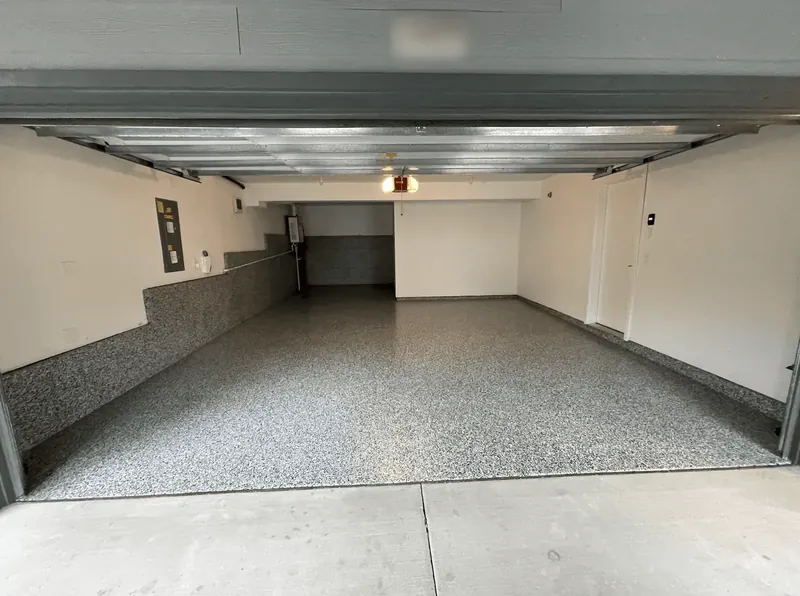
What an epoxy flooring contract should include
What to put in an epoxy flooring contract and scope of work: prep, system, exclusions, deposits and payment rules, change orders, warranty and lien notices.