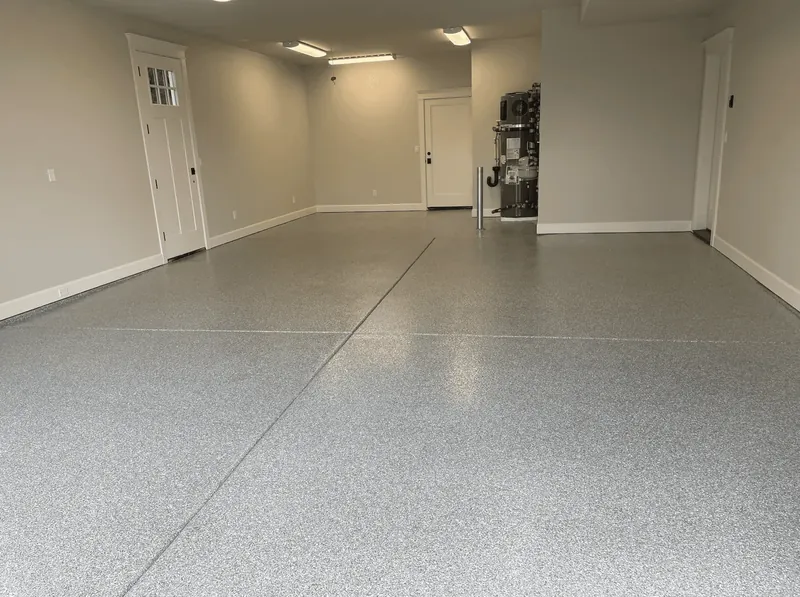
Key takeaways
- Price every job from four parts: materials from spread rates, labor at a loaded hourly cost, a share of overhead, then profit.
- Installed epoxy typically sells for $4–10 per sq ft, or $1,600–5,800 for a two-car garage; your price comes from your own costs, not the average.
- Divide your full cost by (1 minus your target margin) to get the price; a 25% markup is only a 20% margin.
- In the worked example, a 484 sq ft flake garage costs $2,459 to do and sells for $3,075 at a 20% net margin, or $6.35 per sq ft.
- Small jobs need a minimum price: at the same $6.35 per sq ft, a 250 sq ft garage would sell below its own cost.
- Price prep, repairs, moisture mitigation, extra visits and travel as separate lines, never as free extras.
To price epoxy flooring, add four things: materials (from each product’s spread rate), labor (crew hours times a loaded hourly cost), a share of your yearly overhead, and profit. Then divide that cost by one minus your target margin. Homeowners typically pay $4–10 per square foot installed, or $1,600–5,800 for a two-car garage, but your price has to come from your own costs. The market average doesn’t know what you pay for material, labor and insurance.
This guide builds a price step by step, then works a full two-car garage example with every number shown. If you’d rather plug in your own numbers, use the epoxy flooring pricing calculator.
Price per square foot or price per job?
Most homeowners compare quotes by the square foot, so you’ll often present a per-square-foot number. Calculate every job as a whole job first, though. A per-square-foot rate hides the costs that don’t shrink with the floor:
- Fixed costs per job: driving there and back, loading, setup, masking, cleanup, the estimate visit and your share of overhead. A 250 sq ft garage costs nearly as much to show up for as a 500 sq ft one.
- Variable costs: material scales with area (and with thickness); grinding time scales with area and with how hard and dirty the slab is.
So use a per-square-foot rate only inside the size range it was built for, and set a minimum job price for everything smaller. Commercial work is usually bid per job from a written spec, which the cost per square foot guide covers.
Step 1: Materials, from spread rates
Every coat on a manufacturer’s technical data sheet has a spread rate: how many square feet a gallon covers at the intended thickness. Gallons needed for one coat = square feet ÷ spread rate. Do it coat by coat, using the data sheet of the product you actually install, and add a waste allowance for mixing cups, rollers and the last inch in the bucket.
Two real full-broadcast flake systems show how much the numbers differ:
| Layer | System A: polyaspartic base and topcoat | System B: polyaspartic chip system |
|---|---|---|
| Primer | None (the base coat bonds to the ground slab) | 330 sq ft per gallon (4 mils) |
| Base coat / broadcast coat | 150 sq ft per gallon | 330 sq ft per gallon (4 mils) |
| Chip, broadcast to refusal | About 400 sq ft per 55 lb box | About 400 sq ft per 55 lb box |
| Topcoat over chip | 130 sq ft per gallon | 160 sq ft per gallon |
Spread rates belong to a product, not to “epoxy” in general. Thicker builds, rougher profiles and smaller flake all use more material. The coverage calculator and flake calculator do this math for you.
Add the small stuff too: crack filler, tape, roller covers, squeegee blades, mixing buckets, and the wear on your diamonds. Materials, including applicators and supplies, typically come to $1–5 of the installed price per square foot, which is a useful check on your total.
Step 2: Labor at a loaded hourly cost
Labor cost = crew hours on the job × each person’s loaded hourly cost.
- Crew hours include everything the job takes: loading, driving, setup, grinding, edge work, repairs, each coat, waiting between coats, cleanup. Time your real jobs; your own numbers beat any rule of thumb.
- Loaded hourly cost is the wage plus what the wage costs you on top. Employer Social Security and Medicare alone are 7.65% of wages (6.2% plus 1.45%). Unemployment taxes and workers’ compensation depend on your state and your insurer, and paid time off adds more.
For a wage benchmark, the May 2025 median was $27.15 an hour for floor layers (except carpet, wood and hard tile) and $19.46 an hour for painters’ and plasterers’ helpers. Local pay varies widely.
If you do the work yourself, price your own hours at what you’d pay someone to do them. Otherwise your “profit” is just your wage, and the business can never afford to replace you on the floor.
Step 3: Overhead every job has to carry
Overhead is everything you pay whether or not a floor goes down this week: insurance, the truck, equipment, marketing, phone and software, accounting, licenses. Spread it over the jobs you expect to do:
Overhead per job = yearly overhead ÷ jobs per year
Or, if your jobs vary a lot in length, per billable day: yearly overhead ÷ billable crew days.
New owners often leave overhead out of the price because it doesn’t show up on the floor. Then the jobs look profitable one by one and the bank account says otherwise. Marketing is part of overhead: if a booked job costs you a few hundred dollars in leads, that comes out of every price you set (see the economics of epoxy flooring leads).
Step 4: Profit, and margin versus markup
Markup and margin are not the same number:
- Markup = profit ÷ cost
- Margin = profit ÷ price
- Price for a target margin = cost ÷ (1 − margin)
- Markup = margin ÷ (1 − margin); margin = markup ÷ (1 + markup)
| Target margin | Markup on cost you need | Price for a $2,000 cost |
|---|---|---|
| 10% | 11.1% | $2,222 |
| 15% | 17.6% | $2,353 |
| 20% | 25.0% | $2,500 |
| 25% | 33.3% | $2,667 |
| 30% | 42.9% | $2,857 |
| 35% | 53.8% | $3,077 |
| 40% | 66.7% | $3,333 |
| 50% | 100.0% | $4,000 |
The classic mistake: you want a 25% margin, add 25% to your cost, and end up with a 20% margin. Decide whether you’re talking about gross margin (after materials and labor only) or net margin (after overhead too), because the “epoxy margins” you hear quoted mix the two. Epoxy flooring profit margins goes deeper.
Worked example: a 484 sq ft two-car garage
Every input below is a real market figure or a stated assumption. Swap in your own.
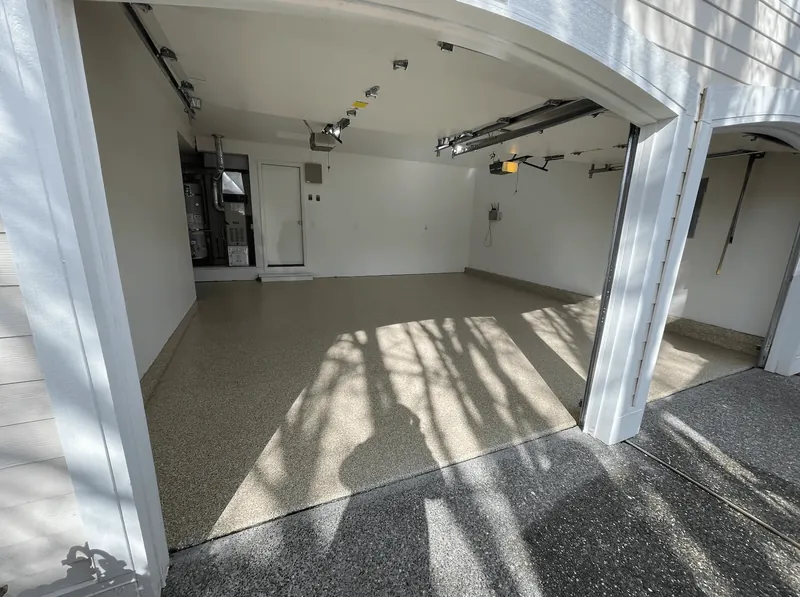
The job: a 22 ft × 22 ft two-car garage, 484 sq ft (two-car garages typically run 400–576 sq ft). Sound slab, a few hairline cracks, no moisture problem on testing. One-day full-broadcast flake system with a polyaspartic base and topcoat (System A above).
Material prices (2026 listing prices): polyaspartic at $275 per 2-gallon kit, so $137.50 a gallon; chip at $174.61 per 55 lb box. Assumption: 10% waste on coatings; leftover chip goes back in the box for the next job.
| Materials | Arithmetic | Cost |
|---|---|---|
| Base coat | 484 ÷ 150 = 3.23 gal; × 1.10 waste = 3.55 gal × $137.50 | $488.03 |
| Topcoat | 484 ÷ 130 = 3.72 gal; × 1.10 waste = 4.10 gal × $137.50 | $563.12 |
| Chip | 484 ÷ 400 = 1.21 boxes × $174.61 | $211.28 |
| Crack filler, tape, rollers, blades, diamond wear | Assumption | $150.00 |
| Materials total | $1,412.43 ($2.92 per sq ft) |
Labor. Assumptions: an installer and a helper, 11 hours each (10 on site plus an hour of loading and driving), paid the May 2025 median wages above, with a 25% burden on top of wages for payroll taxes, unemployment insurance and workers’ compensation (your accountant and insurer will give you your real figure).
| Labor | Arithmetic | Cost |
|---|---|---|
| Installer | $27.15 × 1.25 = $33.94 an hour × 11 hours | $373.31 |
| Helper | $19.46 × 1.25 = $24.33 an hour × 11 hours | $267.58 |
| Labor total | $640.89 |
Overhead. Insurance lines are typical median premiums for a small flooring installer; everything else is an assumption for a one-truck business.
| Yearly overhead | Basis | Per year |
|---|---|---|
| General liability, $1M/$2M | Typical median premium | $919 |
| Commercial auto | Typical median premium | $2,490 |
| Tools and equipment coverage | Typical median premium | $495 |
| Truck payment, fuel, maintenance | Assumption: $800 a month | $9,600 |
| Grinder and dust extractor | $8,488 dual-disc grinder + $3,900 mid-size HEPA extractor (enough for a 7-inch edge grinder), spread over 5 years | $2,477.60 |
| Marketing | Assumption: $1,000 a month | $12,000 |
| Phone, software, website | Assumption | $2,100 |
| Accounting, licenses, bank and card fees | Assumption | $2,400 |
| Total | $32,481.60 |
Workers’ compensation (a typical median premium is $1,726 a year) sits inside the 25% labor burden here, so it isn’t counted twice. Assume 80 jobs a year: $32,481.60 ÷ 80 = $406.02 of overhead per job.
The price:
| Line | Amount |
|---|---|
| Materials | $1,412.43 |
| Labor | $640.89 |
| Direct cost (materials + labor) | $2,053.32 |
| Overhead share | $406.02 |
| Full cost | $2,459.34 |
| Price at a 20% net margin: $2,459.34 ÷ 0.80 | $3,074.18, quoted as $3,075 |
| Price per sq ft: $3,075 ÷ 484 | $6.35 |
| Profit: $3,075 − $2,459.34 | $615.66 |
At $3,075 the job earns a 20% net margin, a 33.2% gross margin (($3,075 − $2,053.32) ÷ $3,075) and a 25% markup on full cost. It also lands inside the typical two-car range of $1,600–5,800, which tells you the price is plausible in the market. It doesn’t tell you the price is right; only your costs do that.
Rule of thumb from the math: if your overhead per job is $400 and you do 80 jobs a year, doing 60 jobs instead raises it to $541 per job ($32,481.60 ÷ 60). Fewer jobs means each one must carry more.
Set a minimum job price
Run the same model on a 250 sq ft one-car garage. Material scales down, but the crew still spends most of a day (assume 9 hours each) and the job still carries a full $406.02 of overhead.
| 250 sq ft garage | Arithmetic | Amount |
|---|---|---|
| Materials | Same rates: $252.08 base + $290.87 top + $109.13 chip + $150 supplies | $802.08 |
| Labor | 9 hours × ($33.94 + $24.33) | $524.36 |
| Overhead share | Same as any job | $406.02 |
| Full cost | $1,732.46 | |
| Price at 20% margin | $1,732.46 ÷ 0.80 | $2,165.58 ($8.66 per sq ft) |
| Price at the two-car rate | 250 × $6.35 | $1,587.50 |
Charging the two-car rate would put this job $144.96 below its full cost. That is what a minimum job price prevents. A simple way to set one: price the smallest job you’ll take as a one-day job at your target margin, and never quote below it. The cost per square foot falls as floors get bigger, and rises just as surely as they get smaller.
Price the adders as separate lines
The base price assumes a sound, dry, clean slab. Anything else is extra work, and it belongs on its own line in the estimate so the customer sees why it costs more.
| Adder | What drives the cost | How to price it |
|---|---|---|
| Crack and joint repair | Linear feet, width, filler used | Per linear foot, from your filler cost and time |
| Spalls, pitting, low spots | Patch material, extra grinding | Per area or per patch; widespread damage can call for resurfacing, typically $3–7 per sq ft |
| Oil and contamination | Degreasing, extra grinding passes | Per hour or per stained area |
| Moisture testing | Kits or meter time | Moisture and hardness testing typically runs $50–300 |
| Moisture mitigation | A vapor-barrier coat at its own spread rate | Like any coat: gallons × price + labor. Chip systems commonly require one above 3 lb/1,000 sq ft/24 h (calcium chloride test) or 75% relative humidity |
| Removing an old coating | Extra passes, more diamond wear, disposal | Per sq ft from timed jobs; never guess |
| Stem walls, steps, cove | Hand work, edge tools | Per linear foot or per step |
Concrete moisture testing explains the calcium chloride and relative humidity tests behind those limits. When you can’t test or fix a condition, write the exclusion into your scope of work instead of absorbing the risk.
Multi-visit systems and travel
A one-day polyaspartic system and a two-day epoxy system can use similar material, but the second one sends the crew back. A polyaspartic chip system can be walked on within hours and return to service after about 24 hours; slower epoxy base coats often need an overnight cure before the topcoat. Read the cure time and recoat window on the data sheet before you price, and see polyaspartic vs epoxy for the trade-offs.
Price every extra visit. In our model, a second trip for two people (an hour of driving and two hours of setup and cleanup each) costs 3 × ($33.94 + $24.33) = $174.79 in labor. Add 30 miles round trip at the IRS business mileage rate of 76 cents a mile (from July 1, 2026), $22.80, and the visit costs $197.59, or about $247 at a 20% margin.
For travel, pick one method and stick to it: a free radius with a per-mile charge beyond it, or price zones. If your vehicle costs are already in overhead, charge only for the extra distance.
Offer good, better and best options
Giving the customer three options keeps the conversation on which floor they want instead of whether to hire you. Build each tier from the same costing model so every option hits your margin:
| Tier | Example contents | What changes in your cost |
|---|---|---|
| Good | Your standard full-flake system | The base price |
| Better | Standard system plus a second, thin topcoat for a smoother finish | Extra material: at 300–400 sq ft per gallon for that coat, 484 ÷ 350 = 1.38 gal, about $190 at our example price, plus crew time |
| Best | Better plus stem walls, a premium flake blend and your longest workmanship warranty | Each addition priced from its own costs, including the cost of standing behind a longer warranty |
Never put a tier on the menu that you can’t install well. A longer warranty is a real cost: see epoxy floor warranties before you offer one. How to present the three options in the home is in the epoxy flooring sales process.
Discount rules
Decide your discount rules before you’re standing in a customer’s garage:
- Write a cap. Decide the most you’ll ever take off, and who besides you may approve it. In the worked example, the 20% net margin is $615.66; a 10% discount ($307.50) takes away half of the profit.
- Trade, don’t cave. Give a discount for something that saves you money: a flexible install date that fills a gap in your schedule, payment in full at signing, or a neighbor job on the same day.
- Change the scope instead of the price. If the budget is short, offer the “good” tier or drop an add-on.
- Never discount the prep. Grinding and repairs are what make the floor last.
Put the agreed price, scope and payment terms in writing. The epoxy flooring contract guide covers deposits and the state rules that limit them.
When to raise your prices
Review your numbers after every job: actual material used, actual crew hours, and callbacks. Raise prices when:
- material, wages or insurance go up (update the model, then the price list);
- you win nearly every estimate, which usually means you’re the cheapest option;
- you’re booked out for weeks and still adding jobs;
- your job costs show the margin coming in under target.
Raise prices on new estimates, not on signed contracts, and keep your estimate template current so every quote uses the same rates.
Check against the market, then quote
Use typical market prices as a sanity check, not as your price:
| Space | Typical size | Typical installed price |
|---|---|---|
| One-car garage | 288–392 sq ft | $1,200–3,900 |
| Two-car garage | 400–576 sq ft | $1,600–5,800 |
| Three-car garage | 576–864 sq ft | $2,300–8,600 |
| Any epoxy floor | per sq ft | $4–10 (materials $1–5, labor $3–5) |
Prices by system (flake, metallic, quartz, polyaspartic, urethane cement) and what moves them are in epoxy flooring cost per square foot. If your full-cost price sits far above these ranges, look at your crew hours and overhead before you look at your margin.
Pricing is one of the Seven Systems we teach. The Epoxy Playbook pairs recorded installation training, full jobs you can replay, with the business side: job costing, price lists and estimates. To run your own numbers now, open the pricing calculator; for the startup side, try the startup cost calculator.
Questions
How much should I charge per square foot for epoxy flooring?
Work it out from your costs: materials, labor, overhead and your target margin, divided by the square footage. Installed prices typically run $4–10 per sq ft. In our worked example a 484 sq ft flake garage comes out at $6.35 per sq ft, but a smaller 250 sq ft garage needs $8.66 per sq ft to earn the same margin.
What is the difference between margin and markup?
Markup is profit as a share of your cost; margin is profit as a share of the price. A job that costs $2,000 and sells for $2,500 has a 25% markup but only a 20% margin. To hit a target margin, divide cost by (1 minus the margin): $2,000 / 0.80 = $2,500.
Should I price epoxy floors by the square foot or by the job?
Calculate by the job, then quote however your customer understands best. A per-square-foot rate only works inside the size range it was built for; below that range, your fixed costs per job (travel, setup, overhead) push the true rate up, which is why you need a minimum job price.
How do I price a garage with cracks, oil stains or a moisture problem?
Inspect and test before you quote, then price each fix as its own line: crack and joint repair by the linear foot, oil-stain treatment, extra grinding passes, and a moisture vapor barrier coat priced from its own spread rate and cost. If you can't test, write the condition and the exclusion into the estimate.
How often should I raise my prices?
Review your numbers after every job and your rates whenever your material costs, wages or insurance change. Signs your price is too low: you win almost every estimate, you're booked out for weeks, or your job-cost reports show margins under target.
Keep reading
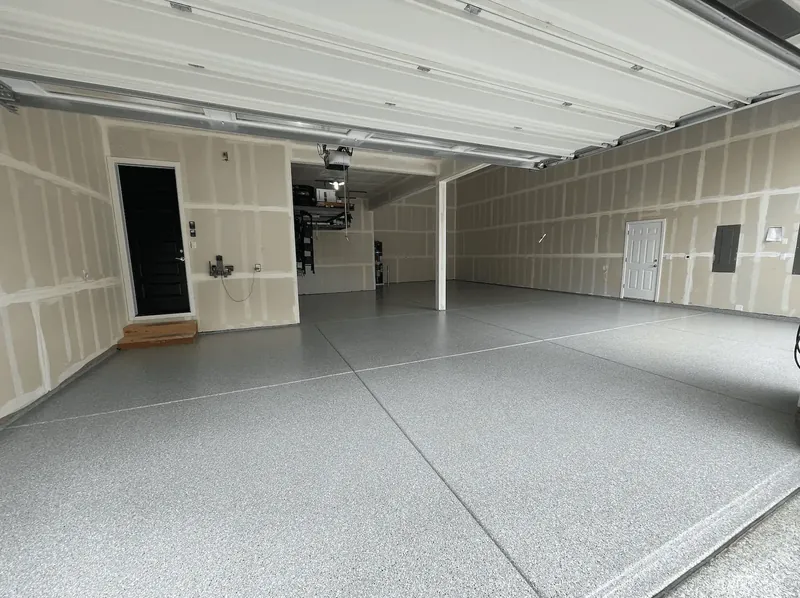
Epoxy floor cost per square foot: what buyers pay, and what it means for your price
Epoxy floors cost about $4–10 per sq ft installed. Prices by system and by space, why quotes vary so much, and what moves the price on a given slab.
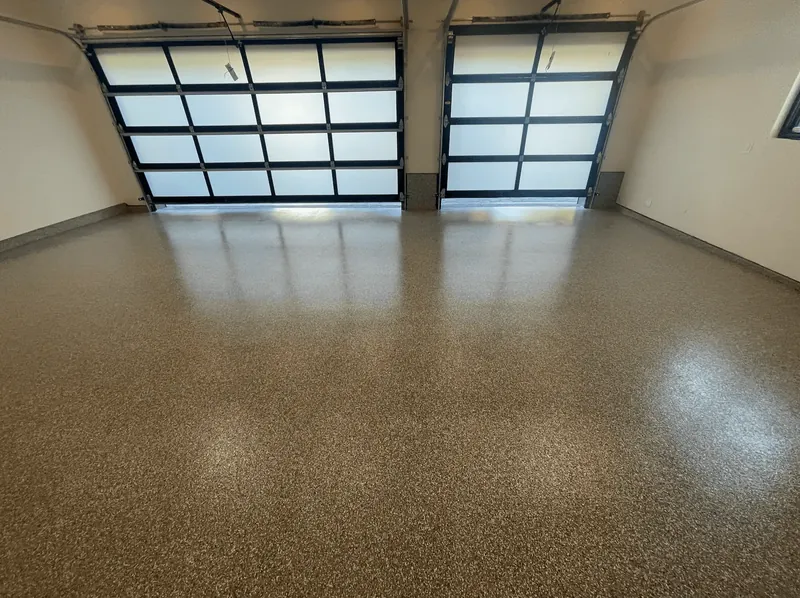
Epoxy flooring profit margins: what's realistic, and where margin leaks
Gross vs net margin for epoxy flooring jobs, the margin claims you'll hear, a markup-to-margin table, job costing, and the seven places margin leaks.
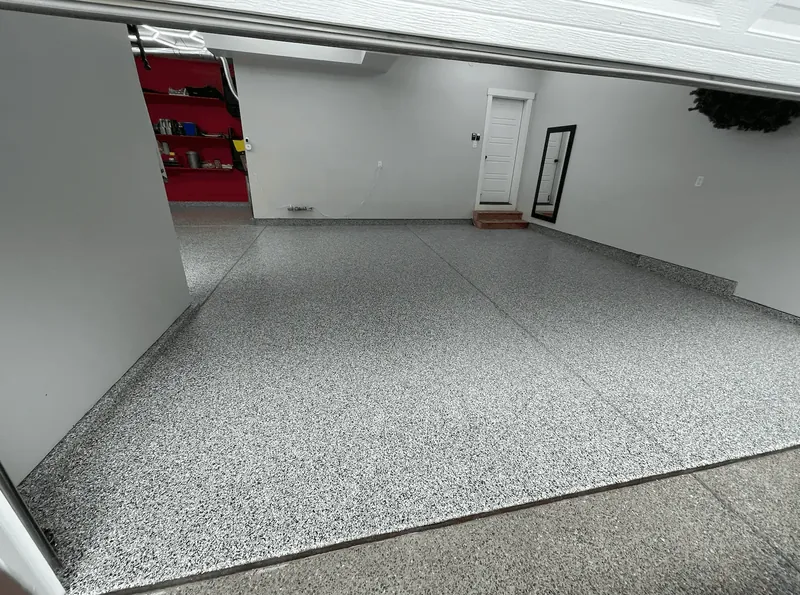
Job pricing calculator
The epoxy flooring sales process: from first call to signed contract
The in-home epoxy flooring sales process: pre-qualifying calls, measuring, moisture checks, three options, the $200 DIY kit objection, deposits and follow-up.