Start an epoxy flooring business
The whole start-up, step by step, with typical prices.
Reference
97 coating terms in plain English, from amine blush to wet film thickness, with the typical values a contractor works with and links to the guides that go deeper.
A coating with no solvent or water to evaporate, so the film you spread is the film that stays: wet and dry thickness are the same. Many epoxy primers and base coats are 100% solids.
Profiling concrete with a diluted acid wash instead of a machine. It leaves sealers, curing compounds and oil behind, so many coating makers now call for mechanical preparation, diamond grinding or shot blasting, instead.
A family of resins that resist breaking down and yellowing in sunlight. Aliphatic polyaspartics and polyurethanes are used as clear topcoats over epoxy for that reason; compare aromatic.
A very hard grit mixed into or broadcast onto a topcoat to make it more slip resistant. More grit means more grip, and a floor that is harder to mop.
The yellowing of epoxy under sunlight or strong artificial light. It is cosmetic, but it is why exposed epoxy gets an aliphatic topcoat; how much it yellows depends on how long and how strongly the floor sees sunlight or intense indoor lighting.
A greasy or waxy film that can form on curing epoxy when the amine hardener reacts with moisture and carbon dioxide in the air, most often in cool, damp conditions. It is not always visible, and coating over it causes adhesion failures, so it has to be washed off before the next coat.
Resins built on aromatic chemistry, which includes most epoxies. They bond and build well but yellow in UV light (ambering), so they usually sit under an aliphatic topcoat.
Rolling over a coat right after it has been spread with a squeegee, to even out the thickness and remove squeegee lines. Data sheets say when to stop, usually once the coat starts to turn sticky.
The main coat of a floor system, applied over the primer. In a flake floor it is the wet layer the flake is broadcast into, typically about 8–12 mils thick.
Domes or bubbles that rise in a cured coating, often with liquid inside, when moisture or vapor pushes up from the slab. It is one reason coating makers set moisture limits before a floor is coated.
Throwing flake, quartz or sand by hand into a wet coat so it embeds as the coat cures. A partial broadcast leaves the color coat showing between the chips; a full broadcast covers it completely.
How much flake or aggregate goes down per area, given as square feet per pound or pounds per square foot. A full broadcast of 1/4-inch flake typically takes one pound per 5–7 sq ft; a partial broadcast, one pound per 25–50 sq ft.
A moisture test (ASTM F1869) in which a dish of dry calcium chloride is sealed under a dome on bare concrete for 60–72 hours and then weighed. The weight it gains gives the moisture vapor emission rate; the guideline is three tests for the first 1,000 sq ft and one more for each additional 1,000 sq ft.
How well a cured coating stands up to specific chemicals such as brake fluid, gasoline or acids. Data sheets rate each chemical (excellent, good, fair, not recommended), and the ratings assume a fully cured film, often tested after 5 days or more.
The roughness of prepared concrete, graded by the International Concrete Repair Institute (guideline 310.2R) from CSP 1, nearly flat, to CSP 10, very rough, using replica chips you compare against. The coating's data sheet names the profile it needs; flake systems commonly call for CSP 3 or rougher.
A groove sawn or tooled into a slab so shrinkage cracks form in a straight line instead of at random. Saw-cut joints can be filled and coated over, with the risk that the coating cracks there if the slab moves; joints built to move must be left open (see isolation joint).
Coating carried a few inches up the wall with a rounded (coved) transition at the floor, so floor and wall form one seamless, washable surface. Common in commercial kitchens, food plants and restrooms.
Opening up (chasing) a crack with a grinder or crack-chasing blade, cleaning it, filling it with an epoxy or polyurea filler and scraping the filler flush before the floor is coated. Cracks, holes and spalls are patched before the primer goes down.
A diamond wheel shaped like a shallow cup that mounts on a hand grinder, used for edge grinding and small areas the floor grinder can't reach.
How long a coating takes to reach full hardness and chemical resistance, which is longer than it takes to walk on. A 100% solids epoxy base coat can need about 5 days at 72°F and 50% humidity to cure fully, and colder slabs slow every stage.
A liquid sprayed onto fresh concrete to hold water in while it cures. It leaves a film that stops coatings from bonding, so it has to be ground off before a floor is coated.
A measure of how slippery a surface is for someone already walking, tested wet under ANSI A326.3; higher numbers mean more grip. A textured topcoat over a full flake broadcast can test at 0.6 or more.
A coating letting go of the concrete, or of the coat beneath it, and peeling or lifting in sheets. The usual causes are poor surface preparation, moisture in the slab, contamination and a missed recoat window.
A liquid silicate (lithium, sodium or potassium) that soaks into concrete and reacts with the lime in it to harden the surface, mostly used on polished concrete. A densified or sealed slab is harder for a coating to grip, so it is ground before coating.
The temperature at which moisture in the air condenses into water. If the slab is at or near it, a film of moisture can form on the floor or the fresh coat, so many data sheets require the floor to be at least 5°F above the dew point.
Preparing concrete with a floor grinder fitted with diamond tooling, which removes the weak top layer, old sealers and contamination and leaves a profile the coating can grip. OSHA's silica rule requires a water system or a dust collector on walk-behind floor grinders.
The diamond segments, inserts or pads a grinder runs on. Tooling wears with use, so it is a running cost whether you rent or own the grinder; a set for a dual-disc grinder lists at about $195–530.
A system that broadcasts flake or quartz twice, with a second resin coat in between, for more thickness and texture than a single broadcast.
The thickness of a coat after it has dried or cured, in mils. For a coating that is not 100% solids it is thinner than what you spread: DFT = wet film thickness × volume solids.
A walk-behind floor grinder with two counter-rotating discs. A new 22-inch machine lists at about $8,500 and rents for about $90–142 a day.
A guard around a hand grinder's wheel that connects to a dust extractor. For handheld grinders, OSHA's silica rule calls for a shroud with a dust collector that pulls at least 25 cubic feet per minute per inch of wheel diameter through a filter of 99% or better efficiency.
Grinding the strip along walls, in corners and around posts that the floor grinder can't reach, with a hand grinder, a cup wheel and a dust shroud connected to an extractor. Skip it and the coating has nothing to grip along the walls.
A white, powdery deposit of salts left on concrete when moisture moving through the slab evaporates at the surface. On a floor you plan to coat, it is a sign of moisture to test for.
A two-part thermosetting coating: a resin (part A) and a hardener (part B) that react chemically once mixed and cure into a hard plastic. Epoxy bonds well to prepared concrete and builds thickness quickly, but most epoxies yellow in sunlight, so they are usually topcoated.
The heat a resin gives off as it cures. A mixed batch left in the bucket heats itself and sets fast, which is why data sheets tell you to pour mixed material onto the floor right away.
A small round crater where wet coating pulls away from a spot, usually because of oil, silicone or other contamination on the surface. Thorough cleaning and grinding prevent them; sanding and recoating fixes them.
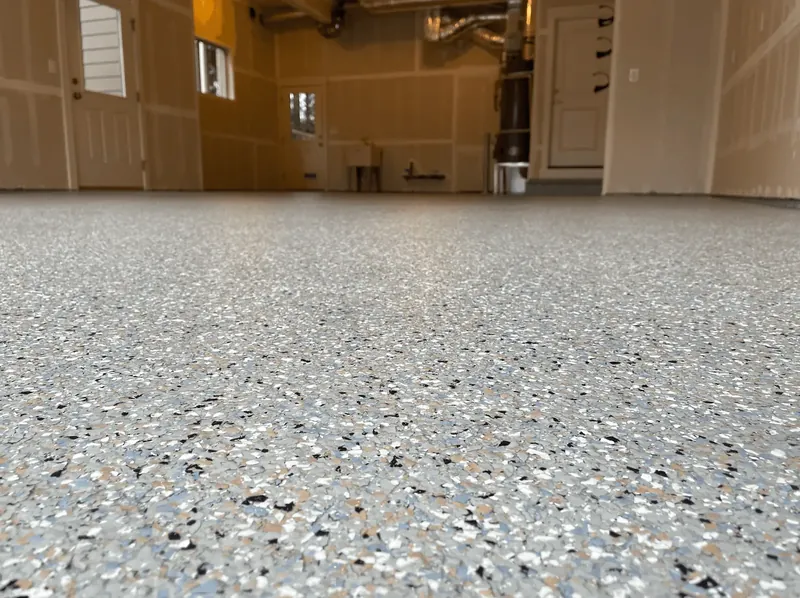
Decorative chips broadcast into a wet base coat. Flake comes in blends and in sizes from about 1/32 inch to 1 inch, usually in 40 lb cartons; smaller chips take more pounds to cover the same floor.
A mix of flake colors (and sometimes sizes) sold as one product, so every box gives the same look. Color can vary slightly from one production lot to the next, so intermix boxes from different lots before you start.
Broadcasting flake or quartz until the wet coat cannot take any more and no wet spots show. The loose excess is swept up after cure; a full broadcast of 1/4-inch flake typically takes one pound per 5–7 sq ft.
How shiny a surface is, measured with a gloss meter at a 60° angle (ASTM D523) in gloss units. On a common scale, 40–70 units is semi-gloss, 70–85 gloss and above 85 high gloss.
The size class of the diamonds or abrasive in a tool; lower numbers are coarser and cut more aggressively. Coarse metal diamonds, around 30 grit, are used to take off old topcoats.
The B side of a two-part coating, which reacts with the resin to cure it. In epoxies it is usually an amine; in polyaspartics and polyurethanes the isocyanate side does that job.
An industrial vacuum built for grinding dust, with a HEPA filter (rated to remove at least 99.97% of particles 0.3 microns across) and a way to clean the filter while you work. For floor grinders, OSHA's silica rule calls for a dust collector with 99% or better filter efficiency and a filter-cleaning mechanism, plus a HEPA vacuum between passes indoors.
When hot tires soften a coating and lift it off the floor, leaving bare patches in the tire paths. It is most often traced to thin, poorly bonded or not fully cured coatings, so good prep, full film thickness and a full cure before the first car are the usual defenses.
Water pressure from below a slab, for example from a high water table, pushing water into the concrete. A coating alone won't hold it back; the water has to be dealt with before the floor is coated.
The reactive component that turns polyols and amines into polyurethanes, polyureas and polyaspartics. The main health effects of exposure are occupational asthma and other lung problems, plus eye, nose, throat and skin irritation, so follow the SDS on respirators and gloves.
A joint that separates a slab from walls, columns or another slab so each can move on its own. Moving joints are honored, kept open with a flexible joint material after coating, because a coating bridged over them will crack.
A weak, chalky layer of cement and fine particles brought to the surface of concrete by bleed water as it sets. A coating bonded to laitance fails with it, so laitance is ground or blasted off.
Diamond grinding segments held in a metal matrix, used for aggressive work: opening up concrete, removing thin coatings and cutting a profile. The bond is matched to the concrete: softer bonds for hard concrete, harder bonds for soft.
Epoxy mixed with metallic or pearlescent pigment and worked into swirls, veins and other effects. It goes on much thicker than a flake base coat, often 30–40 mils or more, to avoid streaks.
One thousandth of an inch (0.001 in, or 25.4 microns), the unit coating thickness is specified in. One US gallon spread over 1,604 sq ft makes a film 1 mil thick, which is where the coverage formula comes from.
The proportion of part A to part B, by volume or by weight, that a two-part coating must be mixed at. For example, 2:1 by volume for many epoxies and 1:1 for many polyaspartics; off-ratio mixes can leave soft or sticky spots.
A coating, often a 100% solids epoxy, applied first to hold back moisture vapor when a slab tests above the floor system's limits. ASTM F3010 covers two-part resin moisture mitigation membranes. A common trigger is a slab above 3 lb (F1869) or 75% RH (F2170), but each coating maker sets its own limits.
How much water vapor comes out of a slab, in pounds per 1,000 sq ft per 24 hours, measured with the calcium chloride test. The test method sets no pass mark; each coating maker sets its own limit, commonly 3 lb.
A squeegee with notches in the blade that leaves a set amount of material as you push it, so the coat goes down at an even thickness, for example a 1/8-inch notch for a flake base coat.
An epoxy made with novolac resin, which cross-links more densely than standard epoxy and resists stronger acids and solvents. It is used for secondary containment, labs and industrial floors.
Air and gas rising out of concrete pores into a fresh coat, leaving bubbles or pinholes as it cures. It is worst on a warming slab; a tight, thin primer coat, without back-rolling, is the usual way to minimize it.
Tooling with chunks of polycrystalline diamond that scrape and gouge rather than grind, used to strip old coatings, mastic and glue quickly. It leaves a rough surface that is usually ground with metal bonds afterward.
A grinder whose heads spin on a plate that turns the opposite way, for an even scratch pattern on larger floors and polished concrete. A new 20-inch planetary lists at about $15,700–17,800 and rents for about $350–425 a day at specialty shops.
A quick moisture check (ASTM D4263): tape a sheet of plastic to the slab, wait, and look for condensation or darkened concrete under it. It shows that moisture is present but does not measure how much, so it does not replace the calcium chloride or RH test.
Concrete ground and polished with progressively finer diamonds, usually with a densifier, until it shines. It is a finish of the concrete itself, not a coating.
A fast-curing, aliphatic member of the polyurea family, used mostly as a clear topcoat and sometimes for one-day floor systems. It resists UV yellowing, cures faster in humid air, and can go on up to about 16 mils in one pass over a full broadcast.
A coating formed when an isocyanate reacts with an amine resin. Pure polyureas cure in seconds and are sprayed with heated plural-component equipment; the polyaspartics used on garage floors are a slower, hand-applied branch of the same chemistry.
A coating formed when an isocyanate reacts with a polyol (a compound with alcohol groups). On floors, thin aliphatic polyurethane topcoats are used over epoxy for abrasion, chemical and UV resistance.
How long a mixed batch stays usable in its container before it thickens and sets. Heat and a bigger batch shorten it, so mix only what you can spread in time, often no more than you can apply in 10–15 minutes.
The first, thin coat on bare concrete. It soaks into the pores, seals the surface against outgassing and gives the next coat a strong bond; a 100% solids primer typically goes on at about 3–8 mils.
A test that glues a metal dolly to the coating and pulls it straight up to measure bond strength (ASTM D7234 for coatings on concrete). A strong result breaks the concrete, not the bond; floor coating data sheets commonly report more than 400 psi with the concrete failing first.
Colored quartz sand broadcast into a resin coat, sometimes in two layers, for a textured, hard-wearing and slip-resistant floor. Quartz systems are common in commercial kitchens, locker rooms and other wet areas.
The time after one coat during which the next can go on and bond chemically, given as a minimum and a maximum. For a typical epoxy base coat at 72°F it might be 8 to 24 hours; miss it and the coat has to be sanded before recoating.
A moisture test (ASTM F2170) in which probes are sealed into holes drilled into the slab and read once the air in each hole has equilibrated, which the standard has allowed after 24 hours since 2018. The coating maker sets the limit, for example 75% RH.
The A side of a two-part coating, mixed with the hardener at the mix ratio on the data sheet. Pigment is usually added to the resin before the hardener goes in.
The fine quartz dust released when you grind, cut or blast concrete, small enough to reach deep into the lungs. OSHA's construction rule limits exposure to 50 micrograms per cubic meter averaged over 8 hours and lists the dust controls required for floor and hand grinders.
When a new floor can go back into use: light foot traffic first, then heavy traffic and vehicles. For a standard-cure epoxy at 72°F that might be about 10 hours for light foot traffic and 2 days for heavy traffic; cooler slabs take longer.
Preparing concrete with a machine whose rotating cutters chip at the surface, used to remove thick coatings or cut a deep profile. It leaves a much rougher surface than grinding.
After a flake broadcast cures, scraping the floor with a long-handled floor scraper and vacuuming to knock off loose and standing chips before the topcoat. It also takes off sharp edges before the clear coat.
The 16-section hazard document a manufacturer must supply for every hazardous product under OSHA's Hazard Communication Standard. It covers hazards, safe handling, protective equipment and first aid; read it before you open the kit.
A thin protective coat, such as an acrylic or a penetrating silane, applied to bare concrete. A new coating won't bond to a sealed slab, so sealers are ground off before coating.
A flowable epoxy that levels itself into a smooth, glossy surface as it cures, spread with a notched squeegee and back-rolled, typically at about 10–30 mils.
Hardness measured with a durometer on the Shore D scale (ASTM D2240); higher is harder. A polyaspartic topcoat can read about 70 after 24 hours and the mid-80s after 5 days, which shows how much a coating keeps hardening after you can walk on it.
Preparing concrete with a machine that throws steel shot at the surface and vacuums it back up, removing contamination and leaving an even, open profile. Coating makers generally accept either diamond grinding or shot blasting.
A concrete slab poured directly on the ground, as most garages and basements are. Ground moisture can move up through it, so coating makers expect a vapor retarder under the slab and moisture tests on top.
How well a floor resists slips, especially when wet. Texture from flake, quartz or aluminum oxide grit raises it; it is measured as wet DCOF under ANSI A326.3.
The share of a coating that stays on the floor as film after its solvent or water leaves, stated by volume on the data sheet. Use volume solids, not weight solids, in coverage math: 1,604 × volume solids ÷ dry mils = square feet per gallon.
A piece of concrete broken away from the surface, leaving a shallow pothole, often at joints or from impact or freeze-thaw. Spalls are filled with an epoxy patch and scraped flush before coating.
Shoe covers with spikes that let you walk across a wet coat to spread, back-roll or broadcast without leaving footprints.
How many square feet one gallon covers at the specified thickness. Theoretical spread rate = 1,604 × volume solids ÷ dry mils; real floors take more because of porosity, profile and waste.
A lab test (ASTM D4060) that wears a coated panel with abrasive wheels and weighs the material lost; fewer milligrams lost means better wear resistance.
When a coat is no longer sticky to the touch, which is not the same as cured: an epoxy that is tack-free after about 5.5 hours at 72°F can still need 5 days to cure fully.
The manufacturer's data sheet for a product: solids, mix ratio, coverage, film thickness, temperature limits, recoat and cure times. When a general rule of thumb and the data sheet disagree, follow the data sheet.
Stress from sudden, large temperature changes, such as boiling water or steam cleaning on a cold floor. It is the reason urethane cement is chosen for commercial kitchens and food plants.
The final clear coat or coats that take the wear: they lock in the flake and protect against abrasion, chemicals and UV light. Polyaspartic and aliphatic polyurethane are the usual choices; over a full flake broadcast a topcoat typically goes on at about 100–160 sq ft per gallon.
A troweled or self-leveling floor made of polyurethane resin, cement and aggregate. It tolerates thermal shock, steam cleaning and heavy wear, so it is common in commercial kitchens, breweries and food processing.
A plastic sheet laid under a slab when it is poured, to slow moisture moving up from the ground. It can't be added later; if it is missing, the slab may need a moisture vapor barrier coating.
Carbon-based chemicals that evaporate from products into the air as they dry. EPA regulates them outdoors mainly because they help form smog, and federal and state rules cap the VOC content of coatings, which data sheets report in grams per liter.
Epoxy carried in water rather than made at 100% solids. The water evaporates, so each coat dries thinner than it went on and it takes more gallons to reach the same dry film thickness.
The thickness of a coat right after you spread it, checked with a notched wet film gauge. WFT = DFT ÷ volume solids, so 10 dry mils of a 90% solids coating means spreading about 11 wet mils.
How long you have to spread, roll and broadcast a coat on the floor before it starts to set, often about 20–40 minutes for an epoxy at 72°F; heat shortens it.
Questions
It means throwing flake or quartz into a wet coat until the coat cannot hold any more and no wet spots show. The loose excess is swept up after the coat cures. A full broadcast of 1/4-inch flake typically takes one pound per 5–7 sq ft; the flake calculator turns that into boxes.
Epoxy is a two-part resin that bonds well to concrete and builds thickness quickly, but most epoxies yellow in sunlight. Polyaspartic is a fast-curing, UV-stable member of the polyurea family, used mostly as the clear topcoat over an epoxy base and flake. Many garage systems use both.
A mil is one thousandth of an inch, the unit coating thickness is specified in. One gallon spread over 1,604 sq ft makes a film 1 mil thick, so a 100% solids epoxy at 10 mils covers about 160 sq ft per gallon before waste.
Whatever the coating’s data sheet calls for. Profiles are graded CSP 1 to CSP 10 on the ICRI scale, and flake systems commonly call for CSP 3 or rougher, which is usually reached by diamond grinding or shot blasting.
The two standard tests are the calcium chloride test (ASTM F1869), which reports pounds of vapor per 1,000 sq ft per 24 hours, and the in-slab relative humidity test (ASTM F2170). Compare the results with the coating maker’s limits, commonly around 3 lb and 75% RH.
The whole start-up, step by step, with typical prices.
Grinders, extractors, tooling and application tools, and what they cost.
Full installations recorded start to finish that you can replay, plus pricing, quoting and selling the job. Required before the hands-on class.
Typical values vary by product. Always follow the technical data sheet for the product you use.
The Epoxy Playbook: full installations recorded start to finish, which you can replay as often as you need, plus pricing, quoting and selling the job.