Key takeaways
- OSHA's construction silica standard, 29 CFR 1926.1153, limits respirable crystalline silica to 50 µg/m³ as an 8-hour average and applies to employers whose workers grind, cut or drill concrete.
- Follow Table 1 exactly and you don't have to measure exposure: walk-behind floor grinders need water or the maker's dust collection with a 99%-efficient filter, plus a HEPA vacuum between passes indoors, and no respirator.
- Hand grinders need a shroud and a collector with at least 25 cfm per inch of wheel, so 175 cfm for a 7-inch wheel; indoors, more than four hours a shift requires a respirator with an APF of 10.
- Employers also need a written exposure control plan, a competent person, no dry sweeping or compressed air, and medical exams for anyone required to wear a respirator 30 or more days a year.
- A HEPA dust extractor costs about $1,900–2,400 (DE 110 class) or $3,400–3,900 (DE 120 class) to buy, or about $225 a week to rent.
OSHA’s silica standard for construction, 29 CFR 1926.1153, limits workers’ exposure to respirable crystalline silica to 50 micrograms per cubic meter of air as an 8-hour average. For floor grinding, the simplest way to comply is its Table 1: run the walk-behind grinder with water or with the dust collection system its maker recommends (a 99%-efficient filter and at least the recommended airflow), HEPA-vacuum between passes indoors, and no respirator is required. A HEPA dust extractor to do that costs about $1,900–3,900 to buy or about $225 a week to rent.
This article covers the parts of the standard that matter for coating prep, works through a garage example, and explains what to look for in an extractor. It’s a summary, not legal advice: confirm requirements with OSHA, your state plan or a safety professional. For the other equipment on a job, see the epoxy flooring equipment list.
Why silica matters
Grinding concrete releases silica particles at least 100 times smaller than ordinary sand. Breathing them can cause silicosis, an incurable lung disease that can lead to disability and death, as well as lung cancer, chronic obstructive pulmonary disease and kidney disease. Coating prep is a silica task from start to finish: grinding the field, edge grinding, crack chasing and shotblasting.
Who the standard covers
- Employers. It covers employers whose workers are exposed in construction work, unless exposure will stay below 25 µg/m³ as an 8-hour average under any foreseeable conditions. That 25 µg/m³ figure is also the action level.
- Not the self-employed. The OSH Act doesn’t cover self-employed workers. A one-person company has no legal duty under this standard until it hires, but the dust in a garage is the same either way.
- State plans. States with OSHA-approved plans can have different or more stringent requirements.
- In force since 2017. Construction employers have had to comply since September 23, 2017.
Two ways to comply
Employers can either follow the control methods in Table 1 of the standard, or measure workers’ exposure and choose the dust controls that keep it under the permissible exposure limit.
Table 1 lists tasks with specified controls. If you fully and properly implement the controls for your task, you don’t need to measure exposure for it.
Exposure assessment is the alternative: keep exposure at or under the permissible exposure limit of 50 µg/m³ as an 8-hour average, assess exposure by air monitoring or objective data, and use engineering controls first and respirators where those aren’t enough. For small coating crews, Table 1 is usually the practical route.
The Table 1 rows for floor prep
The two Table 1 entries that cover coating prep read:
Walk-behind milling machines and floor grinders
Use machine equipped with integrated water delivery system that continuously feeds water to the cutting surface. Operate and maintain tool in accordance with manufacturer’s instructions to minimize dust emissions.
OR
Use machine equipped with dust collection system recommended by the manufacturer. Operate and maintain tool in accordance with manufacturer’s instructions to minimize dust emissions. Dust collector must provide the air flow recommended by the manufacturer, or greater, and have a filter with 99% or greater efficiency and a filter-cleaning mechanism. When used indoors or in an enclosed area, use a HEPA-filtered vacuum to remove loose dust in between passes.
Required respiratory protection: none for four hours or less per shift; none for more than four hours.
Handheld grinders for uses other than mortar removal
For tasks performed outdoors only: Use grinder equipped with integrated water delivery system that continuously feeds water to the grinding surface. Operate and maintain tool in accordance with manufacturer’s instructions to minimize dust emissions.
OR
Use grinder equipped with commercially available shroud and dust collection system. Operate and maintain tool in accordance with manufacturer’s instructions to minimize dust emissions. Dust collector must provide 25 cubic feet per minute (cfm) or greater of airflow per inch of wheel diameter and have a filter with 99% or greater efficiency and a cyclonic pre-separator or filter-cleaning mechanism.
Required respiratory protection with the shroud and collector: outdoors, none at any duration; indoors or in an enclosed area, none for four hours or less per shift and APF 10 for more than four hours.
Two more rules sit next to the table. Indoors, employers must provide a means of exhaust as needed to keep visible airborne dust from building up. And when a worker does more than one Table 1 task in a shift, the hours add up: if all the Table 1 tasks together run more than four hours, the respiratory protection for each task is the one listed for more than four hours.
What it means in a garage
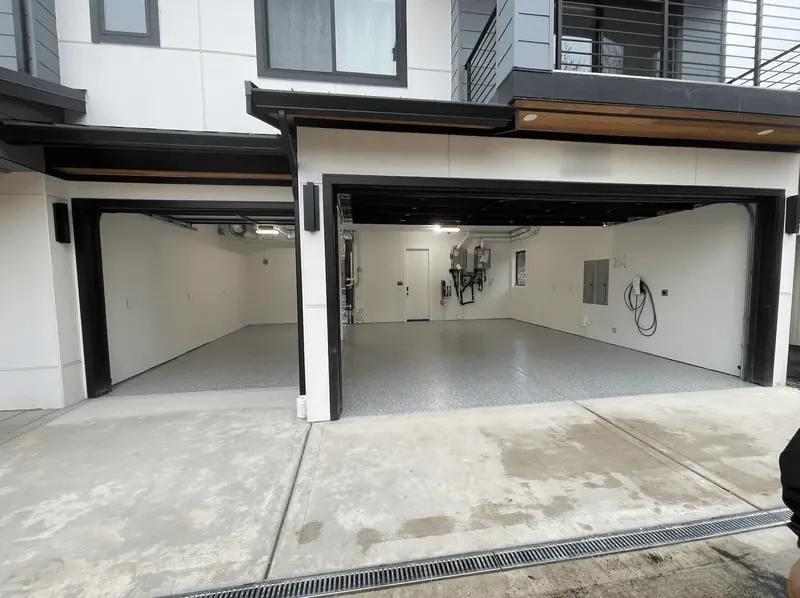
Say an employee grinds a two-car garage with a walk-behind grinder for three hours, then edge grinds with a 7-inch hand grinder for two hours, with the doors partly closed:
| Task | Controls needed | Respirator |
|---|---|---|
| Floor grinding, 3 hours | Grinder’s recommended dust collector, 99% filter with filter cleaning; HEPA vacuum between passes | None |
| Edge grinding, 2 hours | Shroud and collector with at least 7 × 25 = 175 cfm, 99% filter, cyclonic pre-separator or filter cleaning | APF 10, because Table 1 tasks total 3 + 2 = 5 hours, more than four |
| Cleanup | HEPA vacuum or wet methods; no dry sweeping, no compressed air | — |
An assigned protection factor of 10 is the factor OSHA assigns to a half-mask air-purifying respirator, used inside a full respirator program with medical evaluation and fit testing. A half-mask with P100 filters costs about $23–52. The safety guide covers the program.
The rest of the employer’s duties
- Written exposure control plan: describe the silica tasks, the controls and respiratory protection for each, the housekeeping measures, and how you restrict access to the work area; review it at least once a year; make it available to employees.
- Competent person: someone who can identify existing and foreseeable silica hazards and has the authority to correct them promptly, and who makes frequent and regular inspections of job sites, materials and equipment.
- Housekeeping: no dry sweeping or dry brushing where it could expose workers unless wet sweeping, HEPA vacuuming or other low-dust methods aren’t feasible; no compressed air for cleaning clothing or surfaces unless a ventilation system captures the dust cloud or there’s no alternative.
- Medical surveillance: for each employee required to wear a respirator under the standard for 30 or more days a year, at no cost to the employee: an initial exam within 30 days of assignment, including a chest X-ray, a lung function test and a tuberculosis test, and repeat exams at least every three years.
- Hazard communication and training: include silica in your hazard communication program and train workers on its health hazards, the tasks that expose them and the controls in use.
What to look for in a dust extractor
| Feature | Why it matters | What to look for |
|---|---|---|
| Filter efficiency | Table 1 requires 99% or greater for the collector | A HEPA filter is at least 99.97% efficient at 0.3 micrometers |
| HEPA certification | Lets one machine serve as both the collector and the between-pass HEPA vacuum | H-class units with certified HEPA filters, such as Husqvarna’s DE 110 H and DE 120 H |
| Airflow | Hand grinders need 25 cfm per inch of wheel; floor grinders need the maker’s recommendation | Compact 120-volt units move around 124 cfm (DE 110 H); larger units about 200–241 cfm (EDCO VAC-200, DE 120 H) |
| Filter cleaning | Required by Table 1 (or a cyclonic pre-separator for hand grinders) | Push-button or automatic filter cleaning |
| Pre-separator | Takes the bulk of the dust before the filter | A separate pre-separator, the first filter stage for heavy dust; a 30-gallon unit runs about $5,763 |
| Bagging | How you empty it decides how much dust you handle | Continuous bag systems such as Longopac |
| Power | The extractor needs its own circuit next to the grinder’s | The DE 110 H and DE 120 H run on 120V single-phase |
Two cautions. First, check the airflow arithmetic for your wheel: a 5-inch wheel needs 5 × 25 = 125 cfm, so an extractor rated at 124 cfm is short on paper. Rated airflow is the maker’s figure; hose length and diameter and a loading filter all cut what reaches the shroud, which is why good extractors have a filter alarm. Second, not every collector is HEPA: some rental dust collectors carry M-class filters. Confirm the filter meets the 99% requirement, and use a HEPA vacuum for cleanup.
For floor grinders, follow the grinder maker’s pairing. EDCO, for example, pairs its dual-disc grinder with its 200-cfm VAC-200 for OSHA-compliant dust control.
What it costs
| Item | Buy | Rent |
|---|---|---|
| HEPA extractor, DE 110 class | About $1,900–2,400 | About $225 a week |
| HEPA extractor, DE 120 class | About $3,400–3,900 | — |
| Half-mask respirator, OV/P100 | About $23–52 | — |
Those costs belong in your startup budget from the first job; the startup cost calculator includes the extractor, and the concrete grinder rental guide covers renting the grinder and extractor together. For choosing the grinder itself, see concrete grinders for epoxy prep.
Dust control is a selling point too. Homeowners notice a crew that grinds without filling the house with dust. Set up your written plan before you hire your first helper, and keep it in the truck with the SDSs. In The Epoxy Playbook you watch the full installation, replay any step, then do it on the slab in a hands-on class before you buy a grinder or an extractor.
Questions
Do I need a HEPA vacuum to grind concrete?
Under OSHA's Table 1, a walk-behind floor grinder needs either water or the manufacturer's dust collection system with a filter of 99% or greater efficiency, and when the work is indoors or enclosed, a HEPA-filtered vacuum to remove loose dust between passes. A HEPA extractor connected to the grinder covers both jobs.
Does OSHA's silica rule apply if I work alone?
OSHA doesn't cover self-employed people working alone; the rules apply to employers and their employees. The day you hire help, the silica standard applies to their exposure. The dust is the same either way, so use the same controls.
Do I need a respirator when grinding concrete with a dust extractor?
For a walk-behind floor grinder with the Table 1 controls in place, OSHA requires no respirator. For hand grinders used indoors or in an enclosed area with a shroud and collector, a respirator with an assigned protection factor of 10 is required when the task, or all Table 1 tasks combined, run more than four hours in the shift.
What size dust extractor do I need for a 7-inch grinder?
Table 1 requires at least 25 cfm of airflow per inch of wheel diameter for hand grinders, so 7 × 25 = 175 cfm for a 7-inch wheel. Compare that with the extractor's rated airflow: a compact 120-volt unit may move around 124 cfm, a larger one around 241 cfm. The filter must be 99% efficient, with a cyclonic pre-separator or filter-cleaning mechanism.
What goes in a written exposure control plan?
A description of the tasks that expose workers to silica; the engineering controls, work practices and respiratory protection for each; the housekeeping measures; and how access to work areas is restricted. Review it at least once a year, make it available to employees, and designate a competent person to inspect job sites and carry it out.
Keep reading
Concrete grinders for epoxy prep: types, brands and what fits the job
Which concrete grinder to use for epoxy prep: hand-held, single-disc, dual-disc and planetary machines compared, with EDCO and Husqvarna examples and costs.
Epoxy flooring safety: chemicals, dust, PPE and the OSHA rules that apply
Epoxy flooring safety for installers: hardener burns and skin allergy, isocyanates, solvents, silica dust and slips, the PPE to wear, and the OSHA rules.
Concrete grinder rental: what to rent, what it costs, how to use it
Concrete grinder rental rates for hand-held, dual-disc and planetary grinders, what's charged extra, power and OSHA dust rules, and a garage step by step.
Epoxy flooring equipment: the complete tools list, with costs
Every tool an epoxy flooring business needs, stage by stage: grinders, dust extractors, tooling, application, testing and safety gear, with rent and buy prices.