Questions and answers
Frequently asked questions
71 answers about the school, the online course, hands-on classes, the consultation, tuition, certification and licensing, starting a coating business, and our tools and text messages. The same answers appear on the pages they come from.
01
The school
What Epoxy Business School is, who teaches, and how it stays independent.
What is Epoxy Business School?
A training company for people starting or growing an epoxy and concrete-coating business. The Epoxy Playbook teaches the installation on recorded video you can replay, along with pricing, quoting and selling the job. Hands-on classes then put you on real slabs with partner trainers who install floors for a living.
Is this a franchise or a dealership?
No. There is no territory fee and no product line you have to buy. You run your business under your own name and buy materials where you choose.
Where should I start?
Start from what you’re missing. If you need the numbers, start with the free startup cost calculator. If you need to learn the installation and the business, start with The Epoxy Playbook. If you want to talk your plan through, book a consultation. The learning paths show where to start for your situation.
Who teaches the hands-on classes?
Partner trainers: installers who do coating work for a living, or companies that already run classes, in the states where students are asking for a class. Every partner class follows the school’s two-day curriculum standard.
Where is Epoxy Business School based?
The school runs online. The Playbook, the consultation and the free tools work from anywhere in the US, and hands-on classes are held at partner trainers’ venues, opening state by state.
Do you sell coatings or equipment?
No. Epoxy Business School doesn’t sell coatings, equipment or territories, and there are no paid placements or affiliate links on this site. Classes and suppliers we mention are there to help you compare, not because they pay us. How we stay independent.
Who writes the guides on this site?
Pages are drafted with AI assistance, then fact-checked and reviewed by a working coating-company owner before they go live. Our editorial standards explain the process.
Can I teach classes for Epoxy Business School?
If you install coatings for a living, run a supplier store that hosts classes, or already run a training school, you can apply to become a partner trainer. Partners are added state by state, where students are asking for classes. How partnering works.
Can a supplier store or an existing school be a partner?
Yes. Supplier stores and schools that already run hands-on classes are the first partners we talk to in a state, because they have the venue and the routine. Working installers who can host a class come next.
Where are you looking for partner trainers?
In the states where students are asking for classes. You can apply from any state; if yours isn’t busy yet, we keep your application for when it is.
Who enrolls the students in a partner class?
The school. Students enroll through Epoxy Business School, complete the installation recordings in The Epoxy Playbook before class, and receive the school’s certificate of completion. The partner teaches the two days.
02
The online course
The Epoxy Playbook: recorded installations, start to finish, and the business side.
What does The Epoxy Playbook cover?
Full installations recorded start to finish: prep, grinding, repairs, base coats, flake broadcast and top coats. On top of that, the business side: pricing, quoting, selling, warranties and hiring. It’s organized by the Seven Systems of a coating business, and the curriculum lists every module.
Does The Epoxy Playbook teach the installation?
Yes. At its core are full installations recorded start to finish, so you see exactly how each step is done and why, and you can pause and replay any step as often as you like. The business side comes on top.
Can I rewatch the lessons after the class?
Yes. You can watch, pause and replay any step while you’re a member, before your class and after it, when you’re getting ready for your own first jobs.
How is the Playbook different from free videos?
Free videos show pieces of jobs. The Playbook shows complete systems, in order, from the bare slab to the top coat, with the reason for each step explained, and adds the business side: pricing, quoting, selling and warranties.
Does the online course replace hands-on training?
No. The recordings show every step; the hands-on class is where you do it yourself, on real slabs, with a trainer watching. The two are built to work together.
Do I need the Playbook before a hands-on class?
Yes, it’s required. You learn every step from the recordings first, so your two days on the slab go to doing the work rather than watching demonstrations.
Who is the course for?
People learning to install coatings, installers going out on their own, contractors adding coatings to what they already sell, and owners in their first year. Anyone taking a hands-on class takes the Playbook first.
I already install floors. Is the Playbook for me?
Yes, if you want to run your own jobs or take a class. The recordings show every step of complete installations, so you can check your method against them, and the business side covers the part an installer’s day doesn’t: pricing, quoting, selling and warranties. It’s also required before a hands-on class.
How does the Playbook membership work?
It’s a monthly membership: recorded lessons you can watch any time, on your own schedule. Enrollment opens to the founding list first; the details are shared when it opens.
Is the Playbook tied to a coating brand?
No. Epoxy Business School doesn’t sell coatings or equipment, so the lessons aren’t built around a product line, and you buy materials where you choose.
Can I see the curriculum before I join?
Yes. The curriculum page lists every module and lesson, and each of the Seven Systems has a free chapter in the library.
Where is each system taught?
Installation is recorded start to finish in the Playbook and then done on real slabs in the hands-on class. Set up, Sell and Grow are taught online. Price, Quote and Protect are taught online and practiced in class, where you price, quote and write warranty terms for the floor you install.
Is the curriculum the same in every state?
Yes. The Playbook is the same for every member, and every partner class follows the same two-day curriculum standard. What changes by state, such as licensing, is covered on the state pages.
When does the online course open?
Enrollment opens to the founding list first. Leave your number on the course page and we'll text you when it opens.
How long is an Epoxy Business School class?
Two days on real slabs. Day one covers reading the slab, moisture testing, grinding and repairs; day two covers base coats, a full-broadcast flake floor, a metallic demonstration, top coats and a business wrap-up.
When will Epoxy Business School classes start?
Classes open state by state. None is scheduled yet. Leave your state and number on the class waitlist and we'll text you when one opens near you.
How do I get a seat in a hands-on class?
Join the class waitlist for your state and complete the installation recordings in The Epoxy Playbook. When a class opens near you, we text you the dates, the location and how to book.
Who can enroll?
Anyone planning to start, or already running, an epoxy or concrete-coating business, including installers going out on their own and contractors adding coatings. No experience is needed. You’ll need a US mobile number to get our texts.
What should I bring to a hands-on class?
Work clothes and boots you don’t mind ruining. The enrollment page has a checklist of the protective equipment coating work calls for.
Can I learn epoxy flooring online?
You can learn every step online: The Epoxy Playbook records full installations start to finish, so you can watch, pause and replay each one. What a recording can’t give you is the feel of the grinder and the squeegee on real concrete, which is what the hands-on class is for.
How much does epoxy flooring training cost in the US?
Hands-on epoxy classes in the US run from $99 for a one-day class to $1,899 for a four-day academy. Most two-day classes cost $495–999, and three- to five-day courses $1,350–1,899. Compare them per day: $495 for two days is $247.50 a day, and $1,750 for five days is $350 a day.
04
The consultation
A one-on-one planning call with someone who runs a coating company.
What happens on the consultation call?
A 30–45 minute one-on-one call with someone who runs a coating company. You cover your market, your startup budget, which systems to offer, a sanity check on your pricing, and your training plan.
Who will I talk to?
Someone who owns and runs a coating company, so the advice on pricing, equipment and first jobs comes from current work.
What should I have ready for the call?
Your state, your startup estimate from the startup cost calculator, the systems you’re thinking of offering and a rough budget. If you’ve already priced or quoted a job, bring that too.
When is the right time to book the call?
When you’re ready to make decisions: after you’ve run your startup numbers, and before you buy equipment, sign a lease or commit to a franchise or dealer program.
Can I pay for a class over time?
Hands-on classes will be offered with payment plans or third-party financing.
What is the refund policy?
The membership, the consultation and hands-on classes each have written cancellation and refund terms, shown before you pay and collected on the refund policy page.
Are there costs besides tuition?
Plan for travel, lodging and time off work if the class isn’t local. The bigger costs come after class, when you set up the business: equipment, insurance and your first materials, which the startup cost calculator adds up.
06
Certification and licensing
What a certificate means, and when a license applies.
Is there an epoxy flooring certification?
No single license or certification is required to install epoxy floors nationwide. Manufacturers certify installers on their own products, often as part of a dealer program, industry bodies offer credentials for coatings and concrete repair, and some states require a contractor license for flooring work. Check with your state's contractor licensing board.
Do I get a certificate from Epoxy Business School?
Yes. When you complete a hands-on class you receive a certificate of completion from Epoxy Business School. It shows you finished the class; it isn’t a contractor license or a manufacturer certification. What certification means in this trade.
Do I need a contractor license to install epoxy floors?
It depends on the state, and sometimes on the size of the job. Check your state's contractor licensing board before you quote your first floor. Our license requirements by state page summarizes each state.
Do I need a different license to add floor coatings?
It depends on your state. In states that license contractors by trade, floor coating can fall under a different classification than painting or concrete work. Check the license requirements by state and confirm with your state’s board before you quote coating work.
07
Starting a business
Costs, experience, equipment, insurance, franchises and dealer programs.
How much does it cost to start an epoxy flooring business?
It depends mostly on whether you rent or buy the grinder. If you rent, most of the startup cost is training, small tools, a dust extractor, insurance and setup. Buying a new dual-disc or planetary grinder plus a mid-size dust extractor adds roughly $12,000–22,000. Use the startup cost calculator with your own numbers.
Do I need experience to start?
No. The startup cost calculator and the start-a-business guide assume none. You watch every step of the installation on video in The Epoxy Playbook first, so you arrive at the hands-on class knowing what comes next and spend class time on the slab.
Is epoxy flooring a good business to start?
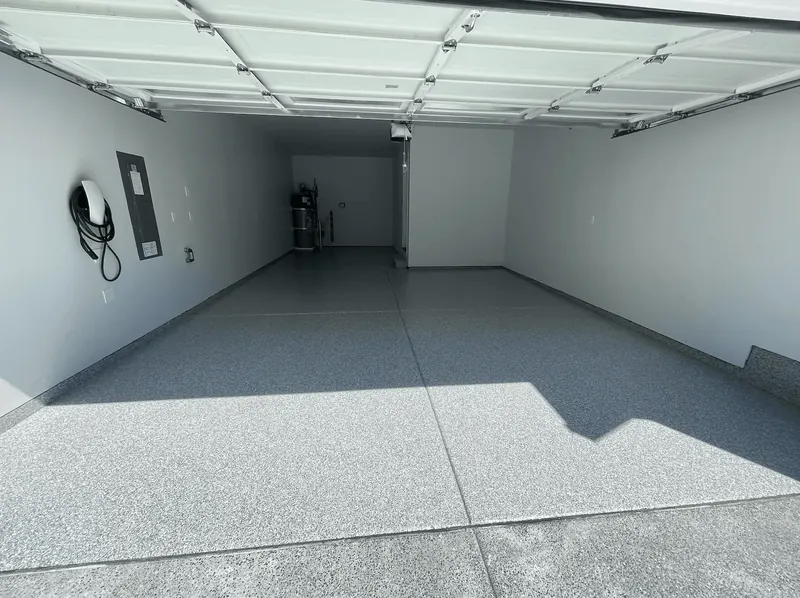
It can be, if the jobs are priced to carry your overhead and the leads come in steadily. A two-car garage sells for about $1,600–5,800 installed, with materials about $1–5 a square foot of that. The usual trouble spots for a new coating business are pricing, lead flow and job systems, which is what this school focuses on.
How much can I make with an epoxy flooring business?
Nobody can promise you an income, and we don’t. Revenue depends on your market, your prices, your costs and how many jobs you close, and profit is what’s left after all of them. The earnings disclaimer explains how we handle income figures.
How long does it take to learn epoxy flooring?
Hands-on classes run one to five days. Most of the skill comes from your first jobs, so plan a few practice floors before you charge full price.
Can I start epoxy flooring as a side business?
It can work, especially with residential garages, which usually take a day or two. Rent the equipment per job, insure before the first one, and price as if it were your full-time work: your costs don’t shrink because your hours do. More in epoxy flooring as a side business.
Should I buy a franchise or dealership instead?
Franchises and dealerships sell a brand, a product line and sometimes a territory; the garage-floor franchises cost five figures and up. Going independent costs less up front, and you build your own brand and buy materials where you choose.
How much does an epoxy flooring franchise cost?
Among five garage and concrete-coating franchises, initial franchise fees run from $38,500 (a GarageExperts micro-territory) to $69,950 (Concrete Craft’s franchise and territory fees together), and the total initial investment from $132,900 (the low end of Garage Force’s range) to $246,400 (the high end of GarageExperts’). After opening, royalties of 4–7% of revenue and brand or marketing fund fees of 1–2% are the norm. The full comparison.
When do I get a franchise disclosure document?
The FTC’s Franchise Rule requires that you receive it at least 14 days before you sign a contract or pay any money. Items 5 through 7 set out the initial fee, the other fees and the total initial investment; Item 19, if the franchisor includes one, makes claims about sales or earnings; Item 20 lists current and former franchisees you can call.
What is the difference between a dealer program and a franchise?
A franchise licenses a brand and an operating system for fees, usually including a royalty on your revenue. A dealer program ties you to a manufacturer’s products: you buy and install them, and the manufacturer trains you and backs the product. Most coating dealer programs charge no franchise fee or royalty, but they expect you to use their products. Under the FTC’s rule, what a program is called doesn’t decide whether it’s legally a franchise.
How much does it cost to become an epoxy flooring dealer?
It varies widely. CTi’s packages run $9,995–39,995; Floor Shield asks for a non-refundable $10,000 initial deposit and $50,000–75,000 in the first year; GarageFloorCoating.com asks for $55,000–75,000 to invest; Concrete Coatings, Inc. charges $500 for its two-day class for up to two people. Penntek and FloorTek discuss costs during their application process. The full comparison.
Is it cheaper to rent or buy a floor grinder?
Renting a 22-inch dual-disc grinder runs about $90–142 a day, and a new one is $8,488. At those rates buying pays off after roughly 60–95 rental days, before you count tooling, maintenance and resale value.
What insurance does an epoxy flooring business need?
General liability before the first job; for a flooring installer it typically runs about $77 a month. Add workers' compensation when you hire, commercial auto if you use a vehicle for the business, and tools and equipment cover once you own the grinder.
What equipment do I need to add floor coatings?
A floor grinder and a HEPA dust extractor (rent them at first), diamond tooling, an edge grinder kit, moisture tests, application tools and respirators. The equipment list prices each one, and the startup cost calculator adds them up.
Can I take customers with me from my old employer?
Have a lawyer read any non-compete, non-solicitation or confidentiality agreement you signed before you contact customers you met through your employer. Whether and how it applies depends on your state and on the agreement’s wording.
How should I price my first jobs on my own?
From your full costs, not your old day rate: materials, your labor and a helper’s, the truck, insurance, marketing and a share for estimates that don’t close. Then check the result against what floors sell for near you. The job pricing calculator does the arithmetic.
Can a painter do epoxy floors?
Yes, with training. Prep discipline, estimating and customer habits carry over. What’s new is diamond grinding to the profile the data sheet calls for, moisture testing, and two-part chemistry with a fixed working time. Learn the steps from the recordings and practice them in a hands-on class before your first coating job.
Will my current insurance cover epoxy floor work?
Ask your agent before your first coating job. Policies are written for the work you described when you bought them, so tell your insurer you’re adding floor coatings and update the policy if it doesn’t cover them.
Why am I busy but not making money?
Start with pricing. Check that your overhead is in your price, that you have a minimum job, that multi-visit systems are priced per visit, and that discounts follow a rule. Then check what a booked job costs you in leads, by channel.
How do I know what a lead really costs?
Divide the cost per lead by your close rate. At $55 a lead and one job closed for every five leads, a booked job costs $275 in lead spend before any other marketing. The lead cost calculator does it by channel.
When should I hire my first helper?
When the jobs you turn down, or the estimates you can’t get to, are worth more than a helper costs. Budget for workers’ compensation once you have employees; for a flooring business it typically runs about $144 a month.
08
Tools and text messages
The free tools, why we ask for a mobile number, and how texting works.
Are the calculators and templates free?
Yes. The calculators, the templates and the guides are free to use.
Do I have to give my number to use the tools?
For most of them, no. The startup cost calculator asks for a mobile number before it shows your total, so it can text you a copy. The guides are open to everyone.
Why do you ask for a mobile number instead of an email?
Because we follow up by text. The startup cost calculator texts you your estimate, and the class waitlist texts you when a class opens in your state. Email is always optional.
What texts will I get if I sign up?
Messages about what you asked for, such as your estimate or a class opening in your state, and, if you tick the consent box, messages about our classes, online course and tools. Message frequency varies. Message and data rates may apply. Consent isn’t a condition of any purchase. The SMS terms have the details.
How do I stop the text messages?
Reply STOP to any message and you’ll get one text confirming you’re unsubscribed, then no more. Reply HELP for help.
Do you sell or share my phone number?
No. We don’t sell personal information, and mobile numbers and text opt-in data aren’t shared with third parties for their marketing. Our privacy policy explains who we share information with and why.
How do I report an error on a page?
Use the contact form and choose “A correction”. Tell us the page and what’s wrong. We check every report and fix confirmed errors.
Still deciding?
Talk it through with an owner
A one-on-one call with someone who runs a coating company, to plan your start and pick the right class.