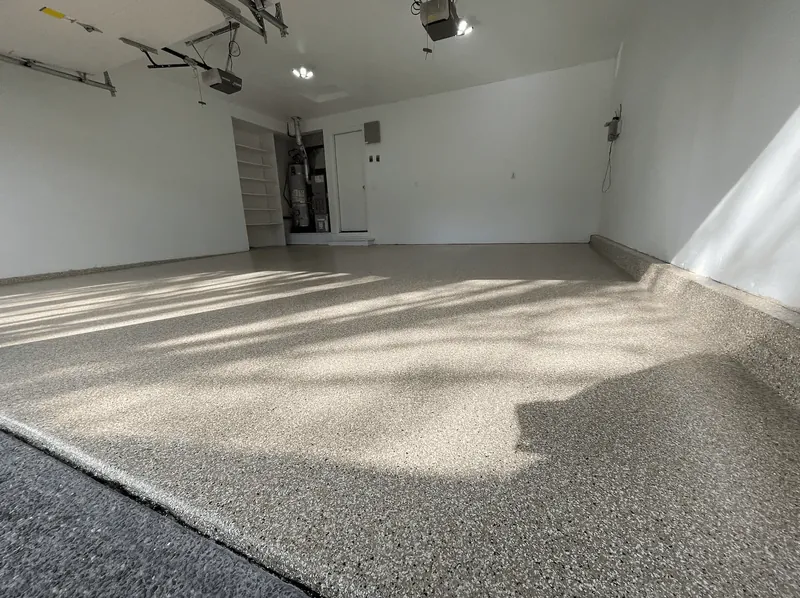
Flake floor installation, step by step
Every layer, coverage rate and cure time for a full-broadcast garage floor.
Class type
Garage floor coating training teaches the flake system: a tinted base coat, vinyl flake broadcast until the base won’t take any more, and a clear top coat, often polyaspartic. A good class puts you on real concrete for all of it, from the moisture test to the cure.
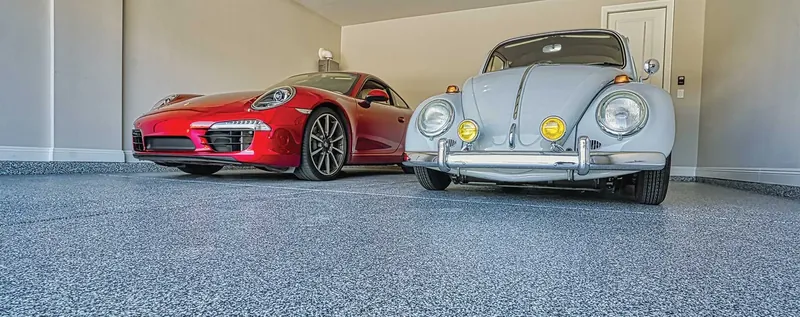
What to expect from a good class
Eight blocks, in the order the work happens on a real garage. Use the list to judge any class, ours or anyone else’s.
Calcium chloride (ASTM F1869) or in-slab RH (ASTM F2170) tests placed days ahead. Standard systems allow about 3 lb per 1,000 sq ft per 24 hours, or 75–80% RH; above that, a moisture-vapor-barrier primer.
Diamond grinding to CSP 3 or more, with the grinder on a HEPA dust extractor. Old coatings that aren’t epoxy come off completely.
Hand grinder and shroud along the walls, cracks and spalls filled flush, and a plan for joints and the edge at the garage door.
A thin, tight primer applied as the slab cools, so air leaving the concrete doesn’t come up through the floor as outgassing bubbles.
Tinted to the flake, mixed in small batches, pulled out with a notched squeegee at the data sheet’s rate and back-rolled.
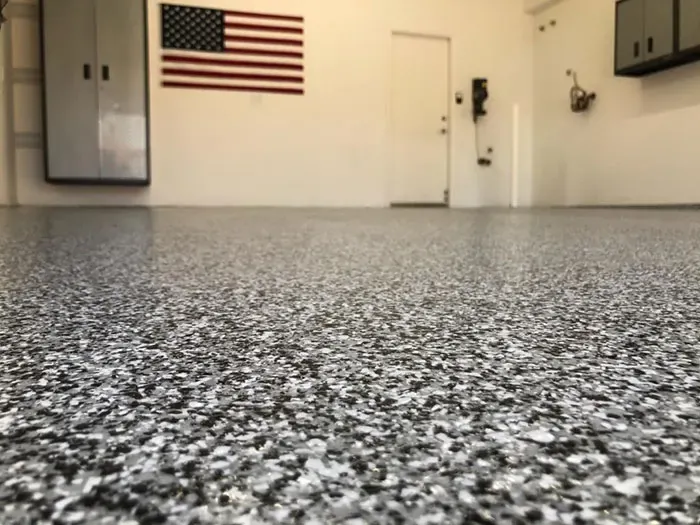
Flake thrown high and loose until the base won’t take more: about 5–7 sq ft per pound, or 63–88 lb for a 440 sq ft two-car garage.
Scrape and vacuum, then a clear coat inside the recoat window: within 24 hours of an epoxy base. Polyaspartic working time drops as humidity rises.
Cove base where it’s sold, then foot and vehicle traffic times by temperature and humidity, so the customer knows when the garage is back.
Ask what you’ll do yourself. Some classes teach grinding without letting students grind, because grinding a floor takes hours and the practice floor has to stay intact for the coating work. That’s a fair trade-off. Just know before you book whether you’ll run the grinder, mix the base and throw the flake, or watch someone else do it.
Systems
Garage flake floors are built with an epoxy base or a fast-cure polyaspartic one. The base changes the schedule and how fast you have to work, so train on the one you’ll sell.
| Step | Epoxy base, polyaspartic top coat | One-day polyaspartic |
|---|---|---|
| Primer | Clear 100%-solids epoxy, 3–8 mils | None |
| Base coat | Pigmented 100%-solids epoxy, 8–12 mils | Fast-cure polyaspartic, 8–12 mils |
| Broadcast | After the base levels for 10–15 minutes | Immediately, before the surface skins over |
| Working time at 72°F | Slow-cure polyaspartic top coat: about 70 minutes at 20% humidity, 28 at 80% | Fast-cure base: about 25 minutes at 20% humidity, 14 at 80% |
| Top coat | Slow-cure polyaspartic within 24 hours of the base | Polyaspartic, the same day |
| Two-car garage | Two to three working days | One day |
Figures from one complete professional system; follow the system guide for the products you buy.
With 14–25 minutes of working time per batch on a fast-cure base, the broadcast has to keep pace with the squeegee, so practice it before a customer’s floor. The epoxy route gives you more time per batch and asks for more patience between coats. The full step-by-step for both is in flake floor installation, and the resins are compared in polyaspartic vs epoxy.
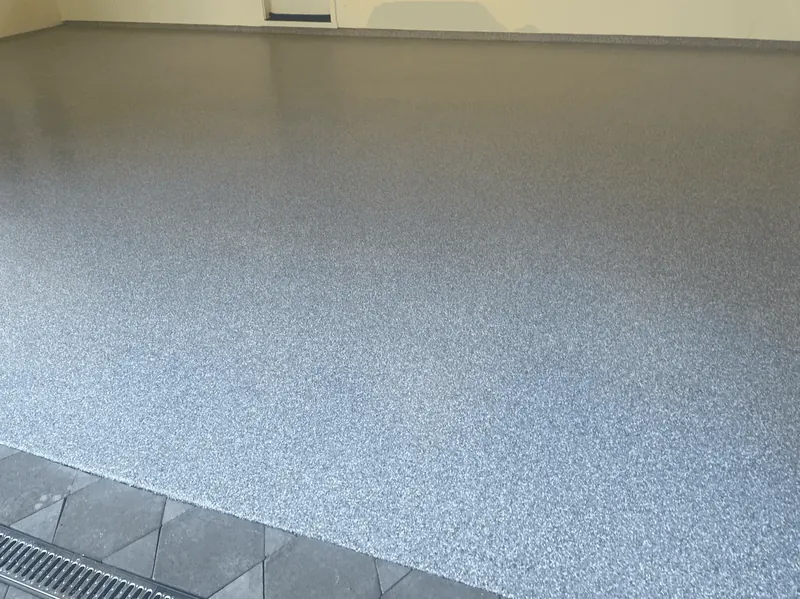
Base, flake to refusal, clear top coat.
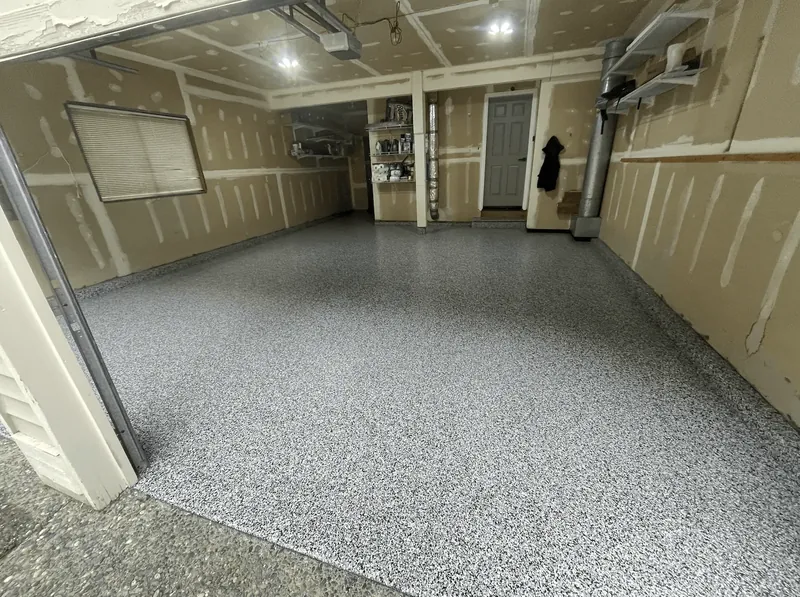
Same system, base tinted to the blend.
Compare
16 providers in 19 states run hands-on classes that list flake systems. We list them so you can compare; it isn’t an endorsement or a partnership.
| Provider | Where | Length | Published price | What the class covers |
|---|---|---|---|---|
| One Stop Epoxy | Orlando, FL | 2 days | $495 | Materials and lunch included; each student builds a full flake floor and a metallic floor; covers pricing jobs and material costs |
| ResinForce (CleanPro Supply) | Cincinnati, OH; Rochester and Buffalo, NY; Indianapolis, IN; Jacksonville, FL | 2 days | $500 ($400 each for 2 or more) | Travelling class: prep, grinding and shot blasting, metallic, flake, quartz and grind-and-seal systems; meals included |
| Epoxy Depot | Supplier stores in FL (Jacksonville, Tampa), TX (Fort Worth), OH (Bowling Green), NC (Charlotte, Raleigh/Durham), TN (Nashville), IL (Joliet, the Chicago-area store), PA (Lebanon), MD (Baltimore), SC (Duncan) and more | 2–3 days (Intro to Epoxy) | About $750 where posted; varies by store | Intro class covers surface prep, crack filling, flake, solid and metallic; Advanced Metallics follows it |
| Xtreme Polishing Systems (Polished Concrete University) | Pompano Beach and Orlando, FL; Euless (Dallas–Fort Worth), TX; Los Angeles, CA; Las Vegas, NV; Oklahoma City, OK; Cedar Rapids, IA; Milwaukee, WI | 5 days (3 days in Los Angeles and Oklahoma City) | $1,750 for 5 days; $1,350 for 3 days; 15% off extra attendees | Prep, concrete testing, cove base, metallic, flake, quartz; a 5-day class in Spanish in Pompano Beach; a 2-day Stardek pool-deck class ($900) |
| XPS New York City (FlooringClasses.com) | Garfield, NJ | 3 days, monthly | $1,500 | Moisture testing, prep, epoxy and polyaspartic, flake and metallic, bidding and lead generation |
| Epoxy Classes NY | Johnstown, NY | 3 days (Friday to Sunday) | $1,400 ($700 deposit) | Prep and grinding, metallic, flake and quartz, business and marketing; interest-free financing offered |
| U.S. Resin Supply | Los Angeles, Anaheim, Sacramento, San Jose and Visalia, CA; Las Vegas, NV; Montgomery, IL; Fort Lauderdale, FL | 2 days (Intro to Epoxy); shorter system classes | $499–999 for the 2-day intro | Supplier stores; materials and lunch included; dates are posted city by city |
| E2U | Phoenix, AZ; Anaheim and Rancho Cordova, CA | 1 day | $150–299 by location | Garage floor systems: prep, mixing, product selection and application |
| FloorRescue Academy | Dallas, TX (plus travelling classes) | 3–4 days | Not published | Prep, repairs, metallic epoxy, polyaspartic and flake floors, polished and sealed concrete |
| New Era Epoxy Academy | Spring (Houston) and Austin, TX | 4 days | $1,899, materials included | Moisture testing and barriers, repairs, primers, metallic and flake, job pricing; taught in English and Spanish |
| Concrete Floor Shop | Houston, TX | 1 day | $200, lunch included | Flake and metallic epoxy class for installers and contractors only |
| Action Epoxy Training | Fort Worth, TX | 1 day | $250, paid at the door | Garage flake systems, metallic, prep and crack repair, estimating and bidding |
| Versatile Building Products | Lewisville (Dallas area), TX | 1 day, first Saturday monthly | $99 | Prep and patching, flake in three sizes, metallic and brindle flake, with the maker's epoxy and polyaspartic |
| Platinum Concrete Coatings of Texas | Katy (Houston area), TX | 1–2 days | $150 | Epoxy, polyurea, flake and overlay classes with the products it sells |
| Paradise Concrete Solutions | Location set per class | 1 day | $200 | Contractors only; prep, crack repair, grinding, and flake, quartz and metallic sample boards |
| Integrity Garage Floors | Kent, WA | 3 days, monthly | $950 | Two field days installing two full garage floors, one business day |
Dates and prices change, so confirm with the provider before you book. Every class in every state is in the class finder.
Coating manufacturers train dealers on their own garage systems, usually as part of signing on: Penntek dealers, for example, complete a two-day, hands-on certified installation class. Epoxy dealer programs compared.
Most of the garage classes listed here are run by supply stores that sell the coatings; the rest by manufacturers and independent schools. How they differ on price, length and product ties: supplier classes vs independent schools.
Before you book
Epoxy Business School
The Epoxy Playbook comes first. The Epoxy Playbook is recorded hands-on installation training: full installations on video, start to finish, that you can pause and replay as often as you need, plus the business side. It’s required before the hands-on class, so you arrive knowing every step of a garage floor.
Then two days on the slab with a partner trainer, an installer who does this work every week:
You leave with a certificate of completion (what it means) and the recordings to replay before your first paid garage. The full outline is in the two-day class standard.
Classes aren’t scheduled yet. Tell us your state and we’ll text you when one opens near you.
Read before your class
Every layer, coverage rate and cure time for a full-broadcast garage floor.
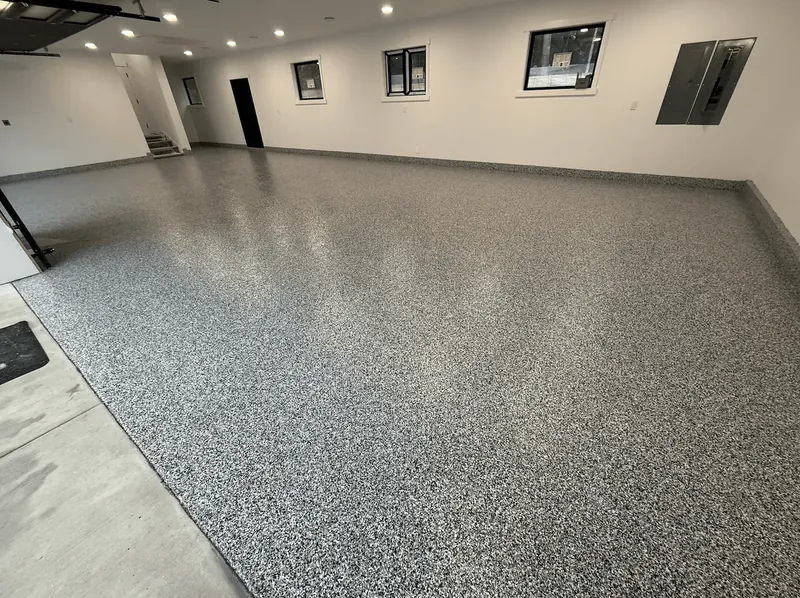
Working time, cure speed, UV stability and cost, and the systems that use both.
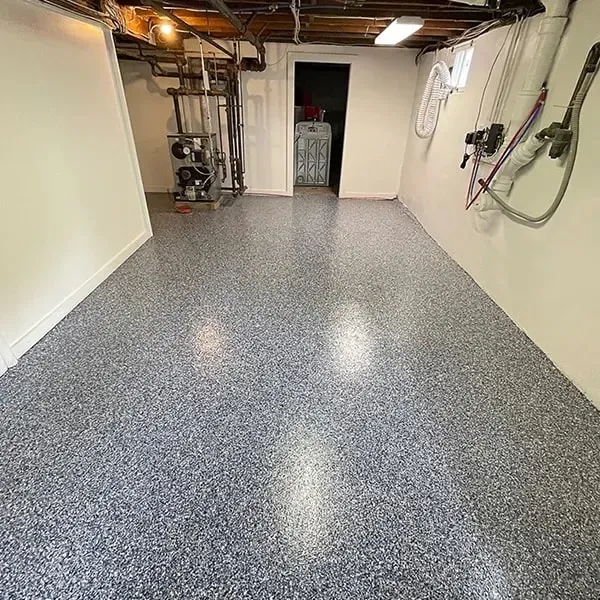
Calcium chloride and in-slab RH tests: how to place them, read them and act on them.
The CSP scale, the profile flake systems need, and how grinding gets you there.
Delamination, hot tire pickup, bubbles and uneven flake, with the causes behind them.
Pounds and boxes of flake for any floor size and broadcast rate.
Questions
The whole floor, in order: moisture testing, grinding to the profile on the data sheet, edges and repairs, primer, a base coat tinted to the flake, a full flake broadcast, scraping, and a clear top coat, often polyaspartic. A good class also covers cove base and how long the floor needs before foot traffic and vehicles.
The classes on this page run one to five days. Longer classes leave time to prep a slab and install a full floor yourself. Most of the skill still comes from your first jobs, so plan a few practice floors before you charge full price.
Published prices for the classes on this page run from $99 for a one-day class to $1,899 for a four-day course, and several include materials. Add travel, lodging and time off work. See the class list for each provider’s price.
Several of the classes on this page list polyaspartic and polyurea coatings and one-day flake systems alongside epoxy. Ask which base and top coat you’ll install, and whether you’ll apply them yourself or watch a demonstration.
You can learn every step online: The Epoxy Playbook records full installations start to finish, so you can watch, pause and replay each one. What a recording can’t give you is the feel of the grinder and the squeegee on real concrete, which is what the hands-on class is for.
Yes, it’s required. You learn every step from the recordings first, so your two days on the slab go to doing the work rather than watching demonstrations.
It depends on the state, and sometimes on the size of the job. Check your state's contractor licensing board before you quote your first floor. Our license requirements by state page summarizes each state.
The Epoxy Playbook: full installations recorded start to finish, which you can replay as often as you need, plus pricing, quoting and selling the job.