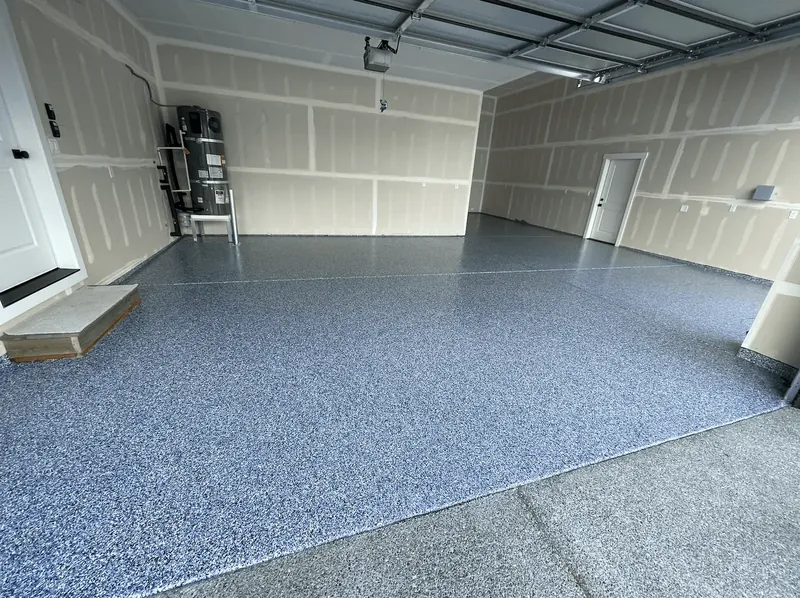
Key takeaways
- Georgia has no state license for floor coating: painting and special coatings is a specialty trade outside the residential and general contractor licenses, as long as the job stays within it.
- Your city or county issues the business license, called an occupation tax certificate, and you need a state sales tax number before you can get one.
- A Georgia LLC costs $110 to form and $60 a year, with the annual registration due between January 1 and April 1.
- Workers' comp starts at three regular employees, part-time included, and LLC members count toward the three even if they opt out of coverage.
- Morning humidity averages 86–91% in July and August in Atlanta, Athens, Macon and Savannah, so check the slab against the dew point before every coat.
On paper, Georgia is one of the simplest states to start a coating business in: no state license for coating work, a $110 LLC, and workers’ comp that starts at three employees. The paperwork that does apply is local, and the hard part is the air. Georgia summers keep the dew point close to the slab for months.
Do you need a license for epoxy floors in Georgia?
Not a state license, as long as the job stays coating work. Georgia’s State Licensing Board for Residential and General Contractors licenses residential and general contractors, and it treats painting and special coatings as a traditional specialty trade outside those licenses. A specialty contractor working within the specialty doesn’t need either one.
The line is the scope of the job. Coating a garage, a basement or a shop floor is specialty work. Once a job grows into other construction, such as rebuilding steps, framing a wall or finishing a garage conversion, and that work runs over $2,500, the residential or general contractor license applies. If you want to offer that work, get licensed or bring in a licensed contractor for it.
The local license: an occupation tax certificate
Without a state license, the license that matters is local. Georgia cities and counties levy an occupation tax and issue an occupation tax certificate, usually charged on gross receipts, to businesses located within their limits. Atlanta requires one for every business operating inside the city limits. Gwinnett County issues them for businesses in unincorporated Gwinnett and sends businesses inside a city’s limits to that city. You get yours where your business is located, and you need a state sales tax number first.
Sales tax and out-of-state contractors
Every Georgia contractor registers for a sales and use tax number through the Georgia Tax Center. Georgia treats you as the consumer of the materials you install, so you pay sales tax on coatings, flake and supplies when you buy them.
Installers based in South Carolina, Tennessee, Alabama or Florida who cross the line for jobs count as nonresident contractors until they’ve had an established Georgia business location for a year. A nonresident contractor files a bond with the Department of Revenue for 10% of any contract over $10,000. Resident contractors don’t.
Setting up the business: LLC, annual registration and workers’ comp
Forming an LLC costs $110 with the Secretary of State: $100 plus a $10 service charge. Every year after that, the LLC files an annual registration for $60 between January 1 and April 1; file late and you add a $25 penalty.
Workers’ comp is required once you regularly employ three people, full- or part-time; regular weekend and seasonal workers count. In an LLC, the members count toward the three, and up to five members or officers can reject coverage for themselves on Form WC-10 but still count. Sole proprietors and partners are treated as employers, not employees, so they don’t count themselves, and they can choose to be covered. A two-member LLC with one regular weekend helper needs a policy.
Safety is federal in Georgia. The state has no OSHA plan for private employers, so federal OSHA enforces the silica rules that apply when you grind concrete. A shroud and a HEPA dust extractor belong in the starting kit; see dust extractors and silica rules.
Heat, humidity and storms: installing in Georgia
Georgia’s limit is humidity more than heat. The rule on the data sheets is the same everywhere: keep the slab at least 5°F above the dew point before, during and after you coat. Here’s what Georgia’s cities work against:
| City | Normal July high | Normal July low | Average morning humidity, July–August | Normal January low |
|---|---|---|---|---|
| Atlanta | 90.1°F | 71.8°F | 86–87% | 35.6°F |
| Athens | 92.0°F | 70.0°F | 88–90% | 33.8°F |
| Macon | 93.5°F | 71.5°F | 88–91% | 35.9°F |
| Savannah | 92.3°F | 73.7°F | 87–90% | 40.0°F |
On a muggy day, with 80°F air at 80% humidity, the dew point is 73°F, so the slab must be at least 78°F. Slabs lag the air. A garage floor that cooled overnight can sit near the dew point after sunrise, and when you open the door, warm, wet air condenses on it. You won’t see the film, but it can ruin the bond. What that means on the job:
- Measure the slab with an infrared thermometer and check the dew point before you mix, not after.
- Keep the door closed until the slab is safe, and run a dehumidifier in the space the night before if the forecast is wet.
- Polyaspartic cures with moisture from the air: a slow-cure polyaspartic that gives about 70 minutes of working time at 20% humidity gives only about 28 minutes at 80%. In a Georgia summer, mix smaller batches.
- Do the base coat and broadcast in the morning and keep the door shut through afternoon thunderstorms, which can push the dew point up within minutes.
- Heat shortens pot life too. Atlanta has about 14 days of 90°F or hotter in a normal August, so keep kits out of the truck and out of the sun.
Winters are short but real. Atlanta’s normal January low is 35.6°F and Athens’s is 33.8°F, and the north Georgia mountains run colder. Cold slows the cure, and slabs at 55°F or lower dry slowly and bond poorly, so keep the floor at 60°F or more for two days before you coat, using electric or vented indirect heat. Never use an unvented propane heater: it adds moisture and carbon dioxide and causes amine blush. The guide to cure time, temperature and humidity has the details.
Where the work is in Georgia
Georgia had 11,302,748 residents on July 1, 2025, and added 98,540 that year, the fourth-largest gain of any state. Metro Atlanta took the biggest share: it added 61,953 people, third among the country’s metros behind Houston and Dallas–Fort Worth.
The fastest growth is on Atlanta’s edges and near the coast. Jackson County, northeast of Atlanta, grew 5.3% in a year and Dawson County, in the north Georgia foothills, 4.2%; Long County, southwest of Savannah, grew 5.2%. All three were among the ten fastest-growing counties in the country. For a garage-floor business, that points to the outer suburbs, where new homes are going up, alongside the established northern suburbs: Alpharetta, Roswell, Johns Creek, Marietta and Lawrenceville. Outside metro Atlanta, Savannah, Augusta, Columbus, Macon and Athens are the markets.
Where to take an epoxy class in and near Georgia
Blessed By Chris Academy, run by an Atlanta coating company, holds a four-day hands-on epoxy and resin flooring class in Atlanta that covers installation, metallic epoxy, pricing and marketing. It’s the only Georgia class we list. Supplier classes run within a few hours’ drive:
| Class | Where | Length | Price |
|---|---|---|---|
| Blessed By Chris Academy | Atlanta | 4 days | See provider |
| Epoxy Depot Intro to Epoxy | Duncan, SC; Charlotte, NC | 3 days | Ask the store |
| Epoxy Depot Intro to Epoxy | Nashville, TN | 2–3 days | Ask the store |
| ResinForce (CleanPro Supply) | Jacksonville, FL | 2 days | $500 |
| One Stop Epoxy | Orlando, FL | 2 days | $495 |
Duncan, near Spartanburg, is the closest supplier class to north Georgia; Jacksonville is the closest to Savannah and south Georgia.
Epoxy Business School classes in Georgia
Epoxy Business School hasn’t scheduled a Georgia class yet. Classes open state by state with partner trainers who install floors for a living, in the states where enough people ask. Before the two days on the slab, students complete The Epoxy Playbook: recorded hands-on training that shows full installations start to finish, from prep, grinding and repairs to base coats, flake broadcast and top coats, with the business side on top. Replay any step as often as you need, before and after class. Leave your number below and we’ll text you when a Georgia class is set; if you also work in the Carolinas or Tennessee, the license requirements by state cover those rules.
Classes in and near Georgia
Listed so you can compare; not an endorsement or a partnership. Confirm dates and prices with the provider before you book.
| Provider | Where | Format | Price | Notes |
|---|---|---|---|---|
| Blessed By Chris Academy | Atlanta | 4 days, hands-on | See provider | Run by an Atlanta coating company: installation, metallic epoxy, pricing and marketing. |
| Epoxy Depot | Duncan, SC | 3 days (Intro to Epoxy) | $699 | Prep, crack filling, flake, solid color and metallic; materials included. Next class November 12–14, 2026. |
| Epoxy Depot | Charlotte, NC | 3 days (Intro to Epoxy) | $695 | Same intro class. Next class November 19–21, 2026. |
| Epoxy Depot | Nashville, TN | 2–3 days (Intro to Epoxy) | Ask the store | Materials and lunch included, certificate of completion. The store lists a two-day class; the chain's schedule shows three-day dates, so confirm the length. |
| ResinForce (CleanPro Supply) | Jacksonville, FL | 2 days | $500 ($400 each for 2 or more) | Jacksonville date not set yet. Prep, metallic, flake, quartz and grind-and-seal systems. |
| One Stop Epoxy | Orlando, FL | 2 days | $495 | Each student builds a flake floor and a metallic floor; materials and lunch included. |
Cities in Georgia
- Atlanta
- Savannah
- Augusta
- Columbus
- Macon
- Athens
- Sandy Springs
- Roswell
- Alpharetta
- Marietta
- Johns Creek
- Lawrenceville
Questions
Do I need a license to install epoxy floors in Georgia?
Not a state license for coating work alone. Georgia treats painting and special coatings as a specialty trade, outside the residential and general contractor licenses. You still need your city or county's occupation tax certificate, and a residential or general contractor license if a job grows into other construction work over $2,500.
What is an occupation tax certificate in Georgia?
Georgia's local business license. The city or county where your business is located issues it, usually charging a tax based on gross receipts, and Atlanta requires one for every business operating inside the city limits. You need a state sales tax number before the certificate can be issued.
How much does it cost to start an LLC in Georgia?
$110 to file ($100 plus a $10 service charge), then a $60 annual registration every year between January 1 and April 1. A late registration adds a $25 penalty.
Can you install epoxy floors in Georgia in the summer?
Yes, with dew point checks. Summer mornings average 86–91% humidity in the state's main cities, and a slab that cooled overnight can sit close to the dew point. Keep the slab at least 5°F above it, mix polyaspartic in smaller batches, and finish coats before the afternoon storms.
Where is the nearest epoxy flooring class to Atlanta?
Blessed By Chris Academy runs a four-day hands-on class in Atlanta. Supplier classes run in Duncan, South Carolina, and in Charlotte, Nashville, Jacksonville and Orlando. Epoxy Business School's two-day class opens in Georgia when enough people ask; leave your number on this page.
Keep reading
License requirements by state
North Carolina
Tennessee
Florida
Epoxy cure time: how temperature, humidity and dew point change it
Epoxy and polyaspartic cure times from real data sheets: pot life, recoat windows, foot and vehicle traffic, the 5°F dew point rule, and cold-weather planning.
How to start an epoxy flooring business
Start an epoxy flooring business step by step: training, LLC, insurance, equipment to rent or buy, pricing and first jobs, with published prices.