Key takeaways
- At 72°F and 50% humidity, a standard-cure 100%-solids epoxy base coat gives about 20–25 minutes of working time, an 8–24-hour recoat window, light foot traffic at about 10 hours, heavy traffic at 2 days and full cure at about 5 days.
- Polyaspartic cures with moisture from the air: a slow-cure version gives about 70 minutes of working time at 20% humidity but only about 28 minutes at 80%, and its traffic times assume at least 72°F and 50% humidity.
- Keep the slab at least 5°F above the dew point before, during and after application; at 70°F and 60% humidity the dew point is 55°F, so the slab must be at least 60°F.
- Heat shortens pot life and working time; cold slows cure, and slabs at 55°F or below dry slowly and bond poorly.
- Don't heat a cold garage with salamander or torpedo heaters: they add moisture and carbon dioxide, which cause amine blush.
Epoxy floor coatings cure by chemical reaction, and temperature and humidity set the clock. A standard-cure 100%-solids epoxy base coat, for example, gives about 20–25 minutes of working time at 72°F and 50% humidity, has to be recoated between 8 and 24 hours, carries light foot traffic after about 10 hours and heavy traffic after 2 days, and reaches full cure in about 5 days. Warmer conditions shorten every one of those numbers, colder ones stretch them, and through all of it the slab has to stay at least 5°F above the dew point.
This article defines the terms on a data sheet, compares a real epoxy and a real polyaspartic, and shows how to plan for cold, heat and humidity, and how to measure them on the job. It’s part of the installation side of starting an epoxy flooring business.
The terms on a data sheet
| Term | What it means |
|---|---|
| Pot life | How long mixed material stays usable in the container. A 100%-solids epoxy gives about 30–40 minutes; water- or solvent-borne epoxies stretch to about two hours. |
| Working time | How long it can be spread, rolled and leveled once on the floor. Some data sheets list this “work time” instead of pot life. |
| Tack free | When the surface no longer feels sticky. |
| Recoat window | The minimum time before the next coat, and the maximum after which the surface must be sanded first. |
| Light foot traffic | When people can walk on it carefully. |
| Heavy traffic | When it can take carts, equipment or vehicles: the return to service for a garage. |
| Full cure | When the film reaches its final hardness and chemical resistance; see cure time. |
Mixed epoxy left in the bucket heats itself up. The mass accelerates the reaction until the container can get very hot and even start to smoke. That’s why data sheets tell you to pour it out onto the floor right away.
Cure times for a real epoxy and a real polyaspartic
100%-solids epoxy base coat (Simiron 1100SL) at 72°F (25°C) and 50% relative humidity:
| Slow | Standard | Fast | |
|---|---|---|---|
| Work time | 35–40 min | 20–25 min | 12–17 min |
| Tack free | 7 hr | 5.5 hr | 3 hr |
| Light foot traffic | 16 hr | 10 hr | 6 hr |
| Heavy traffic | 2 days | 2 days | 2 days |
| Full cure | 5 days | 5 days | 5 days |
| Minimum recoat | 14 hr | 8 hr | 5 hr |
| Maximum recoat | 24 hr | 24 hr | 24 hr |
Past the maximum recoat, the coating has to be sanded before the next coat.
Polyaspartic topcoat (Simiron Polyaspartic HS) at 72°F:
| Working time, 20% RH | Working time, 80% RH | Tack free, 80% RH | Foot traffic | Heavy traffic | |
|---|---|---|---|---|---|
| Extra slow | 2 hr | 70 min | 6.5 hr | 30–34 hr | 3 days |
| Slow | 70 min | 28 min | 3.75 hr | 17–20 hr | 24 hr |
| Medium | 32 min | 17 min | 90 min | 10–12 hr | 24 hr |
| Fast | 25 min | 14 min | 40 min | 4–6 hr | 24 hr |
The traffic times assume at least 72°F and at least 50% humidity; if either is lower during cure, expect them to stretch. A second coat goes on as soon as the first is tack free.
Two things stand out. Cure speed is a choice: the same product comes in versions for hot, humid and cool jobs, and picking the right one is part of planning. And polyaspartic is far more sensitive to humidity than epoxy: at 80% humidity the slow version’s working time drops from 70 to 28 minutes. Polyaspartic vs epoxy covers the chemistry behind that.
Temperature: air, surface and material
Data sheets set three separate ranges:
| Product | Air | Surface | Material |
|---|---|---|---|
| 100%-solids epoxy base (Simiron 1100SL) | 35–85°F | 35–85°F | 60–85°F; below 60°F, fast cure only |
| Polyaspartic topcoat (Simiron Polyaspartic HS) | 35–85°F | 35–85°F | 60–85°F; below 60°F, fast cure only |
| Complete flake system (Simiron SimFlake SB) | 60–85°F | 60–85°F | 60–85°F |
| Moisture-vapor-barrier primer (Simiron MVB) | 60–85°F | 60–85°F | 60–85°F; fast activator down to 50°F |
A system guide can be stricter than the individual products in it; when they differ, follow the stricter number.
The surface temperature is the one to watch, and it isn’t the air temperature. Measure the slab itself. Floors at 55°F or lower greatly slow the cure and can hurt the coating’s physical properties and adhesion, so keep the floor at 60°F or more for two days before application. Slabs or materials that are too cold, or too hot, also leave an “orange peel” texture; aim for a slab above 60°F with the material at 70–75°F.
Temperature also drives outgassing. A slab that’s warming pushes air out through the wet coating, so apply the first coat when the slab is at its warmest and starting to cool.
The dew point rule
The dew point is the temperature at which moisture in the air condenses into water. If the slab sits at or near it, a film of water forms on the concrete or the wet coating. The rule: keep the floor at least 5°F above the dew point before, during and after application, through the cure.
Worked examples from a standard dew point chart:
| Air temperature | Relative humidity | Dew point | Minimum slab temperature (dew point + 5°F) |
|---|---|---|---|
| 60°F | 80% | 54°F | 59°F |
| 70°F | 60% | 55°F | 60°F |
| 80°F | 80% | 73°F | 78°F |
| 90°F | 50% | 67°F | 72°F |
The third row is the trap: on a humid summer morning, a garage slab still cool from the night can sit below the minimum even though the air feels warm.
Humidity: blush for epoxy, speed for polyaspartic
Epoxy. Amine hardeners absorb moisture from the air and can react with water and carbon dioxide, especially in cold, humid conditions, forming amine blush: a greasy or milky film that can break the bond to the next coat. Dehumidifiers lower both the humidity and the dew point.
Polyaspartic. Moisture speeds it up. It cures faster with moisture in the air, and higher temperature and humidity both shorten pot life and working time. In hot or humid conditions, apply it by dip-and-roll from a pan with an 18-inch roller to buy working time. In very dry air, plan for longer traffic times.
Polyaspartic chemistry is less dependent on temperature than conventional two-component coatings, which helps in cool weather, but it doesn’t remove the data sheet’s limits: Simiron’s Polyaspartic HS, for example, still requires its fast-cure version below 60°F.
Cold-weather planning
- Choose the cure speed. Use the fast-cure versions below 60°F; some moisture-barrier primers with a fast activator work down to 50°F.
- Warm the space early. Bring the room to temperature at least two full days before application, and bring the containers to room temperature too. Cold resin is thick, hard to mix and slow to level.
- Use the right heat. Fuel-burning salamander and torpedo heaters put moisture and carbon dioxide into the room and cause blush, and fuel-burning heaters and engines in an enclosed space produce carbon monoxide. Use electric heat or vented indirect-fired heaters, and keep the heat on through the cure.
- Watch the overnight low. The slab has to stay inside the range and above the dew point through the cure, not just while you’re there.
- Extend the schedule. Below the data sheet’s test conditions, every time is longer. Tell the customer before they plan to park.
Hot-weather planning
- Mix smaller batches and pour them out at once; pot life and working time shrink as temperature rises.
- Keep resin out of the sun and the truck; materials should be at 60–85°F when you mix.
- Coat as the slab cools in the afternoon or evening, not as the sun hits it in the morning.
- Switch to slower cure versions when it’s hot or humid.
- Keep tie-ins short: don’t let more than 5–10 minutes pass between polyaspartic mixes.
How to measure on the job
- A digital thermo-hygrometer for air temperature and relative humidity.
- An infrared or contact surface thermometer for the slab, read in several spots: by the door, in the sun, in the coldest corner.
- A dew point chart, calculator or meter, then add 5°F for the minimum slab temperature.
- Readings logged before you start, before each coat, and at the end of the day.
- The product's data sheet on site, with its temperature ranges, recoat window and traffic times marked.
Record the readings with the job. If a floor blushes or peels, they’re what you and the manufacturer will look at first; why epoxy floors fail covers how temperature and humidity show up in failures. To plan how much material each coat takes at a given thickness, use the coverage calculator, and for the full sequence of a flake job see flake floor installation.
Watch the timing, then work to it. Knowing when a coat is ready for the next one is easier once you’ve seen it. In The Epoxy Playbook you watch the full installation, replay any step as often as you need, then do it on the slab in a hands-on class. The Playbook also covers how to put cure times and weather delays into your scope of work, so a cold snap doesn’t become a dispute.
Questions
How long does epoxy take to cure on a garage floor?
It depends on the product and the temperature. A 100%-solids epoxy base coat at 72°F and 50% humidity takes light foot traffic after about 6–16 hours depending on its cure speed, heavy traffic after about 2 days, and reaches full cure in about 5 days. A polyaspartic topcoat typically takes vehicles after 24 hours at 72°F or warmer and 50% humidity or more.
What temperature is too cold to apply epoxy?
Whatever the data sheet says, and it differs by product. Simiron's 1100SL epoxy, for example, is rated for air and surface temperatures of 35–85°F but requires its fast-cure version below 60°F, and its complete flake system calls for 60–85°F. Slabs at 55°F or lower greatly slow drying, so keep the floor at 60°F or more for two days before you start.
Does humidity affect epoxy cure?
Yes, in two different ways. For epoxy, high humidity and low temperature raise the risk of amine blush, a greasy film that weakens the bond of the next coat. Polyaspartic actually cures faster in humid air, which shortens working time; in dry air its traffic times get longer.
Can I use a propane heater to warm the garage before coating?
Not an unvented, fuel-burning one. Salamander and torpedo heaters add moisture and carbon dioxide to the room, which causes amine blush, and fuel-burning heaters and engines in an enclosed space put out carbon monoxide. Use electric or vented indirect heat, and start warming the space days before.
What is the dew point rule for epoxy?
The slab surface has to stay at least 5°F above the dew point, the temperature at which moisture condenses out of the air, before and throughout application and cure. Measure air temperature and humidity, look up the dew point, and measure the slab itself.
Keep reading
Polyaspartic vs epoxy floor coatings: how they differ and when to use each
Polyaspartic vs epoxy compared from data sheets: chemistry, working time, cure speed, UV stability, temperature, odor and cost, and the systems that use both.
Why epoxy floors fail: causes, prevention and how to handle a callback
Why epoxy floors fail and how to prevent it: delamination, hot tire pickup, amine blush, bubbles, fisheyes, yellowing, uneven flake, edge peeling and cracks.
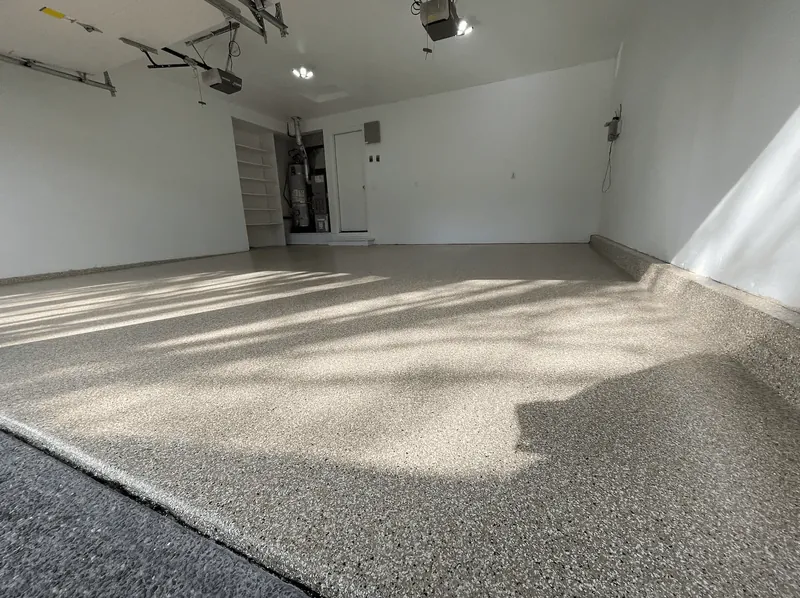
How to install a full-broadcast flake floor, step by step
Install a full-broadcast flake epoxy floor step by step: moisture test, grind to CSP 3, repairs, primer, base coat, flake at 5–7 sq ft per lb, topcoat and cure.