Epoxy dealer programs
Manufacturer programs: product, training and sometimes a territory, usually without franchise fees.
Compare
Compare training
A coating franchise sells you a brand, an operating system, training and a territory, for an upfront fee and a share of your revenue for as long as the agreement runs. Here's what five garage and concrete-coating franchises cost, what the independent route costs instead, and five years of fees worked out side by side.
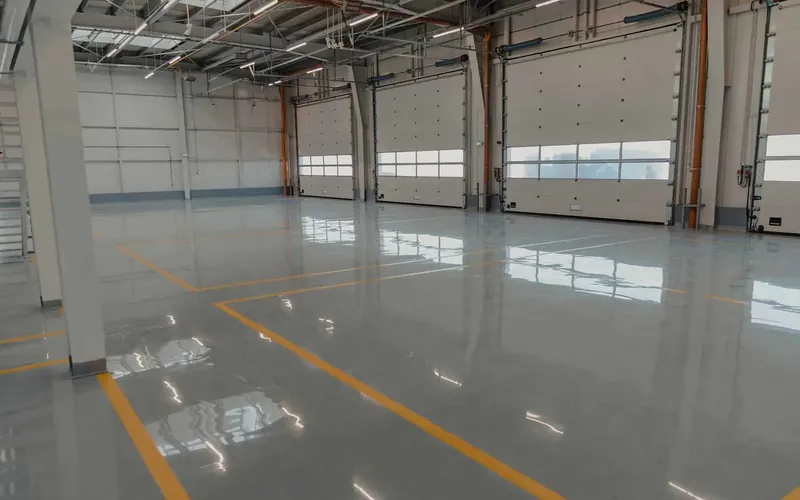
An epoxy flooring franchise, a garage floor coating franchise or any floor coating franchise is a license to run a business under someone else's brand and system. Under the FTC's Franchise Rule (16 CFR 436.1(h)), a relationship is a franchise, whatever it's called, when you get the right to use the franchisor's trademark, the franchisor exerts significant control or gives significant assistance, and you make a required payment to it.
In exchange for the fees, coating franchises typically offer:
Going independent means building each of those yourself, at a much lower upfront cost. Dealer programs sit in between: a manufacturer's product line and training, usually without franchise fees (epoxy dealer programs compared).
The franchises
Garage and concrete-coating franchises, from each brand's Franchise Disclosure Document. They're here to compare, not to recommend or criticize any of them.
| Franchise | Disclosure year | Initial franchise fee | Total initial investment | Royalty | Brand or marketing fund | Other required fees or spend |
|---|---|---|---|---|---|---|
| Garage Force | 2026 | $49,500 | $132,900–200,600 | 5% of gross revenue | 1% branding fee, plus $1,000 a month for digital marketing | — |
| GarageExperts | 2026 | $54,900 ($38,500 for a micro-territory) | $136,300–246,400 | 6% of gross sales (5% above $750,000 a year, 4% above $1.5 million), with monthly minimums of $250–1,500 | 1.5% national advertising fund (minimum $100–500 a month) | Local advertising of at least 6% of gross sales |
| Granite Garage Floors | 2026 | $50,000 | About $150,000–222,000 | 6.5% of gross sales | 2% advertising fund | — |
| Garage Kings | 2024 | $60,000, plus a $7,500 training fee | $189,493–238,253 | 6% of weekly gross revenue | $1,000 at the start, then 2% to the brand development fund | Local marketing of the greater of $48,000 a year or 5% of gross revenue; a regional co-op of 1–2% if one is set up |
| Concrete Craft | 2024 | $19,950, plus a $50,000 territory fee | $156,330–233,450 (before office space) | The greater of a sliding 7% to 4% of monthly gross revenue, or $750 a month in year one and $1,500 after | The greater of 1% or $500 a month | Technology fee of $450 a month |
Franchise terms change from one disclosure to the next: Granite Garage Floors' earlier disclosure carried a $60,000 fee and a $199,000–400,000 total investment. Always read the current FDD, which the franchisor must give you before you sign.
What “total initial investment” includes. The Item 7 range covers far more than the fee: an equipment package, a vehicle, opening marketing, training travel and several months of working capital. Garage Force's includes a $65,000 equipment package and $10,000 of initial coating products; Concrete Craft's includes $10,000–48,000 for a vehicle and $30,000–50,000 of additional funds for the first three months.
Going independent
The default inputs of our startup cost calculator, each one a typical market price. Change any number in the calculator to match your plans.
| Item | Default | Typical range |
|---|---|---|
| Grinder rental, 6 jobs × 1 day × $120 | $720 | A 22" dual-disc grinder rents for about $90–142 a day |
| HEPA dust extractor (DE 110 class) | $1,900 | About $1,900–2,400 |
| Edge grinder kit | $660 | About $640–716 |
| Application tools | $300 | About $150–320 a kit |
| Safety gear for two | $200 | Respirators about $23–52 each |
| Moisture tests | $40 | $12–36 per calcium chloride test |
| Hands-on class | $700 | US classes run about $99–1,899 |
| LLC filing fee | $150 | $35–500 by state |
| General liability insurance, first year | $919 | Typical for a flooring installer |
| Paid leads, first 90 days: 20 × $55 | $1,100 | Google Local Services Ads, about $45–62 a lead |
| Materials fronted for one job: 450 sq ft × $2.50 | $1,125 | Materials about $1–5 per sq ft |
| Subtotal | $7,814 | |
| Contingency, 10% | $781 | |
| Total, renting the grinder | $8,595 |
Swap the $720 of rentals for a new dual-disc grinder ($8,488 plus $400 of tooling) and the total becomes $17,580; for a 20-inch planetary ($15,600 plus $280 of diamonds), $25,271. Both include the 10% contingency.
The calculator leaves out what franchise Item 7 totals usually include: a vehicle, a trailer, months of working capital and your own pay while you start. Add yours before you compare totals. What it shows is the size of the gap: the franchise fee alone, before any equipment, is several times the independent startup default.
The typical prices behind every default are on the calculator page. Prices change; confirm before you buy.
Worked example
Royalties and fund fees are a share of revenue, so they grow as the business does. To show the arithmetic, this example assumes $400,000 a year in revenue, flat for five years, under each franchise's fee structure.
An example, not a prediction. $400,000 a year is a round number chosen to show the math. It isn't a typical, expected or promised result for any franchise or independent business, and revenue isn't profit. See our earnings disclaimer.
| At $400,000 a year | Garage Force | GarageExperts | Granite Garage Floors | Garage Kings | Independent |
|---|---|---|---|---|---|
| Upfront fees | $49,500$49,500 fee | $54,900$54,900 fee | $50,000$50,000 fee | $68,500$60,000 fee + $7,500 training + $1,000 fund | $0 |
| Royalty a year | $20,0005% × $400,000 | $24,0006% × $400,000 | $26,0006.5% × $400,000 | $24,0006% × $400,000 | $0 |
| Brand or marketing fund a year | $16,0001% + $1,000 × 12 | $6,0001.5% | $8,0002% | $8,0002% | $0 |
| Fees a year | $36,000 | $30,000 | $34,000 | $32,000 | $0 |
| Fees over five years | $180,000$36,000 × 5 | $150,000$30,000 × 5 | $170,000$34,000 × 5 | $160,000$32,000 × 5 | $0 |
| Upfront plus five years | $229,500 | $204,900 | $220,000 | $228,500 | $0 |
Fees paid to the franchisor or its funds only. Not included: required local advertising (GarageExperts at least 6% of gross sales, $24,000 a year at this revenue; Garage Kings the greater of $48,000 or 5%), technology, renewal and transfer fees, and the rest of each Item 7 investment. Concrete Craft is left out because its royalty slides from 7% to 4% with revenue.
No franchise fee and no royalty, but the jobs still need marketing, training and systems. You choose the budget: the calculator's default spends $1,100 on leads in the first 90 days and $700 on a class. Over five years, your marketing spend is whatever you decide it's worth, and the brand you build is yours to keep or sell.
At $400,000 a year, every percentage point of fees is $4,000 a year, or $20,000 over five years. A franchise is worth its fees if the brand, the leads and the system add more than that to your revenue or take more than that out of your costs. Ask current franchisees whether they do.
Pros and cons
The installation and the systems are what you can learn: The Epoxy Playbook records full installations start to finish and teaches pricing, quoting, selling, warranties and hiring as the Seven Systems of a coating business, and the templates and calculators are free.
The rules
The FTC's Franchise Rule requires the franchisor to give you its Franchise Disclosure Document at least 14 days before you sign a contract or pay any money. Use the 14 days.
Call as many current and former franchisees as you can, and talk to an accountant and a lawyer before you sign. This page isn't legal or financial advice.
Where we fit
We're an independent school: recorded installation training and the business side online in The Epoxy Playbook, two-day hands-on classes with partner trainers, planning calls with someone who runs a coating company, and free tools and guides. No territory fee, no royalty and no product you have to buy. You run the business under your own name.
Manufacturer programs: product, training and sometimes a territory, usually without franchise fees.
Compare
The order to do it in, with typical prices for each step.
Read the guide
Videos, classes, courses, dealer programs and franchises.
Compare
Questions
Among five garage and concrete-coating franchises, initial franchise fees run from $38,500 (a GarageExperts micro-territory) to $69,950 (Concrete Craft’s franchise and territory fees together), and the total initial investment from $132,900 (the low end of Garage Force’s range) to $246,400 (the high end of GarageExperts’). After opening, royalties of 4–7% of revenue and brand or marketing fund fees of 1–2% are the norm. The full comparison.
Neither is better for everyone. A franchise sells a brand, an operating system, training, marketing and a territory, for upfront and ongoing fees. Going independent costs far less to start (the startup cost calculator’s default comes to $8,595 when you rent the grinder), but you build the brand, the systems and the lead flow yourself. Compare five years of fees, not just the first check.
The FTC’s Franchise Rule requires that you receive it at least 14 days before you sign a contract or pay any money. Items 5 through 7 set out the initial fee, the other fees and the total initial investment; Item 19, if the franchisor includes one, makes claims about sales or earnings; Item 20 lists current and former franchisees you can call.
A required amount you must spend on your own local marketing, on top of the fees you pay the franchisor. GarageExperts requires at least 6% of gross sales; Garage Kings, the greater of $48,000 a year or 5% of gross revenue.
Franchises and dealerships sell a brand, a product line and sometimes a territory; the garage-floor franchises cost five figures and up. Going independent costs less up front, and you build your own brand and buy materials where you choose.
Change any default in the startup cost calculator: rent or buy the grinder, your insurance, your first marketing.