Key takeaways
- A metallic floor is built in four layers over ground concrete: primer, a solid-color epoxy base, a thick clear epoxy coat carrying metallic pigment, and a clear topcoat.
- The metallic coat goes on at 30–48 mils, about 33–54 sq ft per gallon, with roughly 32 oz of pigment per 3 gallons of slow-cure epoxy.
- The look is made while the coat is wet, by back-rolling, swirling and other manipulation, and it keeps changing as the pigment flows and settles during cure.
- Metallic problems come down to timing and consistency: re-rolling after the epoxy starts to set, mixed batches, uneven thickness, outgassing and cold.
- The metallic layer alone takes about $1.36–2.18 of material per sq ft, against $0.27–0.40 for a flake base coat, which is one reason metallic floors cost more.
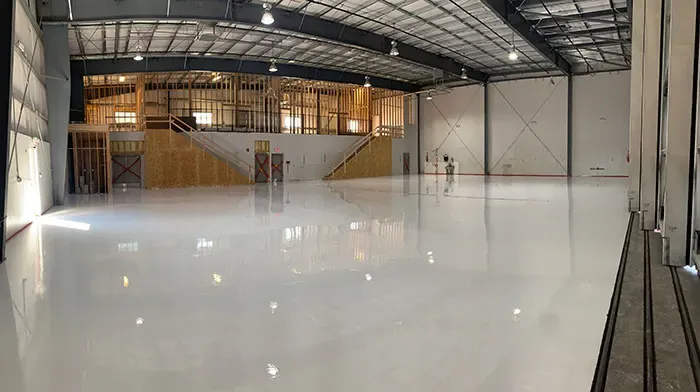
A metallic epoxy floor is a solid-color epoxy floor with one extra layer: a thick coat of clear epoxy carrying metallic pigment, spread and then worked by hand while it’s wet so the pigment forms swirls and depth, then sealed under a clear topcoat. That metallic coat goes on at 30–48 mils, against 8–12 mils for the base coat under it, which is why metallic floors use more material, take longer and cost more than flake floors.
The thicknesses, coverage rates and cure times below are for a complete professional system, Simiron’s SimFloor Metallic; other systems follow the same order with their own products and numbers. If you’re working out where decorative systems fit in a new business, start with how to start an epoxy flooring business.
The layers
| Layer | Product | Wet film | Coverage |
|---|---|---|---|
| Prepared concrete | Ground or shotblasted to CSP 3+ | — | — |
| Primer | Clear 100%-solids epoxy (Simiron 1000HS) | 3–8 mils | 200–533 sq ft/gal |
| Base coat | Pigmented 100%-solids epoxy (Simiron 1100SL) | 8–12 mils | 134–160 sq ft/gal |
| Metallic coat | Slow-cure 100%-solids epoxy with 32 oz of metallic pigment per 3 gal | 30–48 mils | 33.4–53.5 sq ft/gal |
| Topcoat | Epoxy siloxane, satin (Simiron 971EPS) | 3–5 mils (2.5–4.1 dry) | 320–535 sq ft/gal |
Black, gray and white are the usual base colors under the metallic coat, with white under lighter metallic colors.
Step by step
1. Prep and test
The same rules as any epoxy system: test moisture first (standard systems allow about 3 lb per 1,000 sq ft per 24 hours by ASTM F1869, or 75–80% RH by ASTM F2170), let new concrete cure at least 28 days, and diamond grind or shotblast to CSP 3 or more. Patch cracks and spalls flush, honor moving joints, and sawcut keyways at termination points. On a metallic floor, every flaw in the slab shows through a glossy, reflective finish, so the patching has to be flatter than it would under flake. See concrete moisture testing and concrete surface profile.
2. Prime
Spread the primer at 3–8 mils with a flat squeegee or spring blade. A tight, thin coat of primer with no back-roll is the best way to keep outgassing bubbles out. Apply it as the slab is cooling, not warming, so air in the concrete isn’t pushed up through the coating. The primer is ready for the next coat after about 6 hours and has to be recoated within 24.
3. Base color
Tint the base (Simiron’s ratio is one 16-ounce tint pack per 2 gallons of clear base), mix only what you can apply in 20 minutes, pour it in a bead, spread it at 134–160 sq ft per gallon for 10–12 mils wet, and back-roll across the squeegee passes with a shed-resistant 3/8-inch roller. Let it cure to its recoat time; for a standard-cure 100%-solids epoxy that’s about 8 hours minimum and 24 hours maximum.
4. The metallic coat
This is the layer that makes the floor:
- Mix in order. Pre-mix the clear slow-cure base for one minute, add the metallic pigment and mix three minutes, then add the activator and mix three more. Don’t mix more than you can apply in 20 minutes.
- Pour it all. Pour the entire mix onto the floor in a ribbon.
- Spread to thickness. With a notched squeegee and spiked shoes, spread at 33–54 sq ft per gallon for 30–48 mils wet, pushing at a slight angle and overlapping parallel passes.
- Back-roll across the squeegee passes with a shed-resistant 3/8-inch roller for an even film.
- Create the effect. Go back over the floor with a roller in circular, swirling patterns to build the three-dimensional look.
Two things shape everything about this step. Thickness has to be even: a uniform film is what gives a consistent metallic effect. And the floor keeps moving after you stop: the effect you create changes as the pigment flows and settles while the epoxy cures. Slow-cure epoxy is used for a reason; it gives 35–40 minutes of work time at 72°F and is the choice for decorative work that needs more time.
Manipulation goes well beyond roller swirls. Some metallic tool kits include a trowel for glass-like effects, and installers develop their own techniques, which is why the look is learned by doing.
5. Topcoat
The topcoat takes the wear. An epoxy siloxane in satin finish is mixed by hand for 2–3 minutes with a stir stick (no drill), one kit at a time, and rolled on at 320–535 sq ft per gallon. Don’t over-roll it or roll back into coating that has begun to tack up: that traps air and leaves roller marks. Applied thicker than specified or left to pool, it can micro-crack. A well-built metallic system loses about 40 mg in Taber abrasion tests and keeps over 85 gloss units after 1,000 hours of accelerated UV testing.
What goes wrong
| Problem | Cause | Prevention |
|---|---|---|
| Roller marks and visible tie-ins | Rolling into epoxy that has started to set; long gaps between mixes | Back-roll right away; keep mixes moving; use joints as breaks |
| Color shifts across the floor | Re-rolling pigmented epoxy after it’s sat for 15 minutes or more; mixing batch numbers | Finish any re-touching within 10 minutes; check batch numbers on every kit before you start |
| Uneven effect | Uneven thickness in the metallic coat | Spread to the data sheet’s coverage rate with a notched squeegee; measure |
| Bubbles and pinholes | Air leaving the concrete as the slab warms | Thin, tight primer; coat as the slab cools; keep sun and fans off |
| Orange peel, slow cure | Cold slab or cold material, or too hot | A slab above 60°F and material at 70–75°F |
| Yellowing | The epoxy metallic coat isn’t aliphatic and may yellow over time | UV-resistant topcoat; avoid direct-sun floors |
| Footprints and debris | Walking or dust falling into wet coating | Spiked shoes; clean, closed room |
Lighting. A glossy floor shows its defects once the lights are on. Lighting that shows potential imperfections is how you catch trowel and roller marks while you can still fix them; aim work lights low across the surface and look across the floor, not straight down at it.
Slip resistance. A smooth, glossy floor can be slick when wet. Under ANSI A326.3, floors with a wet dynamic coefficient of friction under 0.42, polished surfaces included, should only go where they’ll be kept dry when walked on. Ask the manufacturer about anti-slip additives for garages, entries and anywhere that gets wet.
More causes and fixes are in why epoxy floors fail.
Where metallic floors sell
Metallic systems sell for showpiece spaces: high-end garages, showrooms, commercial spaces and open interiors. Because the epoxy can yellow in sunlight, interiors without direct sun are the safest fit, and because each floor is unique, customers should see samples or photos of your own work before they buy.
What drives the price
Installed epoxy floors run about $4–10 per sq ft, and metallic finishes cost extra. The material arithmetic shows why. In one professional line, a 3-gallon kit of slow-cure 100%-solids epoxy costs $159 and a 3-gallon jar of metallic pigment $59.20 (Simiron 1100SL and Metallic Additive, 2026):
| Layer | Cost per gallon | Coverage | Material per sq ft |
|---|---|---|---|
| Metallic coat | ($159 + $59.20) ÷ 3 = $72.73 | 33.4–53.5 sq ft/gal | $72.73 ÷ 53.5 to $72.73 ÷ 33.4 = about $1.36–2.18 |
| Flake base coat, for comparison | $159 ÷ 3 = $53 | 134–200 sq ft/gal | $53 ÷ 200 to $53 ÷ 134 = about $0.27–0.40 |
Add the primer, the base color, the topcoat, an extra day or more on site and the skill involved, and a metallic floor has to be priced well above a flake floor of the same size. Our guide to epoxy flooring cost per square foot covers installed prices by system, and the coverage calculator works out gallons for each layer.
Why metallic is learned hands-on
Everything that makes a metallic floor good happens in the 20–40 minutes the coat is workable: spreading to an even thickness, back-rolling, choosing and executing the effect, and knowing when to stop touching it. Hands-on classes commonly include a metallic floor for exactly that reason. Practice on boards or a sample floor before you sell one, and price your first metallic jobs knowing they’ll take you longer.
Watch it, replay it, then do it on the slab. In The Epoxy Playbook you watch the full installation and replay the hard parts as often as you need. Then you do it yourself on a real slab: our metallic epoxy training page lists hands-on classes, and you can join the waitlist for one in your state below.
Questions
How thick is a metallic epoxy floor?
A typical system stacks a 3–8-mil primer, an 8–12-mil pigmented base, a 30–48-mil metallic coat and a 3–5-mil topcoat, so about 44–73 mils of wet film in total (3 + 8 + 30 + 3 to 8 + 12 + 48 + 5). Systems differ; follow the system guide you're using.
How long does a metallic epoxy floor take to install?
Plan on three days or more after prep. Each coat has to reach its minimum recoat time before the next: typically about 6 hours for the primer, 8 for a standard-cure base and 14 for the slow-cure epoxy used for the metallic coat, and each has to be recoated within 24 hours. Cold weather stretches every one of those times.
Do metallic epoxy floors yellow?
The epoxy layer can: the metallic coat isn't aliphatic, so it may yellow over time, especially in sunlight. A UV-resistant topcoat slows it, and a well-built system keeps over 85 gloss units after 1,000 hours of accelerated UV testing, but floors in direct sun are the riskiest.
Why do metallic epoxy floors cost more than flake floors?
More material and more skill. The metallic coat covers 33–54 sq ft per gallon against 134–200 for a flake base coat, so it takes roughly 2.5 to 6 times the resin per square foot, plus pigment; it needs a multi-day install; and the result depends on the installer's hand. Metallic finishes cost extra over a standard epoxy floor for those reasons.
Can I learn metallic epoxy from videos?
Videos are the right start, because you can watch the full installation and replay the hard parts as often as you need. But the look is made by hand while the epoxy is wet, so you then have to do it on a real slab. Hands-on classes commonly include a metallic floor.
Keep reading
Metallic epoxy training
Polyaspartic vs epoxy floor coatings: how they differ and when to use each
Polyaspartic vs epoxy compared from data sheets: chemistry, working time, cure speed, UV stability, temperature, odor and cost, and the systems that use both.
Why epoxy floors fail: causes, prevention and how to handle a callback
Why epoxy floors fail and how to prevent it: delamination, hot tire pickup, amine blush, bubbles, fisheyes, yellowing, uneven flake, edge peeling and cracks.