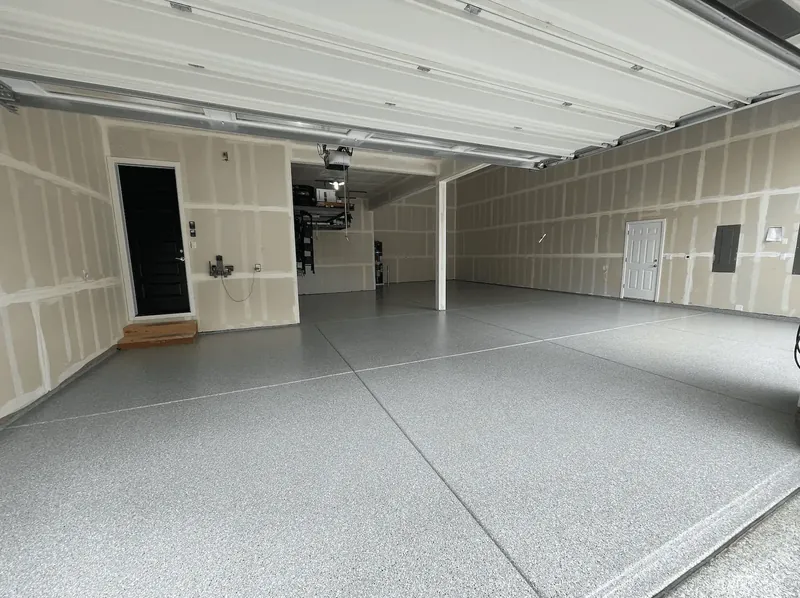
Key takeaways
- Installed epoxy typically costs $4–10 per sq ft, with materials $1–5 and labor $3–5 of that; a two-car garage runs $1,600–5,800.
- Quotes vary widely because 'epoxy' covers everything from a $2–4 thin paint coat to $10–15 thick-coat systems and $7–15 commercial urethane cement.
- Polyaspartic floors typically run $5–12 per sq ft and metallic epoxy $5–12, with high-end metallic work at $9–12.
- Slab condition moves the price most: repairs or resurfacing can add $1–5 per sq ft, and moisture testing $50–300.
- For contractors these ranges are a market check, not a price; small floors need a higher rate per square foot than large ones to cover fixed costs.
Epoxy flooring typically costs $4–10 per square foot installed, with materials making up about $1–5 of that and labor $3–5. A two-car garage of 400–576 sq ft usually runs $1,600–5,800. Quotes outside that range are common, from $2–4 for a thin epoxy paint to $10–15 for a thick-coat system, because “epoxy floor” covers very different systems, slabs and jobs.
This page lays out prices by system and by space, explains why quotes vary so much, and shows what moves the price on a given slab. If you’re a contractor, the last sections cover how to use these numbers without letting them set your price for you.
Epoxy floor cost per square foot by system
“Epoxy floor” covers everything from a thin two-coat paint to a quarter-inch urethane cement floor. Typical installed prices (materials and labor), 2024–2026:
| System | Typical price per sq ft, installed | Notes |
|---|---|---|
| Epoxy floor, all types | $4–10 | The usual residential range |
| Thin epoxy paint | $2–4 | A paint coat, not a floor system |
| Solid-color epoxy | $3–7 | Commercial two-coat jobs often $3–5 |
| Flake (decorative chip), full broadcast | $5–10 | Commercial flake and quartz broadcast $5–9 |
| Polyaspartic | $5–12 | Often the topcoat or full system on one-day garage floors |
| Polyurea | $5–10 | |
| High-build or thick-coat epoxy | $5–15 | Commercial high-build $5–8; thick residential systems $10–15 |
| Metallic epoxy | $5–12 | High-end work $9–12 |
| Quartz broadcast | $5–12 | Commercial $5–9; residential $9–12 |
| Urethane mortar, commercial | $8–15 | |
| Urethane cement, 1/8”–3/8” thick | $7–15 | Rises with thickness |
| Decorative flake or quartz in urethane cement | $15–20 |
Terms used here: flake, quartz, polyaspartic, polyurea, metallic epoxy and urethane cement are all in the glossary.
Why quotes vary so much
The spread is real, and it has causes:
- Different systems under one name. A thin epoxy paint and a thick-coat system are both called “epoxy,” and their prices differ by a factor of three or more.
- Different thickness. More coats and more mils mean more material and more labor.
- Different jobs. Garage floors, basements and commercial floors differ in size, prep and access, and the price per square foot falls as the floor gets bigger.
- Different markets and years. Labor rates differ by city, and material and labor costs have moved between 2024 and 2026.
Treat any single range as a starting point, not the price of a particular floor.
What a $4 floor and a $10 floor usually include
Two quotes for “an epoxy garage floor” can describe very different work. The low and high ends of the typical range usually differ like this:
| Low end (around $4 per sq ft) | High end (around $10 per sq ft) | |
|---|---|---|
| Prep | Cleaning, sometimes acid etching | Diamond grinding to a stated profile, with dust extraction |
| Repairs | Little or none included | Cracks and spalls filled, priced per foot beyond an allowance |
| Moisture | Not tested | Tested before the job, with a barrier coat if readings are high |
| Coats | One or two thin coats | Base coat, full flake broadcast, one or two topcoats |
| Topcoat | Often none, or epoxy | Polyaspartic, which handles sunlight far better than epoxy |
| Return to service | Days | Often 24 hours with polyaspartic systems |
| Warranty | Short or none | A written workmanship warranty, sometimes a manufacturer warranty |
Neither end is wrong for every customer. The point is to compare the scope behind each price, not the number alone; the checklist at the end of this page helps.
Basements are priced differently
Basement floors look like garage floors on a quote, but they bring their own costs: larger, more broken-up areas, stairs and tight access for equipment, and below-grade slabs where moisture is a bigger question. Test before you price, and plan a moisture vapor barrier coat into the scope if readings are high (see concrete moisture testing). Solid epoxy shouldn’t go over a slab with a moisture problem without one.
Price by space: garage, basement and commercial floors
Typical installed prices by space:
| Space | Typical size | Epoxy, installed | Polyaspartic, installed | Polyurea, installed |
|---|---|---|---|---|
| One-car garage | 288–392 sq ft | $1,200–3,900 | $1,400–4,700 | $1,400–3,900 |
| Two-car garage | 400–576 sq ft | $1,600–5,800 | $2,000–6,900 | $2,000–5,800 |
| Three-car garage | 576–864 sq ft | $2,300–8,600 | $2,900–10,400 | $2,900–8,600 |
| Basement | 300–2,000 sq ft | $1,200–20,000 | — | — |
| Patio | 200–400 sq ft | $800–4,000 | — | — |
These ranges are essentially the per-square-foot ranges multiplied by floor size. A thick-coat system at $10–15 per sq ft puts a 575 sq ft two-car garage at $5,750–8,625 and a 1,000 sq ft basement at $10,000–15,000.
Real quotes don’t scale that neatly. Travel, setup, cleanup and the contractor’s overhead cost about the same on a small floor as on a large one, so the cost per square foot often falls on large projects. Expect a higher rate on a one-car garage or a small patio than on a three-car garage.
Epoxy garage floor cost per square foot
Converting the garage totals into dollars per square foot shows the range buyers will see for each size:
| Garage | Low end | High end |
|---|---|---|
| One-car | $1,200 ÷ 288 sq ft = $4.17 | $3,900 ÷ 392 sq ft = $9.95 |
| Two-car | $1,600 ÷ 400 sq ft = $4.00 | $5,800 ÷ 576 sq ft = $10.07 |
| Three-car | $2,300 ÷ 576 sq ft = $3.99 | $8,600 ÷ 864 sq ft = $9.95 |
All three land on the familiar $4–10 per sq ft. Do-it-yourself is cheaper per foot but a different product: DIY epoxy runs about $2–5 per sq ft, or $720–1,800 for a 360 sq ft two-car garage, against $3–12 per sq ft for a professional job.
Where the money goes: materials and labor
Each installed price splits into materials and labor:
| System | Materials per sq ft | Labor per sq ft | Installed per sq ft |
|---|---|---|---|
| Epoxy | $1–5 | $3–5 | $4–10 |
| Polyaspartic | $2–6 | $3–6 | $5–12 |
| Polyurea | $2–4 | $3–6 | $5–10 |
Per-gallon prices show where the materials number comes from. Epoxy costs about $40–100 a gallon for water-based, $50–100 for solvent-based and $70–150 for solid (100% solids) epoxy, and each gallon covers about 80–200 sq ft depending on thickness. One coat of solid epoxy therefore costs between $70 ÷ 200 = $0.35 and $150 ÷ 80 = $1.88 per sq ft. A full floor has several coats, plus primer, flake or quartz and a topcoat, which is how materials reach $1–5 per sq ft. In the worked example in how to price epoxy flooring, a three-layer polyaspartic flake system comes to $2.92 per sq ft in materials.
Labor is the bigger share: typically 50–70% of the total project cost.
Cost per year, not just per square foot
A cheaper floor that has to be redone sooner can cost more over time. A water-based epoxy floor typically lasts 3–5 years; a solid epoxy floor 10–20 years. As an illustration, a $4-per-sq-ft floor that lasts 4 years costs $4 ÷ 4 = $1.00 per sq ft per year; an $8-per-sq-ft floor that lasts 15 years costs $8 ÷ 15 = about $0.53 per sq ft per year. Lifespans depend on prep, thickness, traffic and moisture, so treat these as examples, not promises.
Metallic epoxy flooring price
Metallic floors typically cost $5–12 per square foot installed, with high-end work at $9–12. They cost more than a flake floor of the same size for three reasons:
- More coats and more resin. A metallic layer is a thicker, self-leveling pour over a primer and a base coat, usually under a clear topcoat.
- More skill per square foot. The pattern is made by hand while the resin is wet, and mistakes can’t be hidden by a broadcast.
- More cure time. Metallic systems are usually epoxy, which cures more slowly than polyaspartic, so jobs often take more than one visit.
How metallic systems are installed is covered in metallic epoxy floor installation.
Commercial epoxy flooring cost per square foot
Commercial floors are bid from a written specification, not a price list, so these numbers are a starting point only (see bidding commercial epoxy flooring jobs):
| Commercial system | Price per sq ft | Thickness |
|---|---|---|
| Standard two-coat epoxy | $3–5 | 8–12 mils |
| High-build 100% solids epoxy | $5–8 | 20–30 mils for warehouses and manufacturing |
| Polyaspartic or polyurea | $5–12 | — |
| Urethane mortar | $8–15 | — |
| Urethane cement, self-leveling | $7–12 | 1/8”–3/16” |
| Urethane cement, medium duty | $9–13 | 3/16”–1/4” |
| Urethane cement, heavy duty | $10–15 | 1/4”–3/8” |
A thin two-coat system can wear through in 3–5 years under industrial traffic, which is why specifications state a thickness. A mil is a thousandth of an inch; 3/8” is 375 mils.
What adds to a commercial price beyond the system: cove base and joint details, line striping, night or weekend work, phasing around operations, slip resistance requirements and stricter moisture specs. Larger floors usually cost less per square foot.
What moves the price on a given floor
| Factor | Why it matters | Typical cost effect |
|---|---|---|
| Slab condition and repairs | Cracks, spalls, pitting and old patches need filling before coating | Repairs or resurfacing can add $1–5 per sq ft; widespread damage may need resurfacing at $3–7 per sq ft |
| Surface prep | Mechanical grinding takes time, diamonds and a dust extractor; professional data sheets call for grinding to a profile (see concrete surface profile) | Power washing alone: $0.35–0.77 per sq ft |
| Moisture | Testing first; a vapor barrier coat if readings are high | Moisture and hardness testing: $50–300 |
| Old coatings and contamination | Removing an old coating or oil means extra grinding passes | Priced per job from the extra time |
| System and thickness | More coats and more mils mean more material and time | See the system table above |
| Topcoat | Polyaspartic costs more than plain epoxy but handles sunlight far better; epoxy’s UV resistance is poor to fair | Polyaspartic $5–12 vs epoxy $4–10 per sq ft |
| Customization | Flake blends, colors, logos, extra topcoats | Flakes or custom colors add $0.50–2.00 per sq ft; custom options can add 15–40% |
| Region | Labor rates and competition differ by city | Garage floors in 2024 ran $1,240–2,685 in Miami and $1,705–3,720 in New York |
| Size and access | Small, odd-shaped or hard-to-reach floors cost more per sq ft | See the garage tables above |
DIY kits versus a professional floor
DIY epoxy kits cost about $200–700, or $50–600 in raw materials. A professional floor costs more because the buyer is paying for different work:
- Prep. Professional systems call for mechanical preparation: a typical polyaspartic chip system specifies diamond grinding to a CSP 2 profile. A typical consumer kit, such as Rust-Oleum’s EpoxyShield, ships with a concrete etch and goes on in one coat.
- Thickness and solids. Water-based epoxy may need recoating every 3–5 years; solid epoxy can last 10–20.
- Testing and repairs. Moisture tests and crack repair are part of a professional quote.
- A warranty from the installer, and sometimes from the manufacturer.
For contractors, this gap is the most common objection in the sales call. How to explain it honestly is in DIY epoxy kit vs professional floor and the epoxy flooring sales process.
What these numbers mean if you’re the contractor
Buyers look up these ranges before they call you, so know them. But a market average can’t set your price, for three reasons:
- It doesn’t know your costs. Your material prices, crew wages, insurance and lead costs are your own. Build the price from them, as in the worked example in how to price epoxy flooring, where a 484 sq ft flake garage comes out at $6.35 per sq ft.
- It hides job size. In that same model, a 250 sq ft garage needs $8.66 per sq ft to earn the same margin. Use a minimum job price.
- It mixes systems. If your system is thicker or uses a better topcoat than “average epoxy,” say so in the quote, in mils and product names.
Use the market ranges as a sanity check. If your full-cost price lands far above them, check your crew hours and overhead first. If it lands far below them, check that you included overhead, prep and callbacks at all. Epoxy flooring profit margins shows where margin usually leaks.
How to compare two quotes
Whether you’re a buyer comparing bids or a contractor explaining yours, compare these line by line:
- Prep method: diamond grinding or shot blasting to a stated profile, not just cleaning or etching
- Moisture testing before the job, and what happens if it fails
- Each coat by product, with thickness in mils or spread rate
- Flake coverage: partial or full broadcast
- Topcoat type and number of coats
- Repairs included, and the price of extra repairs
- Warranty: who backs it, how long, and what it excludes (see epoxy floor warranties)
- Return-to-service time for walking and for parking
For contractors: turn your costs into a price list with the pricing calculator. The Epoxy Playbook pairs recorded installation training, full jobs you can replay, with job costing and quoting.
Questions
How much does epoxy flooring cost per square foot?
Professionally installed epoxy typically costs $4–10 per square foot, with materials about $1–5 and labor $3–5. Thin epoxy paint can be as low as $2–4, and thick-coat systems run $10–15. The system, the slab's condition and the size of the job explain most of the spread.
How much does a metallic epoxy floor cost per square foot?
Metallic epoxy typically costs $5–12 per square foot installed, with high-end work at $9–12. Metallic floors cost more than flake because they take more coats, more material and more installer skill.
What does commercial epoxy flooring cost per square foot?
Commercial systems run from about $3–5 per sq ft for a thin two-coat epoxy to $5–8 for high-build epoxy and $8–15 or more for urethane mortar and urethane cement. Commercial work is bid from a written specification, so thickness, prep, phasing and details such as cove base drive the number.
Why is a small garage more expensive per square foot?
Travel, setup, cleanup and the contractor's overhead cost about the same on a small floor as on a large one, so they're spread over fewer square feet. In our pricing model, a 250 sq ft garage needs $8.66 per sq ft where a 484 sq ft garage needs $6.35 to earn the same margin.
Is polyaspartic more expensive than epoxy?
Usually a little: polyaspartic typically runs $5–12 per square foot against $4–10 for epoxy. Many garage systems combine the two, for example an epoxy base under a polyaspartic topcoat, so compare the full system on each quote, not the name.
Keep reading
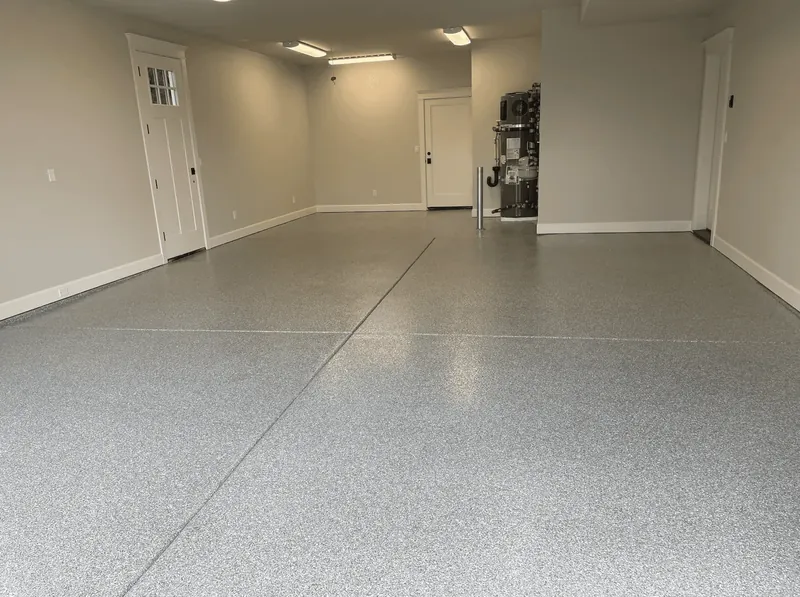
How to price epoxy flooring so every job pays
Build an epoxy floor price from materials, labor, overhead and profit, with a worked two-car garage example, margin vs markup, a minimum job price and adders.
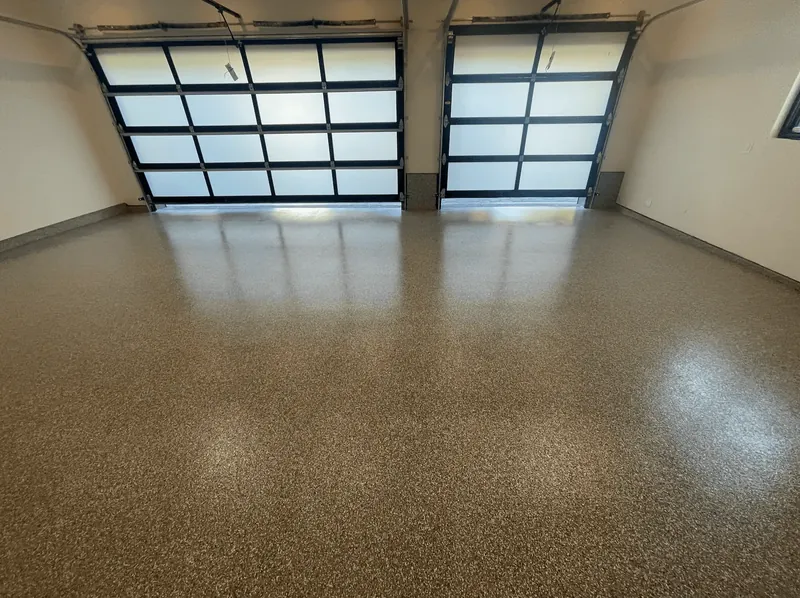
Epoxy flooring profit margins: what's realistic, and where margin leaks
Gross vs net margin for epoxy flooring jobs, the margin claims you'll hear, a markup-to-margin table, job costing, and the seven places margin leaks.
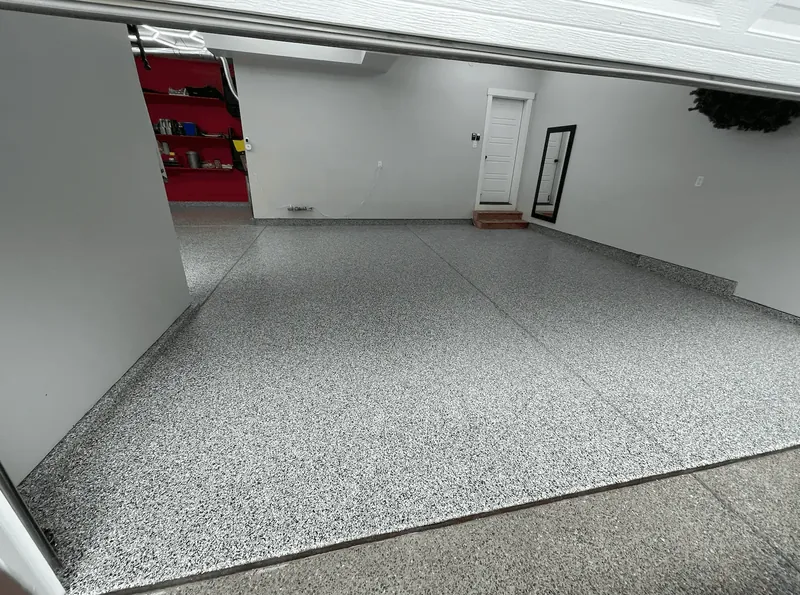
Job pricing calculator
The epoxy flooring sales process: from first call to signed contract
The in-home epoxy flooring sales process: pre-qualifying calls, measuring, moisture checks, three options, the $200 DIY kit objection, deposits and follow-up.