Key takeaways
- A typical one-car big-box kit costs about $105, covers 200–250 sq ft in one coat, and comes with a concrete etch, decorative chips and instructions; a two-car garage needs two.
- One kit coat at its rated coverage is about 6 mils wet; a professional flake system lays down about 23 mils of wet coating in two coats, plus a full chip layer.
- Professional systems start with diamond grinding to a profile and a moisture test; kits start with cleaning and an acid etch.
- Water-based epoxy typically lasts 3–5 years; solid epoxy 10–20; a polyaspartic topcoat adds UV stability and hot-tire resistance.
- A kit is honestly fine for a light-use space, a short horizon or a tight budget on a sound, dry slab. Say so; it builds the trust that closes the jobs that need you.
“I can buy a kit for $200” is true: a typical one-car big-box kit costs about $105, so two of them cover most two-car garages. What the homeowner is comparing is a single thin coat over an acid-etched slab with a professional system: a slab ground to a profile and tested for moisture, a thick base coat, a full chip broadcast and a durable topcoat, with someone standing behind the labor. Your job on the call is to show that difference plainly, without talking down to anyone, and to admit when a kit really is the right choice.
What’s in a big-box kit
Rust-Oleum’s EpoxyShield garage kit is a representative example. The one-car kit:
- holds 120 fl oz of a two-part epoxy in a burst pouch, rated to cover 200–250 sq ft;
- includes decorative color chips, a concrete etch and instructions;
- goes on in one coat, indoors only;
- can be walked on in 1–2 days and driven on in 3;
- sells for about $105, so a 484 sq ft two-car garage needs two kits, about $210.
The chemistry is water-based epoxy. Water-based epoxy is the easiest to apply and the least durable option: it typically lasts 3–5 years, against 10–20 years for solid (100% solids) epoxy. Kits in general run about $200–700 depending on size and brand.
What a professional flake system is
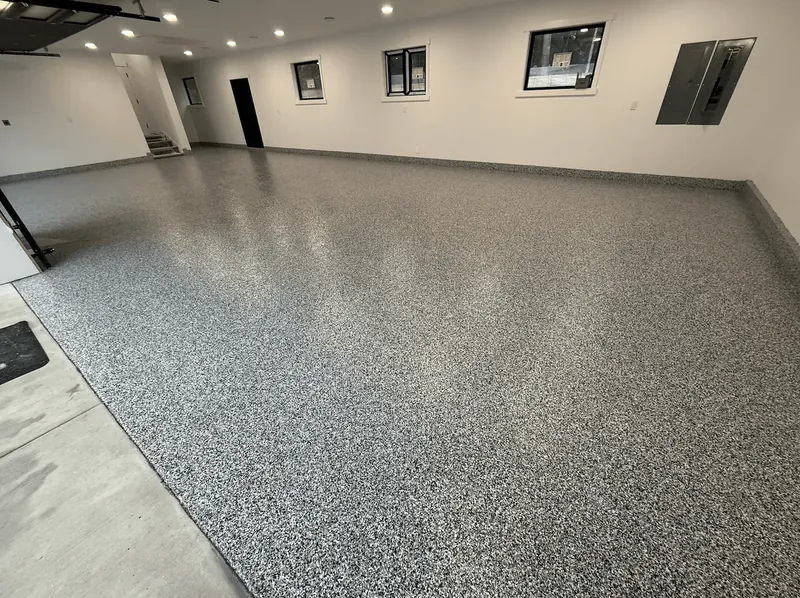
A professional full-broadcast flake floor is a system, not a coating:
- Moisture test, against the manufacturer’s limit (a typical chip system allows 3 lb per 1,000 sq ft per 24 hours by the calcium chloride test, or 75% relative humidity, and calls for a vapor barrier above that).
- Diamond grinding the whole slab to a concrete surface profile, typically CSP 2 for chip systems, with a HEPA dust extractor; edges ground by hand.
- Repairs: cracks, spalls and pitting filled.
- Base coat at a set spread rate, for example 150 sq ft per gallon.
- Full chip broadcast to refusal, then scraped and blown off.
- Topcoat, for example 130 sq ft per gallon of polyaspartic over the chip.
Side by side
| Typical big-box kit | Professional flake system | |
|---|---|---|
| Surface prep | Clean and acid-etch | Diamond grind to a profile, dust extraction, edges |
| Moisture test | None | Tested against the manufacturer’s limit |
| Repairs | Up to the homeowner | Cracks, spalls and pitting filled |
| Coats | One | Base coat, full chip broadcast, topcoat |
| Wet film thickness | About 6 mils at 250 sq ft per kit | About 23 mils across two coats, plus the chip layer |
| Chips | A light sprinkle from a packet | Broadcast to refusal, about 400 sq ft per 55 lb box |
| Topcoat | None in the kit | Polyaspartic: UV stable, resistant to hot-tire pickup |
| Return to service | Walk in 1–2 days, drive in 3 | Polyaspartic chip systems: vehicles after about 24 hours |
| Typical life | 3–5 years for water-based epoxy | 10–20 years for solid epoxy systems |
| Warranty | The manufacturer’s product terms; the labor is the homeowner’s | A written workmanship warranty, sometimes a manufacturer warranty too |
| Price, 484 sq ft garage | About $210 in kits | $3,075 in our pricing example; typically $1,600–5,800 |
Where the price difference goes
In our pricing example, the $3,075 two-car floor breaks down like this:
| Part of the price | Amount | What it pays for |
|---|---|---|
| Materials | $1,412.43 | Base coat, topcoat, a full chip broadcast and supplies: several times the material in two kits |
| Crew labor | $640.89 | An installer and a helper for a full day: grinding, repairs, coats, cleanup |
| Overhead share | $406.02 | Insurance, the grinder and extractor, the truck, marketing, phone and accounting |
| Profit | $615.66 | What keeps the business able to come back if something goes wrong |
Walking a homeowner through a table like this, with your own numbers, answers “why so much more?” better than any adjective.
Where the thickness numbers come from
Wet film thickness in mils = 1,604 ÷ coverage in sq ft per gallon (a gallon is 231 cubic inches; spread over one square foot, it’s 1.604 inches, or 1,604 mils, thick).
- Kit: 120 fl oz is 0.9375 gallon. Over 250 sq ft that’s 266.7 sq ft per gallon, so 1,604 ÷ 266.7 = 6.0 mils wet; over rough concrete at 200 sq ft, 7.5 mils.
- Pro system: base coat at 150 sq ft per gallon = 10.7 mils; topcoat at 130 = 12.3 mils; together about 23 mils wet, before counting the chip layer that fills the space between them.
Dry film is thinner than wet film by the share of the coating that evaporates. A solvent-based polyaspartic at 72% solids, for example, goes on at 8 mils wet and dries to 5.8 mils.
Why the differences matter on a garage floor
- Prep decides adhesion. Professional chip systems require a mechanically prepared, open surface. An etch cleans; a grinder profiles. Manufacturers’ warranties exclude failures from poor prep; one major residential warranty excludes defects on a substrate without a 20–30 grit profile.
- Moisture decides whether it stays down. A coating over a slab with high moisture vapor emission can blister or lift; that’s why manufacturers set limits and why a professional tests first.
- Thickness decides wear. A thin single coat wears through faster under tires, dropped tools and road salt.
- The topcoat decides UV and tires. Epoxy can yellow in sunlight; polyaspartic topcoats are UV stable. Hot tires can mark coatings when plasticizers migrate out of the rubber; well-crosslinked coatings resist it better, and the polyaspartic topcoat above is rated resistant to hot-tire pickup.
More on the chemistry in polyaspartic vs epoxy and on failures in why epoxy floors fail.
How to explain it on the call without talking down
Agree first. The homeowner isn’t wrong that kits exist and cost less. Then compare, and let them choose.
Example wording: “You’re right, a kit’s about a hundred dollars a car. If you want a fresh look for a few years and you don’t mind the work, it’s a fair choice. What I do is different: I grind the concrete so the coating bites into it, I test for moisture so it doesn’t lift, I lay down about four times the coating a kit does, and I put a topcoat on that handles tires and sun. And if anything goes wrong, you call me, not a hardware store.”
What to avoid:
- calling kits junk or the homeowner foolish for asking;
- scare stories you can’t back up;
- vague claims (“ours is commercial grade”) instead of the specifics in the table above;
- dropping your price to match: compare scopes instead, or offer a simpler tier (see the epoxy flooring sales process).
Bring the evidence: a sample board with the chip and topcoat, a ground-concrete sample next to an etched one, the data sheets for your system, and your written warranty.
When a DIY kit is honestly fine
Saying “a kit will do” when it’s true is how you get trusted on the jobs that need you. A kit is reasonable when:
- the space gets light use: a workshop corner, a storage room, a laundry area;
- the homeowner wants a cosmetic refresh for a few years, for example before selling;
- the budget simply doesn’t stretch to a professional system;
- the slab is sound, dry and free of old coatings, sealers and heavy oil;
- they’re willing to follow the instructions, including the etch and the 60–85°F application window.
A kit is a poor choice when cars park on the floor daily, the slab shows moisture or efflorescence, an old coating has to come off, or the homeowner expects a decade of wear. Say that plainly too.
Show, don’t argue. The Epoxy Playbook is recorded installation training, full jobs on video you can replay, plus the business side, including how to present a system and handle this objection. To walk through your own sales call with a working coating-company owner, book a consultation.
Questions
Is a DIY epoxy kit as good as a professional epoxy floor?
No; they're different products. A typical kit is one thin coat over an etched slab, with chips sprinkled in. A professional flake system is a slab ground to a profile, tested for moisture, then a thick base coat, a full chip broadcast and a polyaspartic or similar topcoat, with a warranty behind the labor.
How long does a DIY epoxy garage floor last?
It depends on prep, traffic and moisture. Water-based epoxy, the usual chemistry in big-box kits, typically lasts 3–5 years; solid (100% solids) epoxy typically lasts 10–20 years.
Why does a professional epoxy floor cost so much more than a kit?
Most of the price is labor and equipment: grinding, dust extraction, crack repair, moisture testing and several coats applied within tight time windows. Installed epoxy typically runs $4–10 per sq ft, with labor $3–5 of that, against about $105 for a one-car kit.
When should I tell a customer to buy a kit instead?
When the space gets light use, they want a fresh look for a few years rather than a long-term floor, the budget is tight, and the slab is sound and dry. Telling them that honestly costs you a small job and earns a referral.
Keep reading
The epoxy flooring sales process: from first call to signed contract
The in-home epoxy flooring sales process: pre-qualifying calls, measuring, moisture checks, three options, the $200 DIY kit objection, deposits and follow-up.
Epoxy floor cost per square foot: what buyers pay, and what it means for your price
Epoxy floors cost about $4–10 per sq ft installed. Prices by system and by space, why quotes vary so much, and what moves the price on a given slab.
Epoxy floor warranties: what 'lifetime' means, and how to write terms you can honor
How epoxy and polyaspartic floor warranties work: product vs workmanship cover, what 'lifetime' means, common exclusions, a real program, and claims.
Polyaspartic vs epoxy floor coatings: how they differ and when to use each
Polyaspartic vs epoxy compared from data sheets: chemistry, working time, cure speed, UV stability, temperature, odor and cost, and the systems that use both.