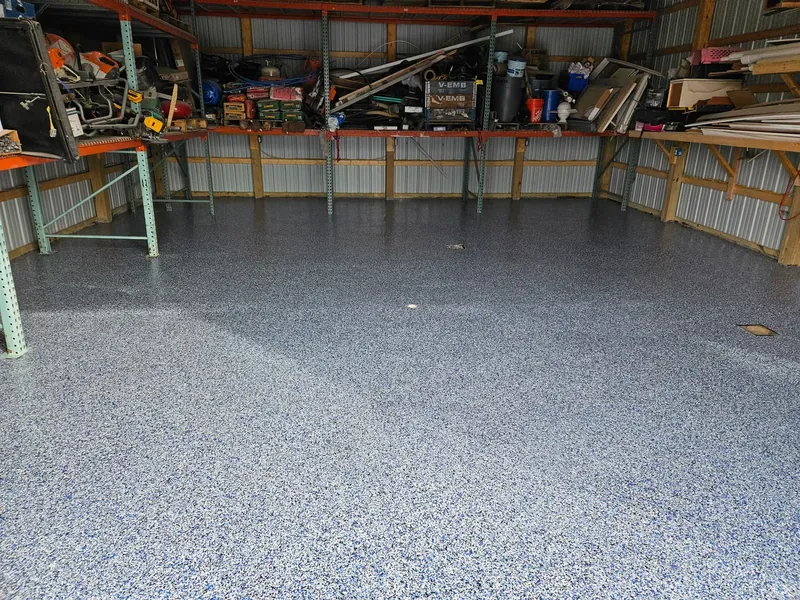
Key takeaways
- A garage flake floor is a system of products from one manufacturer: an epoxy primer, a 100%-solids epoxy base coat, vinyl flake, a polyaspartic topcoat and a crack filler.
- Materials make up about $1–5 per sq ft of an installed epoxy floor; a complete full-flake material kit for up to 400 sq ft costs about $900, or about $2.25 per sq ft.
- Contractors buy from four kinds of sellers: manufacturers and their dealer programs, regional coating supply houses, online stores, and home centers (consumer kits).
- Choose a supplier for data sheets, technical support, local stock and warranty backing before price; some product warranties cover replacement material only and are void if you mix brands.
- To find a distributor near you, use manufacturers' locators, call the technical line printed on any data sheet, and check which supply houses run hands-on classes in your state.
Epoxy flooring supplies are the materials that end up in the floor: epoxy primers and base coats, polyaspartic topcoats, decorative flake, quartz or metallic pigment, crack and joint fillers, moisture-vapor-barrier primers, cleaners and consumables. Contractors buy them from manufacturers and their dealers, regional coating supply houses, online stores and home centers. Materials make up about $1–5 per sq ft of an installed epoxy floor, so where you buy matters less than buying a complete system with data sheets and support behind it.
This guide covers what’s on a contractor’s shopping list, the kinds of suppliers, how to choose one, examples of companies that sell professional coatings (not endorsements), and how to find a distributor near you. For the machines and hand tools, see the epoxy flooring equipment list.
What contractors buy
A coating “system” is a set of layers from one manufacturer, specified together in a system guide. A typical single-broadcast flake system is a clear epoxy primer, a pigmented 100%-solids epoxy base coat with 1/4-inch vinyl chip broadcast into it, and a polyaspartic topcoat, over concrete ground to CSP 3 or more. The shopping list follows from the system:
| Product | What it does | Typical figures |
|---|---|---|
| Epoxy primer | Seals the pores, reduces outgassing, anchors the system | 3–8 mils, 200–533 sq ft/gal (Simiron 1000HS) |
| Epoxy base coat | Builds thickness, holds the broadcast | 100% solids, 10–30 mils, 53–160 sq ft/gal (Simiron 1100SL) |
| Polyaspartic topcoat | Clear wear layer, UV stable | 90–93% solids, 10–16 mils, 100–160 sq ft/gal (Simiron Polyaspartic HS) |
| Polyurea base coats | Fast-cure base for one-day systems | Sold as part of one-day flake systems; follow the system guide |
| Urethane cement | Heavy-duty floors where impact, chemicals and thermal shock matter, such as food plants | Applied in layers measured in millimeters, not mils |
| Vinyl flake | Color, texture, hides slab flaws | About 5–7 sq ft per pound at full broadcast for 1/4-inch flake |
| Quartz aggregate | Colored quartz broadcast systems, slip resistance | Used in double-broadcast systems |
| Metallic pigments | Metallic epoxy effects | 32 oz of pigment per 3 gal of mixed epoxy (Simiron Metallic Additive) |
| Crack and joint fillers | Repairs before priming | Epoxy pastes and polyurea fillers; use the system maker’s |
| Moisture-vapor-barrier primer | Lets you coat damp slabs | Rated up to 25 lb/1,000 sq ft/24 h or 95% RH at 16 mils (Simiron MVB) |
| Anti-slip aggregate | Slip resistance in the topcoat | Aluminum oxide from 220 mesh (slight texture) to 46 mesh (very aggressive) |
| Cleaners and degreasers | Removing oil before grinding | Where oil can’t be removed, an oil-stop primer |
| Consumables | Rollers, tape, mixing buckets, gloves, solvent for cleanup | Acetone or xylene for cleaning tools |
Buying flake
Flake comes in 40-lb boxes, sold by blend and chip size, and a box costs about $90–125. How far it goes depends on the chip size and how heavily you broadcast:
| Flake | Coverage |
|---|---|
| 1/4” or 1/8” chips, full broadcast | About 5–7 sq ft/lb |
| 1/16” chips and hybrid blends, full broadcast | About 3–5 sq ft/lb |
| Partial broadcast | About 25–50 sq ft/lb |
A single-broadcast system like Simiron’s SimFlake SB plans on 6 sq ft per lb, or 240 sq ft per 40-lb box. At 5–7 sq ft per lb, one box of 1/4-inch flake covers 40 × 5 = 200 to 40 × 7 = 280 sq ft at full broadcast, so flake adds about $90 ÷ 280 = $0.32 to $125 ÷ 200 = $0.63 per sq ft of floor. The flake calculator works out the pounds for any floor and blend.
100%-solids or water-based?
Professional base coats are commonly 100% solids content: no water or solvent evaporates, so the film you spread is the film you keep, and 100%-solids epoxy has become the norm in commercial and industrial flooring. Water or solvent carriers stretch pot life to about two hours against 30–40 minutes for a 100%-solids epoxy, but the dry film can be as little as half the wet film: 7 wet mils may dry to 3–3.5 mils. Do-it-yourself epoxy paints are often water-based, and some are light-duty latex paint with a little epoxy resin added. That’s the difference between a home-center kit and a professional system.
For how the two main resins compare, see polyaspartic vs epoxy. For the order the layers go down, see flake floor installation.
What supplies cost
Prices vary by brand and volume. One professional line in 2026: a 3-gallon kit of 100%-solids epoxy base coat costs $159, or $53 a gallon; a 2-gallon kit of polyaspartic topcoat $205.50, or $102.75 a gallon; and a 3-gallon kit of moisture-vapor-barrier primer $247.50, or $82.50 a gallon (Simiron 1100SL, Polyaspartic HS and MVB).
Spread across the floor at their coverage rates, that is:
| Layer | Price per gallon | Coverage | Cost per sq ft |
|---|---|---|---|
| Base coat | $53 | 134–200 sq ft/gal (flake system) | $53 ÷ 200 to $53 ÷ 134 = about $0.27–0.40 |
| Polyaspartic topcoat | $102.75 | 100–160 sq ft/gal | $102.75 ÷ 160 to $102.75 ÷ 100 = about $0.64–1.03 |
| Moisture barrier, when needed | $82.50 | 100 sq ft/gal at 16 mils | $82.50 ÷ 100 = about $0.83 |
Add primer, flake, fillers and waste and you land inside the $1–5 range. Complete kits tell the same story: a full-flake material kit (100%-solids epoxy base, flake and polyaspartic topcoat) for floors up to 400 sq ft costs about $900, which is $899 ÷ 400 = $2.25 per sq ft on a full 400 sq ft floor. Use the coverage calculator and flake calculator to turn your floor’s area into gallons and pounds, and see the epoxy flooring starter kit for what the tools and equipment add.
Ordering for your first jobs
Order from the data sheet’s coverage rates, not from the label on the box. For a 20 × 22 ft two-car garage (440 sq ft) with a single-broadcast flake system like Simiron’s SimFlake SB:
| Layer | Coverage rate | Quantity for 440 sq ft |
|---|---|---|
| Primer | 200–533 sq ft/gal | 440 ÷ 533 to 440 ÷ 200 = about 0.8–2.2 gal: one or two 1.5-gal kits |
| Base coat | 134–200 sq ft/gal | 440 ÷ 200 to 440 ÷ 134 = about 2.2–3.3 gal: one or two 3-gal kits |
| Flake, 1/4 inch | 6 sq ft/lb | 440 ÷ 6 = about 73 lb: two 40-lb boxes |
| Polyaspartic topcoat | 100–160 sq ft/gal | 440 ÷ 160 to 440 ÷ 100 = about 2.8–4.4 gal: two or three 2-gal kits |
Rough or porous concrete drinks primer, so plan on the low end of each coverage range on old slabs. Buy all the base color from one batch; mixing batch numbers causes visible color differences across a floor.
Storage and shelf life
Resins have a shelf life and a temperature range. Expect about a year unopened: Simiron’s epoxies and polyaspartics, for example, keep 12 months in the original container stored indoors at 60–85°F with humidity below 65%, and must never freeze. A truck or an unheated trailer in January doesn’t meet that. Cold resin is also hard to mix and slow to cure, so bring containers to room temperature before mixing. Rotate stock, write the delivery date on each kit, and don’t carry more than a few jobs’ worth until you know your volume.
The four kinds of suppliers
| Supplier type | What you get | Watch for |
|---|---|---|
| Manufacturers and dealer programs | Full systems, technical service, training, sometimes territory or warranty programs | Some sell only through dealers or to licensed contractors; dealer programs can require buying their product line |
| Regional coating supply houses | Local stock, several brands, staff who know local slabs, often classes and rentals | Brand choice is limited to what they carry |
| Online stores | Published prices, nationwide shipping | Freight time and cost; support is by phone |
| Home centers (consumer kits) | Convenience for small, light-duty jobs | Kits built for homeowners, not for a warranty you’ll stand behind |
Many supply houses double as training centers: most hands-on epoxy classes are run by suppliers, which is how a lot of contractors meet the supplier they end up using. Our training page compares the classes.
Dealer programs
Some manufacturers sell through dealer networks that bundle product, training and support. Penntek, for example, trains every dealer through its Penntek Academy, backs dealers with technical and sales support, marketing and lead generation, and helps with tools and inventory at launch. A program like that can shorten your start, but read what it requires before you sign: what you must buy and from whom, whether there is a territory, what happens to your customers and your brand if you leave, and the full start-up cost, in writing. Going independent means choosing your own supplier and brand, and doing your own training and marketing.
How to choose a supplier
Price per kit comes last. Ask these first:
- Data sheets. Does every product have a current technical data sheet and safety data sheet, with prep, thickness, cure times and moisture limits?
- Technical support. Can you reach someone who knows the product when a floor bubbles at 4 p.m. on a Friday?
- Local stock. Can you pick up a missing kit the same day, or do you wait for freight?
- Complete systems. Do they sell the primer, base, broadcast, topcoat and fillers from one maker?
- Warranty terms. What does the manufacturer cover, and for how long? Some product warranties run one year, replace failed material only, exclude labor, and are void if the products are mixed with another brand's. The warranty you give the homeowner is yours to back.
- Training. Do they run classes or let you practice on their slabs?
- Pricing tiers. Is there contractor or volume pricing once you buy regularly?
- Moisture options. Do they carry a moisture-vapor-barrier primer for the slabs that fail testing?
Examples of manufacturers and supply houses
These are examples to start your own research, not endorsements or rankings.
Coating manufacturers
| Company | What it makes | Notes |
|---|---|---|
| Sherwin-Williams High Performance Flooring | Seamless resinous flooring systems for commercial and industrial use | National |
| Sika | Sikafloor systems including Decoflake, Metallic FX and Quartzite, plus flooring primers and moisture barriers | National |
| Simiron | Epoxy, polyaspartic and urethane floor coatings, made in the USA | Michigan; sells through dealers and an online store |
| Penntek | Concrete coatings for homes and businesses; the exclusive concrete coatings partner of The Home Depot Home Services | Dealer program with its own training |
| Elite Crete Systems | Resinous epoxy and urethane floor coatings for commercial and industrial construction | |
| Westcoat | Floor coating and waterproofing systems for commercial, industrial and multifamily buildings | |
| APF Polymer Flooring | Resinous flooring systems, including color quartz systems and epoxy slurries | |
| E2U | Metallic and flake epoxy flooring systems | Runs classes in Arizona and California |
| Factory 1 | Private-label epoxy floor coatings and supplies, including a base coat rated for up to 9 lb moisture emission | Sells direct to licensed contractors; California and Arizona locations |
| Torginol | Decorative flake and broadcast media | Wisconsin; its affiliate locator finds installers, training and distributors |
Supply houses and online stores
| Company | What it sells | Where |
|---|---|---|
| Xtreme Polishing Systems | Epoxy coatings, surface prep equipment, floor machines and decorative concrete supplies, including Torginol flake | Online and several locations; runs classes |
| One Stop Epoxy | Epoxy flooring systems, tools, pigments, vinyl flakes and grinders; free shipping to the 48 contiguous states | Orlando, FL; runs classes |
| Huey’s Epoxy Supply | Epoxy, polyaspartic coatings, decorative flake, prep equipment and tools; equipment rentals | Baton Rouge, LA |
| Epoxy Depot Chicago | Decorative epoxy coatings, urethanes, tooling, equipment, supplies and training | Chicago area |
| Deco-Crete Supply | Decorative concrete products including decorative epoxies, stains and overlays | Ohio |
| The Concrete Protector | Decorative concrete supplies, tools and epoxy training | Ohio |
| Clean Pro Supply | Cleaning, restoration, coatings and polishing products; hosts a traveling epoxy class | Several Midwest and Eastern cities |
| Home centers | Consumer garage floor kits such as Rust-Oleum’s EpoxyShield line | Nationwide |
How to find a distributor near you
- Start from the system, not the store. Pick the manufacturer whose data sheets fit the floors you’ll install, then find who stocks it near you.
- Use manufacturers’ locators. Torginol’s affiliate locator finds installers, training and distributors by zip code; other manufacturers list dealers on their websites or by phone.
- Call the technical line. Every data sheet prints one. Ask who stocks the system within an hour of you.
- Follow the classes. Supply houses run most hands-on classes. Our classes by state directory shows who is teaching near you; the host is often the local distributor.
- Visit before you commit. Check stock on the shelf, ask for the data sheets for the full system, and ask what happens when a floor fails.
See the materials go down before you buy them by the case. In The Epoxy Playbook you watch the full installation and replay any step as often as you need; then you do it on the slab in a hands-on class. The Playbook also covers supplier accounts and how to build material costs into your price.
Questions
Where can I buy epoxy flooring supplies?
From coating manufacturers (directly or through their dealers), regional coating supply houses, online stores that ship nationwide, and home centers. For customer work, buy one manufacturer's complete system from a seller that carries its technical data sheets and can put you in touch with technical support.
What's the difference between a home-center epoxy kit and professional epoxy coatings?
Home-center epoxy paints are often water-based, and some are mostly light-duty latex paint with a little epoxy resin added. Professional floor epoxies are typically 100% solids and cure by chemical reaction into a much thicker film, and they come with data sheets that specify prep, thickness, cure times and moisture limits.
How much do epoxy flooring materials cost per square foot?
About $1–5 per sq ft of the installed price. A full-flake kit with epoxy base coat, flake and polyaspartic topcoat for up to 400 sq ft costs about $900, which is about $2.25 per sq ft on a full 400 sq ft floor. Primer, moisture barrier and repairs add to that when the slab needs them.
Where can I buy polyaspartic floor coating?
From coating supply houses and manufacturers' online stores. A 2-gallon kit of a professional polyaspartic topcoat costs around $200 (Simiron's Polyaspartic HS lists at $205.50). Buy the polyaspartic made for the base coat you use, from the same manufacturer, so the system's data sheet and warranty apply.
Do I need a contractor license to buy professional coatings?
Not usually from online stores and most supply houses, but some manufacturers sell only through dealers or direct to licensed contractors. Licensing to do the work is a separate question that depends on your state.
Keep reading
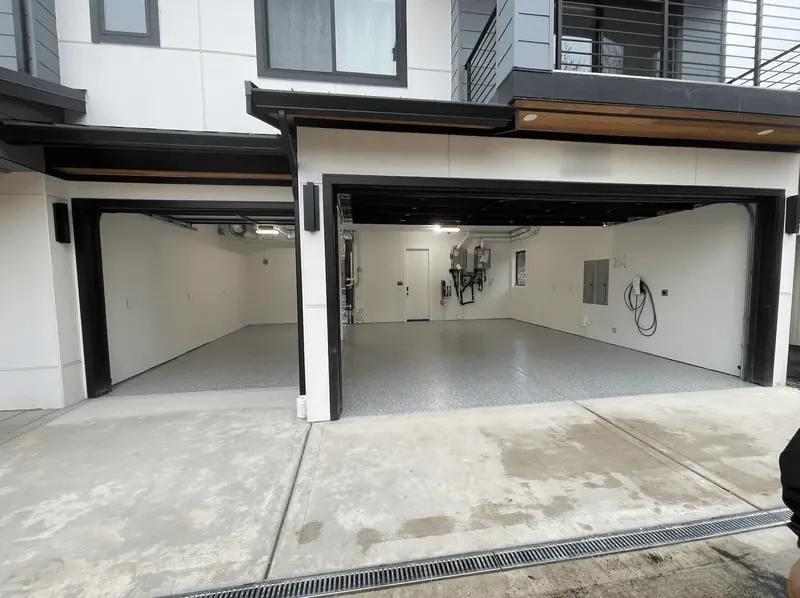
Epoxy flooring equipment: the complete tools list, with costs
Every tool an epoxy flooring business needs, stage by stage: grinders, dust extractors, tooling, application, testing and safety gear, with rent and buy prices.
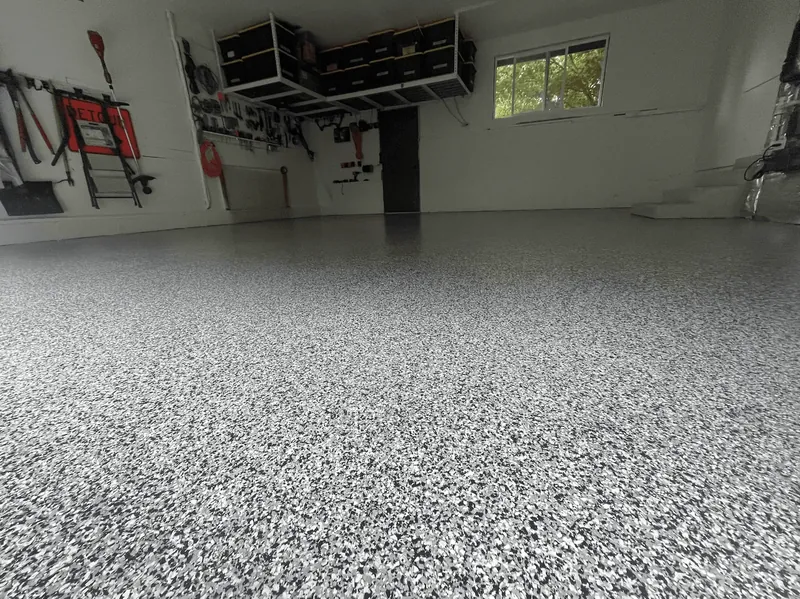
Epoxy flooring starter kit: what to buy first, in three budgets
What an epoxy flooring starter kit costs: three budgets built from published prices, what suppliers' starter kits contain, and what to add as work grows.
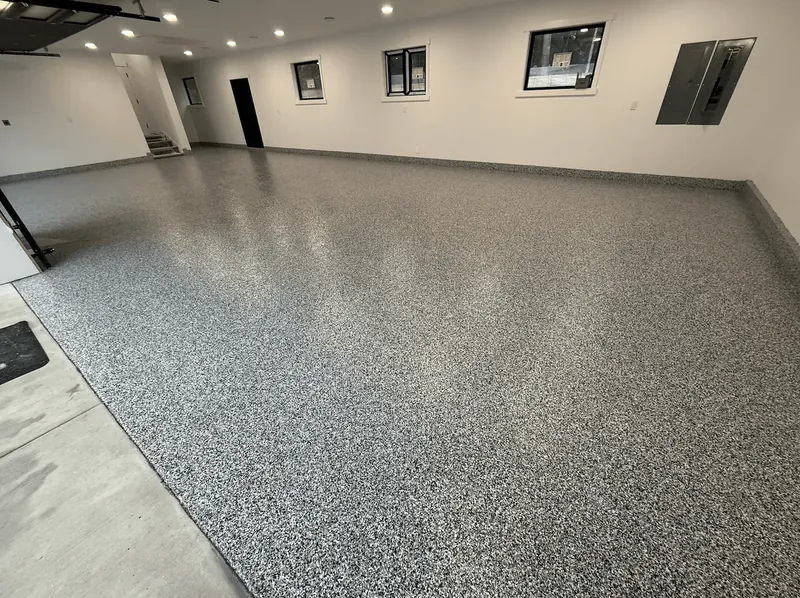
Polyaspartic vs epoxy floor coatings: how they differ and when to use each
Polyaspartic vs epoxy compared from data sheets: chemistry, working time, cure speed, UV stability, temperature, odor and cost, and the systems that use both.
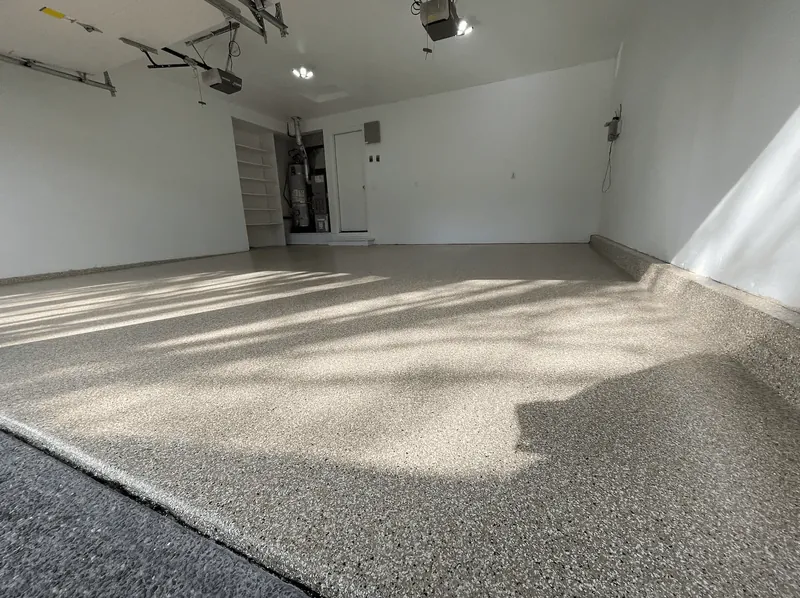
How to install a full-broadcast flake floor, step by step
Install a full-broadcast flake epoxy floor step by step: moisture test, grind to CSP 3, repairs, primer, base coat, flake at 5–7 sq ft per lb, topcoat and cure.