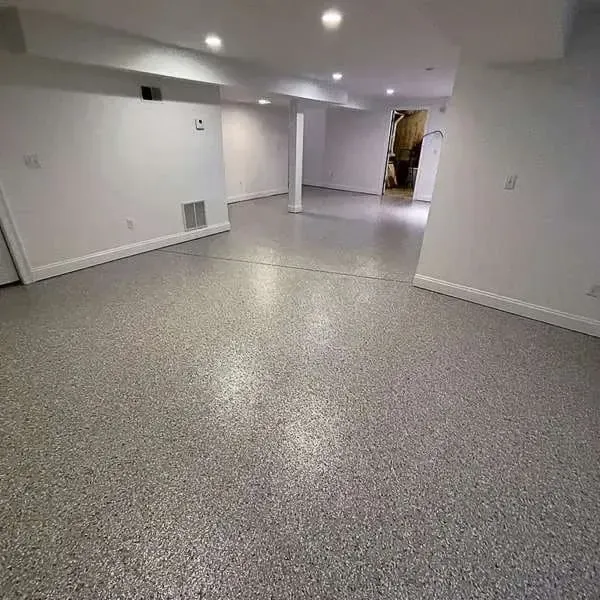
The equipment list
What you need beyond the tools you already own, with prices.
Read the guide
Learning path
You already run a business: customers, quotes, a truck, insurance. Floor coatings can sit next to painting, concrete or handyman work, and some of your customers have garages and basements that need them. Here's what carries over, what's new, and the order to add coatings without learning on a customer's floor.
Where you're starting
Your business skills transfer almost whole. The trade skills are a different story: a floor coating system is usually a two-part chemical product bonded to ground concrete, not a finish rolled onto a clean surface.
You know prep and you know rollers. The difference: a floor coating has a fixed working time once mixed, and it bonds to a mechanically ground surface, so the grinder replaces the scrub brush and the data sheet replaces habit.
You already read slabs: cracks, joints, cure and moisture. What's new is the chemistry, the broadcast systems and the cosmetic finish a garage customer expects to look at every day.
You know homeowners and small jobs. What's new is the equipment (the larger grinders run on 230 volts, which many garages only have at the dryer or range outlet), the prep standard and the chemistry.
License and insurance
Licensing. In states that license contractors by trade, floor coating can fall under a different classification than painting or concrete work. We don't summarize state rules on this page; the license requirements by state page does, with each state's board. Confirm with your board before you quote coating work.
Insurance. Policies are written for the work you described when you bought them. Tell your agent you're adding floor coatings and ask whether your general liability policy covers them. For a flooring installer, general liability typically runs $77 a month ($919 a year).
Two safety rules that may be new to you. Grinding concrete makes respirable crystalline silica dust; OSHA's construction silica standard (29 CFR 1926.1153) limits it to 50 micrograms per cubic meter of air over an 8-hour day and lists dust controls for walk-behind floor grinders. And many polyurethane and polyaspartic top coats are made with isocyanates, which can cause occupational asthma.
Your roadmap
Before anything else, because the answer can change what you're allowed to quote.
The recordings in The Epoxy Playbook show grinding, repairs, base coats, flake broadcast and top coats on real installations, with the reason for each step. Replay the parts that are new to you, and read the free chapters on moisture testing, surface profile and flake floor installation.
Two days on real slabs with a partner trainer, before your first coating job. Better to make your first mistakes on a training slab than on a customer's garage. How classes work.
Coatings aren't priced like paint by the gallon. Price per square foot and per job, with a minimum job and with prep and repairs as their own lines. Installed floors typically sell for $4–10 per sq ft. Run yours through the job pricing calculator.
Your painting or concrete terms won't cover moisture, prep depth or cure times. Start from the scope-of-work and warranty templates.
Rent the grinder (about $90–142 a day) and the extractor for the first jobs. Your existing customers already know your work, which makes them a natural place to start.
What to learn first
You already quote, sell and run jobs. The new risk is technical, so the technical systems come first.
Priority 1 · System 5
Grinding, moisture and chemistry are the new skills, and they decide whether the coating stays down. Watch them recorded start to finish, then do them on the slab.
Read free: Flake floor installation · Use: Flake calculator
Priority 2 · System 6
A coating warranty is a bigger promise than a paint touch-up. Know how floors fail before you write one.
Read free: Epoxy floor warranties · Use: Warranty template
Priority 3 · System 2
Coatings carry their own materials, equipment and visit costs. Price them separately from your other work.
Read free: How to price epoxy flooring · Use: Job pricing calculator
Priority 4 · System 3
Your scope has to name the prep, the repairs and the moisture limits, or the slab’s surprises become your cost.
Read free: Epoxy flooring contracts · Use: Estimate template
Common mistakes
What you need beyond the tools you already own, with prices.
Read the guide
Moisture, prep, mixing and cure: how coatings fail, and how to prevent it.
Read the guide
Flake and polyaspartic garage systems, the usual first coating jobs.
Read more
Yes, with training. Prep discipline, estimating and customer habits carry over. What’s new is diamond grinding to the profile the data sheet calls for, moisture testing, and two-part chemistry with a fixed working time. Learn the steps from the recordings and practice them in a hands-on class before your first coating job.
It depends on your state. In states that license contractors by trade, floor coating can fall under a different classification than painting or concrete work. Check the license requirements by state and confirm with your state’s board before you quote coating work.
Ask your agent before your first coating job. Policies are written for the work you described when you bought them, so tell your insurer you’re adding floor coatings and update the policy if it doesn’t cover them.
A floor grinder and a HEPA dust extractor (rent them at first), diamond tooling, an edge grinder kit, moisture tests, application tools and respirators. The equipment list prices each one, and the startup cost calculator adds them up.
You can learn every step online: The Epoxy Playbook records full installations start to finish, so you can watch, pause and replay each one. What a recording can’t give you is the feel of the grinder and the squeegee on real concrete, which is what the hands-on class is for.
Hands-on classes open state by state. Get a text when one opens near you.