Key takeaways
- A quartz broadcast floor embeds colored quartz granules in layers of clear or pigmented resin, then locks them in with a grout coat and a topcoat for a seamless, textured surface.
- A single broadcast builds about 1/16 inch (roughly 45–65 mils); a double broadcast builds about 3/32–1/8 inch (roughly 80–125 mils) and is the usual choice for busy commercial floors.
- Each broadcast to refusal takes roughly 0.4–0.5 lb of quartz per square foot, so plan on about 1 lb per square foot for a double broadcast.
- Texture is set by the quartz grade, the grout and topcoat thickness and any added grit; make a sample board and get it approved before the job.
- Quartz is harder, heavier and more slip resistant than flake, but it takes more material, more coats and more days, and the price has to reflect that.
A quartz broadcast floor is colored quartz sand embedded in layers of resin: a body coat, a broadcast of quartz to refusal, usually a second body coat and broadcast, then a clear grout coat and a topcoat. A double broadcast builds about 1/8 inch and takes roughly 0.4–0.5 lb of quartz per square foot for each broadcast, about 1 lb per square foot in all. The result is a hard, seamless, textured floor made for wet, busy spaces like commercial kitchens, locker rooms and ramps.
It’s a different job from a flake garage floor: more coats, more material, more days and a texture the customer has to approve in advance. Here is how the system is built, where it belongs and how it compares with flake.
What a quartz floor is made of
The aggregate is natural quartz sand, washed, sized and color-coated with a resin and pigment layer that resists UV and chemicals. Quartz is hard, 7 on the Mohs scale, which is why these floors stand up to foot traffic, carts and cleaning machines. It comes in two kinds of grade:
- Broadcast grade: rounded, evenly sized granules thrown into wet resin.
- Trowel grade: angular granules mixed into resin as a mortar and troweled down, for thicker, heavier-duty floors.
Colored quartz ships in 50 lb bags and comes in solid colors and blends. The binder is usually a 100% solids epoxy, though polyaspartic quartz systems exist for faster return to service.
Where quartz systems are used
Quartz earns its keep where a floor gets wet, gets cleaned hard and has to stay safe underfoot:
- Commercial kitchens, dining areas and food service, within the hot-water wash-down limit on the system’s data sheet (about 140°F for some epoxy systems)
- Restrooms, showers and locker rooms
- Healthcare, labs and pharmaceutical spaces
- Veterinary clinics, kennels and animal facilities
- Car dealerships, concourses and other heavy foot-traffic floors
- Ramps and transitions where a flat, glossy finish would be slippery
In those rooms the floor often turns up the wall as an integral cove base, so the whole surface can be hosed and squeegeed. How to install cove base covers that detail.
Single vs double broadcast
| Single broadcast | Double broadcast | |
|---|---|---|
| Layers | Primer, body coat with quartz, grout coat, topcoat | Primer, body coat with quartz, second body coat with quartz, grout coat, topcoat |
| Nominal thickness | About 1/16 inch (roughly 45–65 mils) | About 3/32–1/8 inch (roughly 80–125 mils) |
| Quartz | About 0.4–0.5 lb per sq ft | About 0.8–1 lb per sq ft |
| Look | Lighter, can show resin between granules | Dense, even color |
| Typical use | Light to medium traffic | Medium to heavy commercial traffic |
Most commercial quartz floors are double broadcast. The second lift fills the voids the first broadcast leaves, evens out the color and adds the build that makes the floor last. For the heaviest duty, troweled quartz mortar systems go to around 1/4 inch.
The build-up, step by step
The order is the same across systems; the rates below are typical ranges, so take the exact numbers from the data sheet of the system you install.
- Test and prepare the slab. Test for moisture first. Typical systems allow about 3 lb per 1,000 sq ft per 24 hours by the calcium chloride test; above that, a moisture-vapor-barrier primer goes in first. Then grind or shot blast to the profile the system calls for, repair cracks and spalls, and decide how each joint will be treated. Concrete surface profile and crack and joint repair before coating cover both.
- Prime. A thin 100% solids epoxy primer, typically about 180–300 sq ft per gallon. Some systems make it optional; on porous or outgassing concrete, don’t skip it.
- First body coat and broadcast. Spread the body coat at about 100–160 sq ft per gallon (10–16 mils) with a squeegee and back-roll it. Give it 10–15 minutes to level, then, wearing spiked shoes, throw quartz up and out so it falls evenly, never down at a sharp angle, which leaves piles. Keep going until the resin won’t take any more and no wet spots show. That’s roughly 0.4–0.5 lb per square foot.
- Cure, sweep and vacuum. Once it has cured (often 5–10 hours, depending on temperature), sweep and vacuum the loose quartz. Clean excess can be reused on the next broadcast. Fix any thin or bare spots now.
- Second body coat and broadcast. A heavier coat this time, typically about 65–100 sq ft per gallon, broadcast to refusal again at about the same rate. Cure, sweep and vacuum.
- Grout coat. A clear epoxy squeegeed over the cured quartz at about 80–110 sq ft per gallon. It fills the gaps between granules and seals the floor. How thick you lay it sets the texture: thinner leaves more grip, thicker gives a smoother, easier-to-clean floor.
- Topcoat. A wear coat of epoxy, typically around 160 sq ft per gallon, or a thin aliphatic urethane at 200–500 sq ft per gallon (or a polyaspartic) where the floor sees UV light, stains or scratching. For a more aggressive texture, roll in aluminum oxide grit, around 3 lb per 100 sq ft.
- Cure before service. Typical epoxy quartz systems take foot traffic after about 24 hours, water after 24 hours and cleaning chemicals after about 7 days, at around 73°F. Cooler slabs take longer.
Every coat has a recoat window. Miss the maximum and the next coat goes on a sanded surface or not at all. Plan the schedule so each lift lands inside its window; the coverage calculator gives you the gallons and kits for each coat.
Slip resistance and texture
Texture is the reason most customers choose quartz, and it’s adjustable. Three things set it: the grade of quartz, the thickness and number of grout and topcoats, and any grit added to the final coat.
For level interior floors that get walked on when wet, the standard target is a wet dynamic coefficient of friction of at least 0.42 under ANSI A326.3. Showers, commercial kitchens and other areas that are wet most of the time are generally held to at least 0.50. Ramps and wet slopes need more texture than level floors.
More texture means more grip and more work to clean, and the customer lives with both. Make a sample board with the actual quartz, grout coat and topcoat, put the finish in the scope of work, and get it signed before you mix the first kit.
Quartz vs flake
| Quartz broadcast | Full-broadcast flake | |
|---|---|---|
| Aggregate | Color-coated quartz sand, Mohs 7 | Vinyl or polymer chips about 5 mils thick |
| Typical build | About 1/8 inch, double broadcast | About 60 mils |
| Aggregate per sq ft | About 0.8–1 lb (double broadcast) | About 0.14–0.2 lb (1/4-inch flake) |
| Coats | Primer, 2 body coats, grout coat, topcoat | Primer, base coat, topcoat |
| Days on site | Usually 2–3 or more | Usually 1–3 |
| Surface | Sandpaper-like, tunable texture | Smoother, texture set by the topcoat |
| Best for | Wet, commercial and food-service floors | Garages, basements, showrooms |
Where quartz wins: hardness, impact and abrasion resistance, slip resistance, and a floor that keeps its texture as it wears. Where flake wins: the decorative range customers want in a garage, faster installation, lower material cost and easier cleaning. Neither is better in general; the room decides. How to install a full-broadcast flake floor covers the flake side step by step.
Pricing a quartz floor
Quartz floors cost more to install than flake floors, and the reasons are all in the build-up:
- Material. About 1 lb of quartz per square foot, plus two body coats, a grout coat and a topcoat. Work out the resin with the coverage calculator for each coat rather than a single rate per square foot.
- Labor. Two broadcasts mean two cure cycles, two cleanups and more trips. Count every visit, not just the install days.
- Details. Cove base, drains, door thresholds and joint treatment are usually priced separately per linear foot or per item.
- Samples and mock-ups. On commercial work, a texture sample or mock-up area is often required before approval; bidding commercial epoxy flooring jobs covers what specs ask for.
Build the price from those costs, not from a flake price with a bump on top. Epoxy flooring cost per square foot shows how installed prices vary by system, and the job pricing calculator turns your material and labor into a price.
Learning the system
Quartz is a two-broadcast, multi-coat system where timing and throwing technique show in the finished floor. Watching a full installation before you try one helps: The Epoxy Playbook includes recorded hands-on installation training you can replay as often as you need, and it’s required before the hands-on class, where you work on real slabs. If you’re still setting up the business around it, start with how to start an epoxy flooring business.
Questions
How much quartz do I need per square foot?
Each broadcast to refusal takes roughly 0.4–0.5 lb of quartz per square foot, so a double broadcast uses about 0.8–1 lb per square foot. Order by the 50 lb bag, and keep the clean excess you sweep up after each broadcast: it can go back into the next one if it's free of dirt and debris.
Is a quartz floor more slip resistant than a flake floor?
Usually, yes. Quartz granules leave a sand-like texture under the topcoat, and the texture can be tuned up or down with the grout coat thickness and added aluminum oxide grit. For level interior floors that get walked on wet, aim for a wet DCOF of at least 0.42 under ANSI A326.3, and more for showers, kitchens and ramps.
Can you put a quartz floor in a residential garage?
Yes. Quartz systems are rated for garages and basements as well as commercial floors. Homeowners usually choose flake for the look and the easier cleaning, so quartz in a garage is mostly for customers who want maximum grip or a harder, more industrial finish.
How thick is a quartz broadcast floor?
A single broadcast system builds about 1/16 inch, roughly 45–65 mils depending on the product. A double broadcast builds about 3/32–1/8 inch, roughly 80–125 mils. Troweled quartz mortar systems go thicker still, around 1/4 inch, for the heaviest duty.
What topcoat goes over a quartz floor?
A clear epoxy grout coat first, to fill the gaps between granules, then a wear coat: more epoxy, or a thin aliphatic urethane or polyaspartic where you want better UV, stain and scratch resistance. Epoxy topcoats can yellow where sunlight reaches the floor.
Keep reading
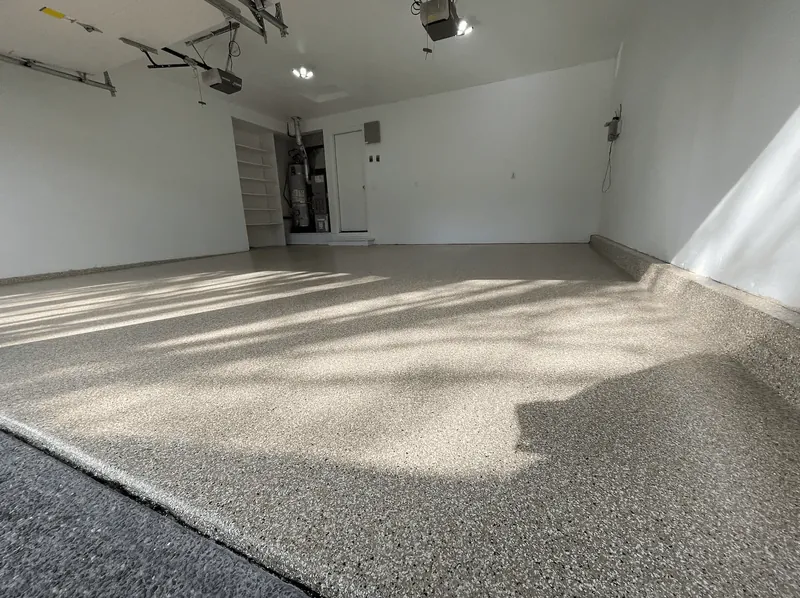
How to install a full-broadcast flake floor, step by step
Install a full-broadcast flake epoxy floor step by step: moisture test, grind to CSP 3, repairs, primer, base coat, flake at 5–7 sq ft per lb, topcoat and cure.
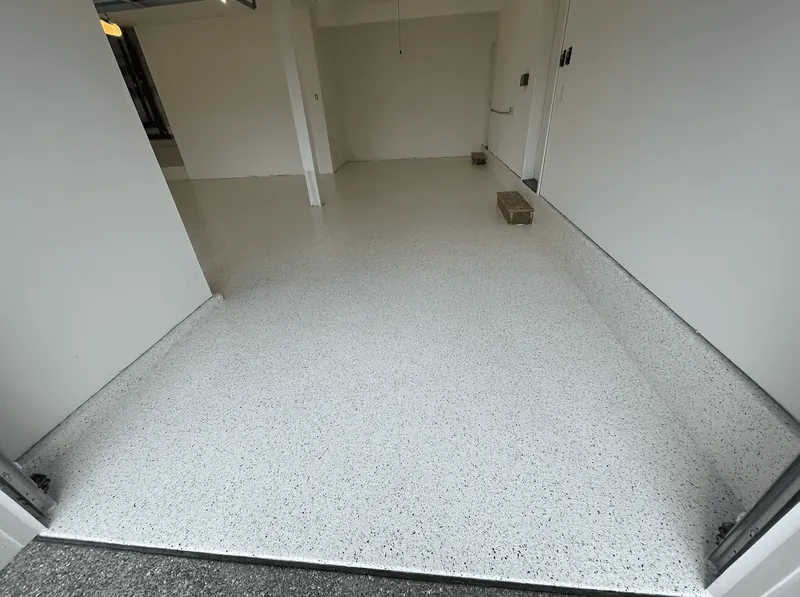
How to install epoxy cove base
How to install epoxy cove base: integral, flake and cant cove, 4- and 6-inch heights, where cove is required, the steps, and how to price it per linear foot.
Coverage calculator
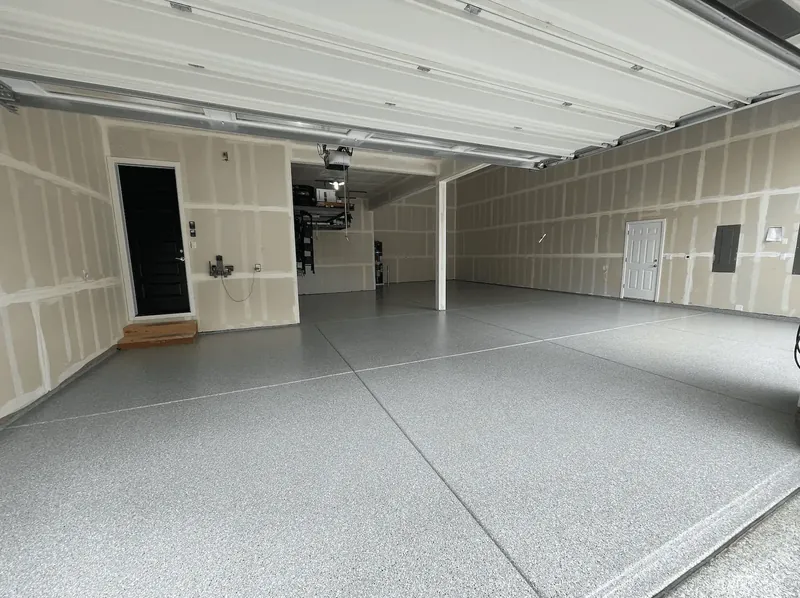
Epoxy floor cost per square foot: what buyers pay, and what it means for your price
Epoxy floors cost about $4–10 per sq ft installed. Prices by system and by space, why quotes vary so much, and what moves the price on a given slab.